How Much Does a 64-Year-Old Need Invested to Replace an $85,000 Salary With Dividends?

This post may contain links from our sponsors and affiliates, and Flywheel Publishing may receive compensation for actions taken through them.

You’re 64, and maybe this is your last full year of work, and one question keeps coming back late at night: can the money you’ve saved stand in for the paycheck? If your salary is $85,000, the answer comes down to one equation. The number gets less scary once you see it on paper.
Three Yields, Three Very Different Price Tags
Divide the income you need by the yield you earn. The result is the capital you need.
- Conservative (3% to 4%): $85,000 divided by 0.035 equals about $2,430,000. This is where broad dividend growth funds and quality payers sit. This level demands the biggest pile of cash, but income tends to rise, and principal tends to grow.
- Moderate (5% to 7%): $85,000 divided by 0.06 equals about $1,420,000. This level covers high-dividend funds, real estate investment trusts (REITs), pipelines, and preferreds. You need less capital, but dividend growth slows, and income can fall behind inflation.
- Aggressive (8% to 14%): $85,000 divided by 0.10 equals $850,000. Covered call funds, business development companies (BDCs), and mortgage REITs live here. Payout cuts and falling principal are common, so you’re often spending down the asset.
A Six-Holding Income Portfolio for Your Last Working Year
Most people near retirement land between the first two levels. Here’s one sample mix. Each yield is the current annualized payout divided by the current price:
- Schwab US Dividend Equity ETF (NYSEARCA:SCHD): 25% weight, about 3.0% yield. Role: the growth engine, with top holdings like Merck, Amgen, and Abbott[1]. Catch: it pays quarterly, and the amount varies, so you’ll have to manage cash between checks.
- State Street SPDR Portfolio S&P 500 High Dividend ETF (NYSEARCA:SPYD): 15%, about 4.1%. Role: extra income from the 80 highest-yielding S&P 500 names. Catch: it tends toward economically sensitive sectors, and payouts move around from quarter to quarter.
- Realty Income (NYSE:O): 15%, about 5.4%. Role: monthly rent checks, backed by its 116th consecutive quarterly dividend increase and 99% occupancy. Catch: REIT dividends are mostly taxed as ordinary income.
- Duke Energy (NYSE:DUK | DUK Price Prediction): 15%, about 3.3%. Role: steady income from a regulated utility. Its quarterly dividend rose from $0.965 in 2021 to $1.085. Catch: dividend growth is slow, and utility stocks are sensitive to interest rates.
- Enterprise Products Partners (NYSE:EPD): 10%, about 6.2%. Role: toll-like pipeline income, with distributions covered 1.9x[2] by cash flow. Catch: it’s a master limited partnership (MLP), so you’ll get a Schedule K-1 and a messier tax return.
- Vanguard Total Bond Market ETF (NASDAQ:BND): 20%, about 4.3%. Role: stability and monthly income at a 0.03% expense ratio. Catch: limited capital appreciation and sensitivity to interest rates.
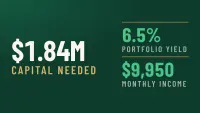
The combined yield comes to about 4.2%. $85,000 divided by 0.0416 equals roughly $2,044,000. That works out to about $7,083 a month before taxes (turning a lump sum into something that acts like a paycheck is the whole subject of our free Paycheck Portfolio Method guide, which covers the mix, the payment calendar, and the withdrawal order).
Social Security Shrinks the Target Fast
The average retired worker collects $2,071 a month after the 2026 cost-of-living adjustment (COLA). That’s $24,852 a year. Add it up, and the gap your portfolio has to fill falls to $60,148. At the same combined yield, covering that gap takes about $1,447,000. One caution: if you claim before full retirement age and keep working, the 2026 earnings test limit is $24,480.
Taxes Make the Check Smaller Than the Salary
In a taxable account, dividends are taxed, so $85,000 in payouts buys less than $85,000 in living expenses. For single filers, qualified dividends are taxed at 0% up to $49,450 of taxable income in 2026, with higher incomes subject to 15% or 20% rates. Realty Income’s dividends and BND’s interest mostly count as ordinary income, which is taxed at 22% for singles above $50,400.
Medicare starts at 65, and its income surcharge looks back two years. In 2027, a single filer with modified adjusted gross income above $112,000 pays a higher Part B premium. Income reported at 64 generally determines Medicare surcharges at 66.
Why the Lowest Yield Often Wins Over a Decade
Picture dividends that start at $85,000 and grow 8% a year. After nine years, they reach about $170,000. A 10% fund paying $85,000 with no growth still pays $85,000, and inflation has eaten part of it. Over a retirement that could last 25 years, the growing stream pulls ahead every year.
Three Moves to Make Before Your Last Paycheck
- Add up what you actually spend. Once you stop saving for retirement and stop paying the 7.65% payroll tax, you may need well under $85,000.
- Get your own Social Security estimates for ages 64, 67, and 70. Subtract the one you plan to use from your target before you run the yield math.
- Look at which account holds which investment. REITs and bond funds often belong in IRAs, and qualified-dividend payers fit better in taxable accounts. If you were born in 1962, required minimum distributions (RMDs) don’t start until age 75, which gives you years to plan withdrawals.
Contact [email protected] for any questions or corrections.
David Beren has been a Flywheel Publishing contributor since 2022. Writing for 24/7 Wall St. since 2023, David loves to write about topics of all shapes and sizes. As a technology expert, David focuses heavily on consumer electronics brands, automobiles, and general technology. He has previously written for LifeWire, formerly About.com. As a part-time freelance writer, David’s “day job” has been working on and leading social media for multiple Fortune 100 brands. David loves the flexibility of this field and its ability to reach customers exactly where they like to spend their time. Additionally, David previously published his own blog, TmoNews.com, which reached 3 million readers in its first year. In addition to freelance and social media work, David loves to spend time with his family and children and relive the glory days of video game consoles by playing any retro game console he can get his hands on.