The Fine Print I Almost Missed on My $25,000 Savings Account
SoFi's app showed me two different interest rates on the same $25,000, and only one of them came with an expiration date buried two screens deep. Finding that date changed what I planned to do with the money.

This post may contain links from our sponsors and affiliates, and Flywheel Publishing may receive compensation for actions taken through them.

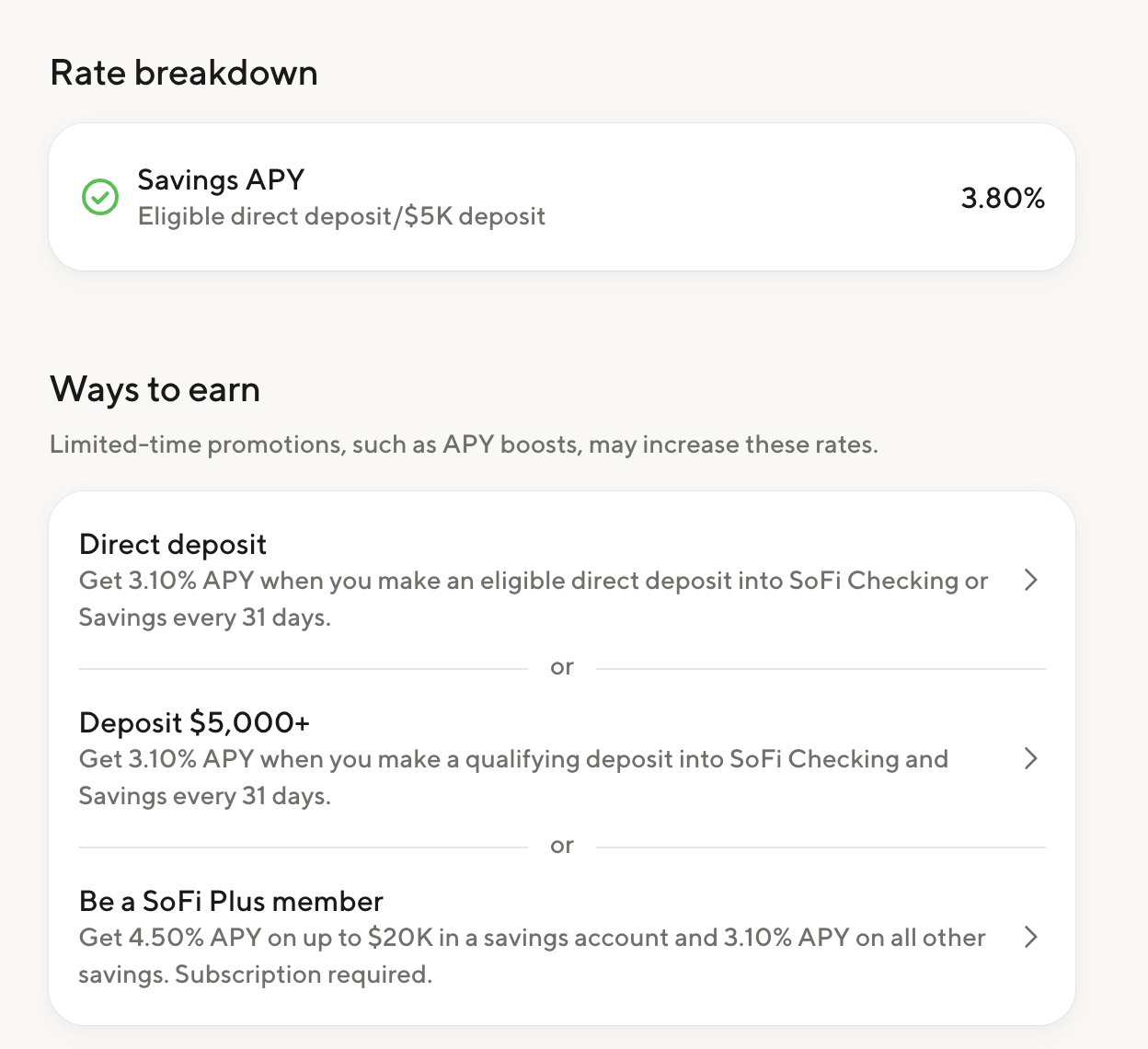
I recently moved $25,000 into SoFi’s High Yield Savings Account. It’s an excellent product, and a better place to park my cash than my normal bank which pays close to zero. But when logging in recently, Mmy SoFi app tells me two different things about the same $25,000. The account header reads 3.80% APY. Two screens deeper, the “Ways to earn” panel lists direct deposit at 3.10% and a $5,000-plus qualifying deposit at 3.10%. Both numbers are accurate. The 0.70% APY Boost between them is a promotion on a six-month clock, and nothing on the header screen says so.
This is a rate promotion, disclosed in SoFi’s terms, and the underlying account is a reasonable place to park cash. Disclosure in a terms page and prominence in the interface are two different things, and a saver who reads the big number at the top will be surprised when the smaller number takes over.
Two Rates, Two Screens
The header displays 3.80% APY in large type. That is the rate shown every time I open the app. Tapping through to the rate details panel reveals a different picture. The “Ways to earn” panel shows the standard savings APY of 3.10%, available with either an eligible direct deposit or $5,000 in qualifying deposits every 31 days. Sitting on top of that is a 0.70% APY Boost.
The boost is a promotion, not a rate tier.
How the Boost Works
SoFi’s promotion window runs from May 15, 2026 through December 31, 2026. Enrolling any time in that window earns the 0.70% APY Boost for up to six months. The clock starts when the boost is applied to your account, not when the promotion window opens.
A few other terms matter. The boost applies to one savings account only, and a member who has already received it on one account is not eligible to receive it again on a subsequent account. It cannot be combined with the 4.50% APY that SoFi Plus pays on up to $20,000 in savings, so a saver cannot stack the two. SoFi Plus is a $10/month subscription, and choosing it means giving up the boost. The underlying 3.10% continues to require an eligible direct deposit or that $5,000 qualifying deposit cadence.
Savings APYs are variable and subject to change at any time. The figures here reflect what SoFi’s app and published terms show as of this article’s date.
What the Cliff Costs
On a $25,000 balance, one year at 3.80% is $950 of interest. One year at 3.10% is $775. The reversion costs $175 a year. In absolute terms that is modest, but it arrives on a date the account holder was never shown prominently.
The realistic first-year yield sits between the two advertised numbers. Six months at the boosted rate followed by six months at the standard rate blends to $862.50, an effective yield of 3.45%, not 3.80%.
Context in a 2026 Rate Environment
The Federal Reserve’s target rate upper bound sits at 3.75%, unchanged from a month ago and down from a high of 4.5% reached in September 2025. HYSA rates have followed policy lower. The FDIC’s national average 12-month CD yield is 1.71% as of August 1, 2026, which frames why 3.10% remains a strong standard savings rate even after the boost expires. The reverted rate stays competitive by 2026 standards, though it sits well below what the header advertises.
Find Your Own Start Date
The single most useful thing you can do is find the date the boost was applied to your account. That date, not the account open date and not the last day of the promotion window, is when your six-month clock started. It lives in the account activity or promotions section of the SoFi app.
Set a calendar reminder 30 days before that six-month mark. That gives you time to decide what to do with the money next. Options worth weighing include staying at the reverted 3.10% for liquidity, moving to a competing high-yield savings account that pays a stronger standard rate, laddering into short-term Treasuries or a CD if you can accept a lock-up, or evaluating whether the SoFi Plus math works for balances at or below $20,000. That last option depends on features beyond the rate and requires its own analysis.
Contact [email protected] for any questions or corrections.
Austin Smith is a financial publisher with over two decades of experience as an investor, analyst, and advisor. He covers stocks, ETFs, Artificial intelligence and personal finance for 24/7 Wall St. Previously, he spent over a decade at The Motley Fool as a senior editor for Fool.com, portfolio advisor for Millionacres, and launched The Ascent to help reader take control of their personal finances.
His work has been featured on Fool.com, NPR, CNBC, USA Today, Yahoo Finance, MSN, AOL, Marketwatch, and many other publications. He is as an advisor to private companies, and co-hosts The AI Investor Podcast with Eric Bleeker.
When not looking for investment opportunities, he can be found skiing, running, or playing soccer with his children. Learn more about Austin's investment approach here.