The Share of American Families Holding CDs Jumped From 6.5% to 10.7% Between 2022 and 2025. Here’s What That Says About How Families Park Their Cash
CD ownership surged across American households in a window that may already be closing, and the Federal Reserve's latest survey reveals a pattern in who actually benefited from the rate boom and what families risk missing at renewal time.

This post may contain links from our sponsors and affiliates, and Flywheel Publishing may receive compensation for actions taken through them.
For much of the last decade, bank certificates of deposit paid so little that many savers didn’t bother with them. A CD is a savings account that holds money for a fixed term. A saver agrees to leave money with a bank for a set period, like 12 months, and the bank pays a fixed rate.
Pulling the money out early usually costs a penalty. Here’s how that once-ignored product made a comeback in American homes and what the national data shows about where families keep their cash.
CD Ownership Rose by Nearly Two-Thirds in Three Years
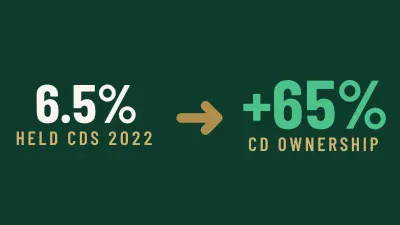
The Federal Reserve’s Survey of Consumer Finances shows the share of families holding CDs rose from 6.5% in 2022 to 10.7% in 2025. That’s a relative increase of about 65%. The survey runs every three years and asks families in detail what they own and owe. The Fed’s report says the jump “likely reflects the increased returns to holding such an asset in 2025, compared with 2022.”
Balances grew as well, though not evenly. Among families that held CDs, the median balance rose 23%, while the mean balance rose 4%. The median is the family in the exact middle if every holder lined up by balance. The mean is the total divided by the number of holders, so a handful of very large accounts can pull it up. When the median grows much faster than the mean, the increases appear to be spread among ordinary holders rather than concentrated in the biggest accounts.
Why CDs Started Paying Again
CD rates tend to follow the Federal Reserve’s benchmark rate, which is what banks charge each other for overnight loans. When the Fed raises it, banks usually pay more on deposits to attract cash. When the Fed cuts, those payouts tend to drift lower.
The Fed’s target range’s upper bound was 4.00% on November 22, 2022, after a year of increases. It reached 5.5% in late July 2023 and stayed there until September 2024. So families answering the 2025 survey had just lived through more than a year in which banks had a reason to compete for deposits.
Rate cuts followed, and the upper bound was 4.5% at the end of 2024 and 3.75% by December 2025. As of November 3, 2026, it was 4%.
What CDs and Treasury Bills Pay Right Now
The FDIC’s national average rate on a 12-month CD was 1.76% as of October 2026, up from a one-year low of 1.52% in March. That average includes plenty of large banks paying very little. Top online banks often pay more than the national average, and recent rate summaries from publications like Fortune and Kiplinger show the best offers sitting well above it as of late October and early November 2026.
Treasury bills, which are short-term loans to the federal government, are another place families park cash. On November 3, 2026, the 4-week bill yielded 3.96%, the 13-week bill 4.13%, and the 52-week bill 4.39%.
Inflation is part of the picture too. Consumer prices rose 3.7% through September 2026. A CD paying the national average is earning less than that, which means the money’s buying power is slipping even as the balance grows.
Falling Rates Change the Math at Renewal
When a CD matures, many banks automatically roll it into a new one at whatever rate they’re offering that day. If rates have fallen since the original purchase, the new term pays less, and many people don’t notice until the next statement. That runs opposite to the trend the Fed survey captured. Families who locked in during the high-rate period may now be renewing into lower offers.
One common way to spread that risk is a CD ladder. A saver splits money across several CDs that mature at different times, say six months, one year, and two years apart, so only part of the cash renews at any single rate. 24/7 Wall St. recently looked at what happens when a CD quietly auto-renews at a low rate, and at how CDs compare with Treasury bills for savers in high-tax states, where Treasury interest is exempt from state income tax.
What the 2025 Survey Leaves Unanswered About Cash Savings
The survey shows that when CDs paid more, a lot more families used them, and the typical holder put more money in. The data runs through 2025, so it doesn’t show how many of those families have kept their CDs as rates have shifted in 2026. The survey data indicates that CD ownership rose during a period of higher deposit rates. Rates on money in checking accounts, savings accounts, and maturing CDs vary by bank.
Contact [email protected] for any questions or corrections.
David Beren has been a Flywheel Publishing contributor since 2022. Writing for 24/7 Wall St. since 2023, David loves to write about topics of all shapes and sizes. As a technology expert, David focuses heavily on consumer electronics brands, automobiles, and general technology. He has previously written for LifeWire, formerly About.com. As a part-time freelance writer, David’s “day job” has been working on and leading social media for multiple Fortune 100 brands. David loves the flexibility of this field and its ability to reach customers exactly where they like to spend their time. Additionally, David previously published his own blog, TmoNews.com, which reached 3 million readers in its first year. In addition to freelance and social media work, David loves to spend time with his family and children and relive the glory days of video game consoles by playing any retro game console he can get his hands on.