He Plans to Claim Social Security at 62, Afraid the Program Will Run Dry, like 40% of Non-Retired Americans. On a $2,400 Benefit, That Fear Costs Him $720 a Month for Life

This post may contain links from our sponsors and affiliates, and Flywheel Publishing may receive compensation for actions taken through them.
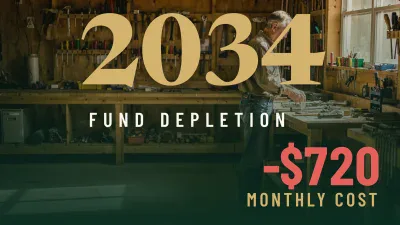
Picture a 61-year-old who has paid into Social Security for four decades and keeps seeing the same headline: the program is running out of money. So he plans to file at 62 and take what he can while it lasts. He is far from alone. A Schroders Survey revealed 40% of non-retired Americans are losing sleep over Social Security running out of money or ending the checks.
The worry makes sense. One recent Fortune headline described the coming shortfall as “No vote, no warning, just plain math.” But with a full retirement age of 67, claiming at 62 cuts the monthly benefit by 30%.
If his full-age benefit would be $2,400, filing early locks in $1,680 instead. That is $720 less every month, or $8,640 a year, for as long as he lives.
Why Running Dry Still Leaves Most of Your Check Intact
The latest Trustees Report projects that the retirement trust fund will run out of reserves in late 2032[1]. After that, incoming payroll taxes would still cover about 78%[1] of scheduled benefits. Combined with the disability fund, the projected depletion date moves to 2034[1], with 83% of benefits still payable.
Depletion is a reduction, and Congress has years to act before it comes. More important for this decision, a cut would apply to every retiree’s check, including the early claimers’.
Run the numbers at that 78%[1] level. The person who waited until 67 would get about $1,872. The person who filed at 62 would get about $1,310. The gap shrinks only slightly, to roughly $562 a month. Claiming early adds a permanent reduction on top of any future cut.
The gap also compounds. Annual inflation increases are percentages, so each raise builds on a smaller base for the early filer every year.
Most People Come Out Ahead by Their Late 70s
Filing at 62 does deliver a head start. Five years of $1,680 checks adds up to about $100,800 collected before 67. At $720 a month, the larger check makes up that lead at roughly age 79. Every year he lives after that, waiting pays more.
Waiting past 67 raises the check further. Each year of delay adds the equivalent of an 8% higher check, so holding out to 70 would turn $2,400 into about $2,976. A man who hits his 60s in good health has a real chance of living well past 79, and that is when a bigger check matters most.
Where the Early Check Collides With Work and Savings
If he plans to keep working part time, an early claim can backfire in another way. In 2026, beneficiaries below the age for full benefits can earn up to $24,480 before Social Security withholds $1 for every $2 above that limit. The program eventually credits withheld months back, but in the meantime he takes the permanent cut and gets smaller checks too.
A common alternative is to use savings as a bridge. He would draw down a 401(k) or IRA between 62 and 67 so the monthly benefit grows. In effect, he spends some savings now and gets a larger lifetime payment that rises with inflation and cannot run out the way an investment account can.
If he is married, the risks are higher. When he dies, his widow could keep the larger of the two checks as a survivor benefit, so filing early can for good reduce her income too.
Two Questions to Answer Before Filing at 62
- Is fear the only reason? If he needs the income at 62 because of his health, a job loss or burnout, filing early can be the right call. If the main reason is concerns about the trust fund, the math points the other way.
- Can savings or part-time work cover the gap years? If he can afford to wait even two or three years, each year shrinks the $720 monthly loss. Starting early is the hardest decision to undo. Once the first year passes, the reduction is locked in for life.
Health, marriage and savings all change this math. Before filing, it is worth checking his own benefit estimate on the Social Security website and running the numbers against his own plans.
Contact [email protected] for any questions or corrections.
Gerelyn Terzo is the author of dividend investing handbook "Dividend Investing Strategies: How to Have Your Cake & Eat It Too." A veteran financial journalist, she covers agri-finance for outlets like Global AgInvesting and the broader stock market and personal finance for 24/7 Wall Street. She began at CNBC and later helped launch Fox Business in New York. Gerelyn currently resides in Woodland Park, Colorado and dabbles in nature photography as a hobby.