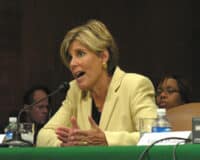
Suze Orman Says Wait Until 70 for Social Security. The Trust Fund Might Not Make It That Long.
Suze Orman has a well-known case for waiting until 70 to claim Social Security, but the 2026 Trustees Report introduced a timing variable that reframes the entire calculation for millions of near-retirees.

This post may contain links from our sponsors and affiliates, and Flywheel Publishing may receive compensation for actions taken through them.

Suze Orman has spent years delivering the same message about Social Security: wait until 70. In a June 11, 2026 blog post titled “What the Latest Social Security Buzz Gets Wrong,” she pushed back hard against a wave of social media advice urging people to file at 62, calling early claiming a “permanent pay cut.”
Two days before her post, the 2026 Social Security Trustees Report projected that the retirement trust fund would be depleted in the fourth quarter of 2032. That timing matters to the debate. The report answers a question millions of near-retirees are quietly running: does the approaching depletion window change whether Orman’s advice still holds?
Trust fund depletion means the reserves are gone and the program runs on incoming payroll taxes alone. Under current projections, those payroll taxes would cover only 78% of scheduled retirement benefits at that point, triggering an across-the-board cut of roughly 22% unless Congress acts. On an average monthly benefit of $2,071, that cut amounts to about $455 per check. The checks keep coming, just smaller.
The Math Behind Orman’s Delay-to-70 Case
Orman’s argument rests on one core mechanic: for each year you wait past full retirement age (67 for anyone born in 1960 or later), your monthly benefit rises by roughly 8%. She frames this delayed retirement credit as one of the safest guaranteed returns in personal finance, and academic research backs her up. A November 2022 working paper from the National Bureau of Economic Research found that more than 90% of workers aged 45 to 62 would maximize their lifetime Social Security income by waiting until age 70, yet only about 10.2% actually do. The median household that claims before 70 forgoes $182,370 in lifetime discretionary spending, according to that same analysis.
The arithmetic is direct. Waiting from 67 to 70 lifts the monthly check by about 24%. Compared with claiming at 62, which locks in only 70% of your earned benefit, the age-70 benefit runs more than 75% higher. The break-even against claiming at full retirement age typically falls around age 82. Live past that point, and the delay wins outright. A woman in average health who reaches 65 carries a life expectancy of around 88, placing her well past that break-even at the median outcome.
Orman also carries a caveat that viral clips often skip. She has clarified that no one is saying you must work until 70, and that drawing down a 401(k) or IRA in your 60s to bridge the gap can be a sound move. The advice is about claiming age, not retirement age. For married couples, the case strengthens further: when the higher earner waits until 70, the surviving spouse inherits that larger, inflation-adjusted benefit for life.
That inflation-adjustment point is gaining new urgency. As of early October 2026, the Senior Citizens League estimates the 2027 Social Security cost-of-living adjustment (COLA) at 3.5%, with AARP projecting 3.6%, which would make it the largest increase in three years. The official announcement is scheduled for October 14, 2026. Every annual COLA is applied as a percentage of the starting benefit, so a larger base built by delaying compounds over time into meaningfully more purchasing power.
What the 2026 Trustees Report Actually Said
Two trust funds, two different timelines. The OASI trust fund, which pays retirement and survivors benefits, is now projected to deplete in the fourth quarter of 2032, one quarter earlier than the prior year’s report. The combined OASDI funds (retirement plus disability) are projected to deplete in 2034, essentially unchanged from last year. Trustees attributed part of the accelerated OASI timeline to the One Big Beautiful Bill Act, signed into law on July 4, 2025. That law created a temporary $6,000 bonus deduction for seniors aged 65 and older (up to $12,000 for married couples), which reduces the income tax revenue that flows back into Social Security.
The 75-year funding shortfall widened from 3.82% to 4.42% of taxable payroll, a 16% deterioration in a single year. That figure captures how much larger the eventual legislative fix needs to be, whether through higher payroll taxes, benefit adjustments, or a combination of both. Social Security already accounts for roughly 6.1% of total U.S. personal income, so any legislated change reaches a substantial share of household cash flow. The average monthly retirement benefit for 2026 stands at $2,071, following the 2.8% cost-of-living adjustment. A 22% automatic cut at depletion would remove about $455 from a typical monthly check.
Does Delaying Still Make Sense?
The percentage-increase logic behind Orman’s advice survives a benefit cut intact. The roughly 8% per-year delayed retirement credit applies to the benefit formula itself, not to the funding mechanism. Delaying still produces a higher check under any post-cut scenario Congress chooses, because the credit is embedded in the formula before any payable-percentage adjustment is applied.
The complication is timing. Today’s 60-year-olds reach full retirement age right around the projected OASI depletion window, and today’s youngest current retirees would be approaching 69. A meaningful cohort of near-retirees could hit age 70 at or just after the point when automatic cuts might take effect. That variable simply did not sit on the table in earlier years.
Orman addressed this concern directly. Claiming early does not protect against a future benefit cut. A 22% reduction applied to a smaller early benefit still leaves the claimant worse off than the same reduction applied to a delayed, higher benefit. The math is structural, not circumstantial.
The Variables That Actually Decide It
Health and family longevity still dominate the calculation. Break-even sits around age 82, so anyone with reason to expect a shorter lifespan tilts toward claiming earlier, while anyone with longevity on their side tilts toward waiting. Trust fund timelines do not change that fundamental.
The urgency of these decisions is visible in recent claiming behavior. An Urban Institute analysis of SSA data found that more than 2.3 million older Americans filed for retirement benefits between January and July 2025 alone, a 16% jump compared with the same period in 2024. Researchers cited economic anxiety, operational changes at the SSA, and fear about long-term program finances as the main drivers. Many of those early filers locked in permanently reduced benefits precisely because they feared a future cut.
Bridge capacity is the second critical variable, and the data show it is thinner than in prior cycles. The personal savings rate stood at 2.8% in Q2 2026, well below its historical average. Consumer sentiment hit a record low of 44.8 in May 2026 before recovering to 55.2 in July, a five-month high. Both readings remain well under their historical averages, according to the University of Michigan’s survey director. Tapping retirement savings in your 60s to delay claiming is not a realistic option for everyone, and where that is true, Orman’s bridging strategy loses practical force regardless of how sound the underlying math is.
What to Actually Do With This
Start with your personalized benefit estimate at SSA.gov. Pull the numbers for age 62, your full retirement age, and age 70. Then run two versions of each: one at the full scheduled amount and one at 78% of that figure to model the depletion scenario. Compare both sets against realistic bridge savings and your own health and longevity picture.
Delaying still increases your share of whatever benefit is ultimately paid. A larger base, even at 78%, beats a smaller base at 78%. The uncertainty now lives in the base amount itself, and its resolution depends on legislative choices that no analyst can price with confidence. Claiming early does not sidestep that uncertainty. It just locks in a smaller share of it.
Editor’s note: This pass adds detail on the One Big Beautiful Bill Act’s mechanism (the temporary $6,000 senior deduction for those aged 65 and older that reduces income tax revenue flowing to Social Security) and confirms the AARP sourcing for the Urban Institute’s January-to-July 2025 early-claiming data (2.3 million filings, up 16%). The 2027 COLA context is updated to reflect the current estimate range of 3.5% to 3.6% and to note that the official announcement is scheduled for October 14, 2026.
Contact [email protected] for any questions or corrections.
Joel South covers large-cap stocks, dividend investing, and major market trends, with a focus on earnings analysis, valuation, and turning complex data into actionable insights for investors.
He brings more than 15 years of experience as an investor and financial journalist, including 12 years at The Motley Fool, where he served as an investment analyst, Bureau Chief, and later led the Fool.com investing news desk. He has also co-hosted an investing podcast and appeared across TV and radio discussing market trends.