He Starts Driving for a Delivery App at 64 amid Same-Day Delivery Frenzy, and Expects $30,000 in Payouts to Cost Him Social Security. The Earnings Test Counts Net Profit, So Mileage Deductions Drop Him Below $25,560 Limit

This post may contain links from our sponsors and affiliates, and Flywheel Publishing may receive compensation for actions taken through them.

A hypothetical 64-year-old who started his retirement benefits this year signs up to deliver for an app, and the orders keep coming. On Nov. 12, Tractor Supply (NASDAQ:TSCO | TSCO Price Prediction) joined the Uber (NYSE:UBER) Marketplace for on-demand shopping. That put nearly 2,500 stores on the app, so bags of feed and boxes of hardware now ride in the back seats of drivers’ sedans.
He figures a full year of driving in 2027 will bring in about $30,000 in payouts. Then then he learns about Social Security’s earnings limit and worries he will have to give part of his benefit back. Plenty of early claimers who pick up gig work have the same worry, though in his case he is measuring against the wrong number.
Your Mileage Log Decides What Social Security Counts
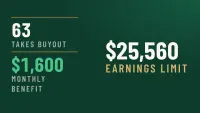
Until you reach full retirement age (FRA), which is 67 for anyone with a birth year of 1960 or after, Social Security applies an earnings test. For 2027 the limit is $25,560, up from $24,480 this year.
For every $2[1] you earn above the limit, the agency holds back $1 in benefits.
If Social Security considered his full $30,000 in payouts, he would lose about $2,220 in benefits. For self-employed workers, though, the test considered net profit, which is what’s left after business expenses. App drivers are independent contractors, so the miles they drive for work are a deductible business expense.
The IRS standard mileage rate is 76 cents a mile for business driving on or after July 1, 2026. The rate is meant to cover gas, maintenance, and wear on the car. That matters when regular gas still averages about $4[2] a gallon nationally.
About 11,800 business miles add up to a $9,000 deduction. That turns his $30,000 in payouts into $21,000 of profit.
He ends up $4,560 under the 2027 limit, and Social Security withholds nothing.
For him, nothing else in this decision matters as much. Every mile he fails to record is a deduction he loses, and a few thousand missing miles could push him over the line. The IRS says “you must keep records to verify your deductions”. A log he keeps as he drives holds up far better than numbers rebuilt from memory.
Going over the limit costs less than most people fear. After full retirement age, Social Security recalculates the benefit to give credit for the months it withheld[1], so any benefits held back come back slowly as a higher monthly check. Scaling back from full-time work this way has its own set of tax complications, and we laid out the four biggest traps in a free semi-retirement guide.
Where the Delivery Profit Lands on His Tax Return
Staying under the earnings limit doesn’t get him out of self-employment tax. That’s 15.3% Social Security and Medicare tax contractors pay because no employer covers half of it. On $21,000 of profit, he’ll owe about $3,000. In return, those earnings go on his Social Security record. If 2027 turns out to be what the agency calls “one of your highest years of earnings[1]“, it raises his benefit automatically.
The mileage deduction also helps with income tax on his benefits. Benefits start to become taxable when half of them plus his other income passes $25,000 for a single filer. Every dollar of mileage he deducts reduces that other income, so the same log that keeps his checks coming in full can also keep more of them from being taxed.
What to Get Right Before the First Delivery
Start the mileage log on day one. Of all the mistakes here, a missing log is the hardest to fix later. His whole case for staying under the limit depends on that $9,000 deduction, and the deduction only holds up if he can prove the miles. A log app or a notebook in the glove box, updated after every shift, is enough.
Give Social Security an accurate estimate of his annual profit, and update it if things change. The agency withholds benefits based on what beneficiaries tell it. If the estimate is too low, he could get a bill for excess benefits at the worst possible time. If driving picks up over the holidays and profit heads toward the limit, telling the agency early leads to a small, planned adjustment.
His math works because expenses eat up about 30% of his payouts. Another driver could face a much smaller deduction. A more fuel-efficient car, shorter routes, or higher tips could put that driver over the limit on the same $30,000. Run your own numbers before you assume you’re in the clear.
Contact [email protected] for any questions or corrections.
Gerelyn Terzo is the author of dividend investing handbook "Dividend Investing Strategies: How to Have Your Cake & Eat It Too." A veteran financial journalist, she covers agri-finance for outlets like Global AgInvesting and the broader stock market and personal finance for 24/7 Wall Street. She began at CNBC and later helped launch Fox Business in New York. Gerelyn currently resides in Woodland Park, Colorado and dabbles in nature photography as a hobby.