




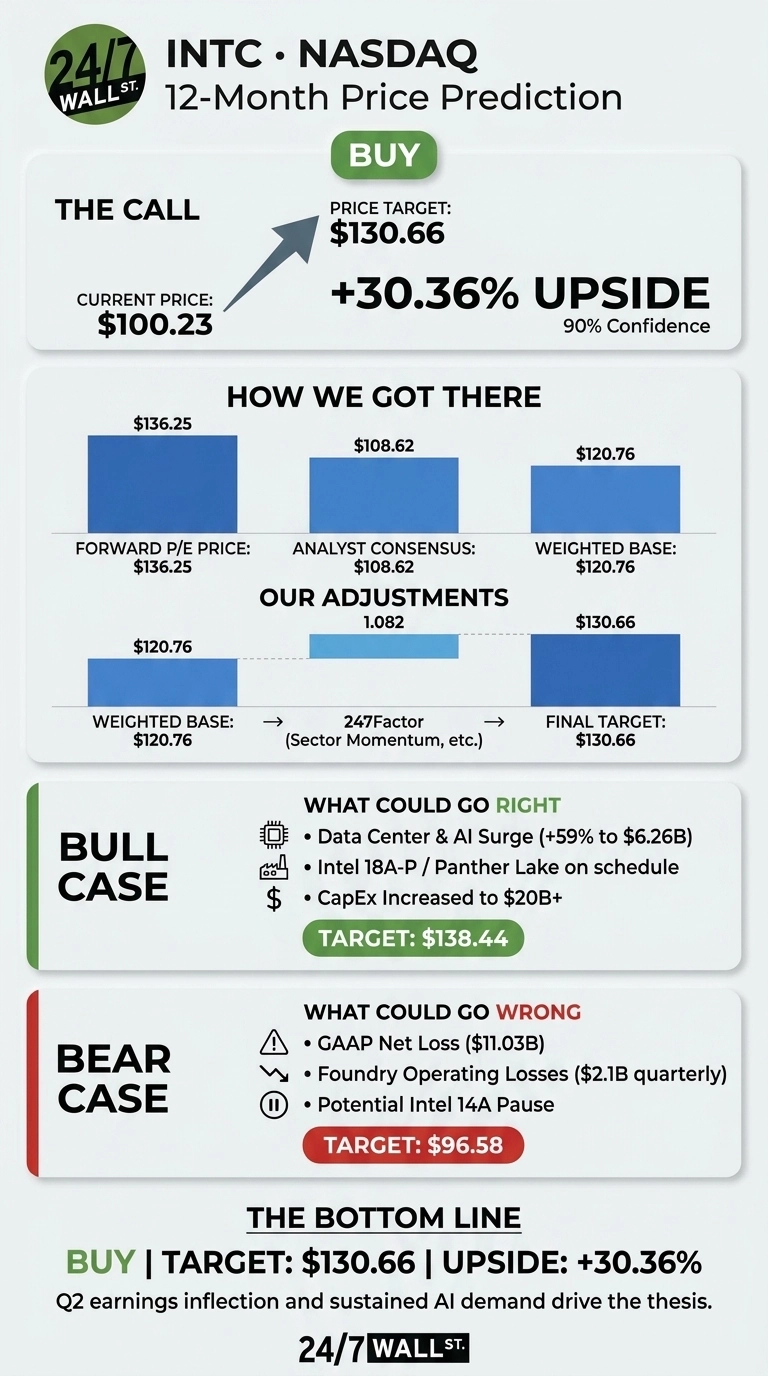
Intel (NASDAQ:INTC | INTC Price Prediction) just delivered its strongest revenue growth in more than 15 years, and our model sees more room to run. The stock trades at $100.23 after a stunning 171.63% year-to-date rally.
Our 24/7 Wall St. price target for Intel is $130.66, implying 30.36% upside over the next 12 months. That earns a buy rating with a 90% confidence level. This is a high-conviction call anchored to a genuine earnings inflection.
| Metric | Value |
|---|---|
| Current Price | $100.23 |
| 24/7 Wall St. Price Target | $130.66 |
| Upside | 30.36% |
| Recommendation | BUY |
| Confidence Level | 90% |
The Rally Has Legs After a Blowout Q2
Intel reported Q2 fiscal 2026 on July 23, 2026, and the numbers reframed the story. Revenue hit $16.13 billion, up 25.4% year over year, beating estimates by 11.64%. Non-GAAP EPS came in at $0.42 versus a $0.10 estimate, a 320% surprise. The Data Center and AI segment surged 59% to $6.26 billion, and CEO Lip-Bu Tan called it “our strongest revenue growth in more than fifteen years.”

The stock has cooled off recently, down 24.23% over the past month from a peak of $142.35, but shares are up 326.69% over the past year. That pullback has compressed the valuation multiple relative to peers.
Why Bulls See a Breakout Ahead
The bull case rests on three pillars:
- AI demand for server CPUs is broadening, and Intel’s Xeon 6 was selected as the host CPU for NVIDIA DGX Rubin NVL8
- Intel 18A-P entered risk production on schedule, and Panther Lake is in high-volume manufacturing using ASML High NA EUV tools
- Intel raised 2026 CapEx to over $20 billion, signaling management confidence echoed by ecosystem partners
The $5 billion NVIDIA equity investment and $2 billion SoftBank investment add strategic ballast. If Q3 lands at the high end of guidance ($16.8 billion) with 42% non-GAAP gross margin, a bull-case path to $138.44 becomes credible.

Morgan Stanley analyst Joseph Moore raised the firm’s price target on Intel to $84 from $75 and keeps an Equal Weight rating on the shares.
The Risks Worth Watching
The GAAP net loss of $11.03 billion looks ugly, driven by a $12.53 billion non-cash charge on CHIPS Act escrow shares, not operating deterioration. Operating income actually rose 156.55% year over year.
Intel Foundry is running roughly $2.1 billion in quarterly operating losses, and management flagged that Intel 14A could be paused if customer demand is insufficient. A bear case with Foundry misses and export-control friction points toward the model’s downside scenario of $96.58.
How Intel Compares to AMD and Qualcomm
AMD (NASDAQ:AMD) is the natural x86 rival. AMD posted Q1 fiscal 2026 revenue of $10.25 billion, up 37.9%, with Data Center up 57% to $5.78 billion. The stock trades at a trailing P/E of 203 with a market cap of $880 billion. Intel’s forward P/E of 119 looks defensible against that.
Qualcomm (NASDAQ:QCOM) trades at a trailing P/E of 33 with an operating margin of 27.9%. Intel is nowhere near that on profitability yet, but its growth is now double Qualcomm’s. On balance, the peer set makes our $130.66 target look reasonable rather than aggressive.
| Company | Forward/Trailing P/E | Latest Revenue Growth |
|---|---|---|
| Intel | 119x fwd | +25.4% |
| AMD | 203x ttm | +37.9% |
| Qualcomm | 33x ttm | -3.5% |
Intel Price Prediction 2026-2030
The 24/7 Wall St. price target is $130.66, the recommendation is buy, and confidence is high. The Q2 earnings inflection combined with sustained AI CPU demand tips the scale. The thesis strengthens if Q3 revenue lands above $16.3 billion with gross margin holding near 42%. The thesis weakens if Foundry losses widen materially or 18A yields disappoint.
Here is where our model projects Intel could trade in the coming years, extending base-case growth assumptions.
| Year | 24/7 Wall St. Price Target |
|---|---|
| 2026 | $130 |
| 2027 | $148 |
| 2028 | $170 |
| 2029 | $192 |
| 2030 | $214 |
These projections assume Intel executes on 18A and 14A ramps and Foundry losses narrow steadily. Significant upside could come from anchor foundry customers signing multi-year commitments. Downside would come from a stalled 14A roadmap.
Contact [email protected] for any questions or corrections.








 Top Gaining Stocks
 Top Losing Stocks