





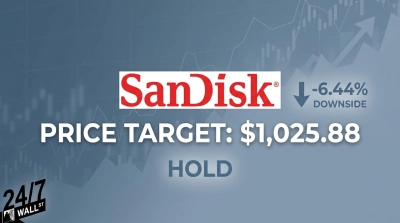
SanDisk (NASDAQ:SNDK | SNDK Price Prediction) currently trades at $1,096.10 against a consensus Wall Street price target of $2,217.77, an implied upside of roughly 102%. One outlier bull, China Renaissance, models a target implying roughly 200% upside from here.
SanDisk is the NAND flash pure play spun from Western Digital in February 2025, selling enterprise SSDs and high-density 3D NAND into hyperscale data centers, edge devices, and consumer channels. Wall Street has fixated on the name because AI storage buildout has lifted NAND pricing and reshaped SanDisk’s margin profile in quarters. The gap between the stock and consensus target reopened violently this week.
A One-Week 31% Drawdown Erased Months of Gains
SanDisk cratered 31.04% in a single week and is down 47.57% over the last month. Shares dropped 14.25% in the most recent session, taking the stock from a monthly starting point of $2,090.71 back near levels when Q3 earnings were filed.
The quarter itself was strong. Q3 FY26 revenue landed at $5.95 billion against $4.73 billion consensus, EPS of $23.41 topped estimates by 59.67%, and the datacenter segment grew 645% year over year. What broke the stock was valuation math on a stock that had run from $41.89 a year ago to well above $2,000, combined with a Reddit-visible narrative that “DUV lithography hurt SNDK the most” as investors priced in supply-side risk to the NAND ramp.
Peers fell alongside, but SanDisk fell twice as hard. Options tape reflects that fear, with the full-chain put/call ratio at 1.02 and November 2026 puts running at 2.08.
Why the Sell-Side Is Still Pounding the Table
Analysts have not blinked because the operating story compounds. Q3 gross margin reached 78.4%, up from 22.5% a year earlier, and free cash flow hit $2.993 billion. SanDisk retired $650 million of debt to reach a zero long-term debt balance sheet and authorized a share repurchase program. Management guided Q4 revenue to $7.75 billion to $8.25 billion with non-GAAP EPS of $30.00 to $33.00.
The bull thesis is a re-rating story. China Renaissance frames SanDisk as an indispensable supplier of high-density enterprise 3D NAND for AI training and inference clusters, assuming a shift from commodity memory multiples of roughly 10x to 12x P/E toward AI infrastructure multiples as ultra-high-capacity SSD shortages persist. That mechanism supports a 200% target. SanDisk has signed five multi-year New Business Model agreements with firm financial commitments and is ramping BiCS8 NAND plus High Bandwidth Flash for AI inference. CEO David Goeckeler called the quarter “a fundamental inflection point” driving “structurally higher and more durable earnings power.”.
Of roughly 22 analysts covering the stock, 3 rate it Strong Buy, 15 Buy, 3 Hold, and 1 Sell. Polymarket traders assign a 89.5% probability that SanDisk beats its next quarterly earnings report, lining up with the sell-side’s willingness to hold targets steady even as the stock unravels.
Memory and Storage Peers All Sold Off, but SanDisk Led the Fall
Micron Technology (NASDAQ:MU) trades at $820.53 after a 15.48% weekly drop, against an analyst target of $1,507.38, an implied upside near 84%. Coverage skews heavily bullish, with 9 Strong Buys and 31 Buys against 4 Holds.
Western Digital (NASDAQ:WDC), the HDD pure play that spun off SanDisk, trades at $463.51 after a matching 15.48% weekly slide. Its target sits at $633.83, roughly 37% upside, with 4 Strong Buys and 18 Buys.
Seagate Technology (NASDAQ:STX) sits at $747.30 after a 16.21% weekly loss. Target of $1,008.61 implies about 35% upside, backed by 4 Strong Buys, 17 Buys, and 3 Holds.
The largest analyst-implied upside sits with SanDisk. Peers offer 35% to 84%; SanDisk offers roughly 102% on consensus, and roughly 200% on the outlier bull.
What the Stock Shows Versus the Target
SanDisk trades at $1,096.10 against a consensus target of $2,217.77, an implied upside of roughly 102%, from 22 covering analysts. The 52-week high sits at $2,354.39 and the low at $40.10.
Year to date, the stock is up 361.75% against an 8.64% gain in the S&P 500. Even after a 47.57% monthly drawdown, the one-year gain sits at 2,516.61%. Analyst targets are one input among many, and this one carries wide dispersion.
Where I Land on SanDisk at $1,096
The bull case here rests on the NAND cycle having structurally reset. Multi-year New Business Model contracts, the BiCS8 ramp, and hyperscaler qualifications support the thesis that this cycle behaves differently from prior ones, and the balance sheet is clean. The path back to the consensus target runs through Q4 execution on the $7.75 billion to $8.25 billion revenue guide and continued datacenter mix shift.
The bear case here rests on the view that NAND is still NAND. Pricing is cyclical, the Kioxia joint venture creates supply concentration, and a stock that ran roughly 25x in a year is exposed to any hint of hyperscaler capex softening. If DUV lithography constraints or a memory glut materialize into 2027, multiple contraction is not finished.
My lean is cautiously constructive. The setup is asymmetric on the consensus target, but the outlier 200% call requires a full re-rating to AI infrastructure multiples not yet earned by two consecutive fiscal years of data. Waiting for the Q4 earnings report to confirm the guide looks more defensible than chasing the bounce.
Contact [email protected] for any questions or corrections.









 Top Gaining Stocks
 Top Losing Stocks