Bonds Tame, Costs Rising, Housing Frozen: 3 Takes on an Economy the Fed Can’t Read
The bond market just calmed down, housing is frozen, costs keep climbing, and the Fed has no clean read on any of it. Three voices from the financial world explain what that mess means for your mortgage, your savings, and…

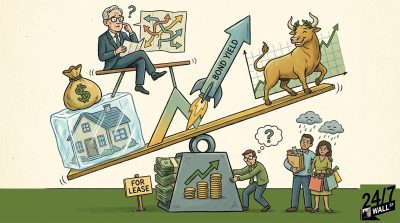
A guest on Bloomberg Businessweek described the economy the Federal Reserve is trying to read as a list of contradictions: “You’ve got the housing markets frozen, but house prices remain high. You have bond yields soaring, but stock markets keep hitting new highs or at least staying high. You’ve got consumer spending strong, but several indicators of consumer sentiment in the doldrums.”
Housing data supports the first contradiction on that list. Existing homes sold at an annualized pace of 3.99 million in September, down from 4.27 million in December 2025. Builders also pulled back. In September, housing starts dropped 5.2%. Even so, the Case-Shiller national home price index read 336.7 in August, just below its July high. Fewer homes are changing hands, and prices have barely moved off their peak.
One Thread Runs Through Every Mixed Signal: Costs
The Bloomberg guest said rich and poor households, and big and small companies, feel this economy differently. They share one complaint: “the unifying narrative among everyone, household and business, is that costs are high and they’re increasing.” Small businesses, the guest added, say “the cost of a loan at their local bank is expensive for them.”
That complaint shows up in the Fed’s preferred inflation gauge, the core Personal Consumption Expenditures price index, which leaves out food and energy. It rose 0.2% in August. The Fed’s policy rate has an upper bound of 4.00%, and traders expect policymakers to hold steady this week while watching for any signal of rate increases later on, according to CNBC.
Why Jim Cramer Refuses to Sound the All Clear
A bond yield is the interest rate investors require to lend money to the government, and mortgage rates and business loan rates are priced off it. Bond yields have eased: the 10-year Treasury yield stood at 4.99% on October 27, down from 5.28% on October 7, and the 30-year yield slid to 5.3% from 5.67% over the same stretch.
Jim Cramer told Mad Money viewers that a calmer bond market does not end the risks: “Bonds are tame going into a Fed meeting which will then be followed by an election and then the potential for fresh bombing runs over the skies of Tehran. I don’t happen to think that’s all of a reason to call all clear.”
He also pointed to the pressure that high rates put on the trillions being spent on large expansion projects: “The rates were getting so high that the return was getting uncertain. That hasn’t changed at all.” He concluded: “the bottom line is nothing has changed.”
Clark Howard’s Rule for Where Your Spare Cash Goes First
For households at or near retirement, high yields have a benefit: cash now makes real money. Consumer advocate Clark Howard built his advice around that point: “If you’ve got an interest rate below 5% on your mortgage, there’s no hurry to pay it off right now because what you can earn on savings is going to be roughly equivalent.”
He added that each quarter point above 5% makes a stronger case for paying down the mortgage early. That only applies “after you are fully funding a Roth IRA each year. You’re fully funding the retirement plan at work. Those things, because the tax advantages baked into them, come before you prepay a mortgage.” The tax code backs him up. A qualified distribution from a designated Roth account “shall not be includible in gross income” under 26 U.S.C. § 402A(d)(1).
Two numbers will tell you whether that math still works. The first is whether the 10-year yield stays below 5%, Howard’s threshold, easing mortgage rates. The second is the next core inflation reading. If prices keep rising at the August pace, the costs everyone complains about will keep growing. As long as savings accounts earn competitive returns, parking extra cash there remains more profitable than paying off a low-rate mortgage early.
Contact [email protected] for any questions or corrections.
Trey has been an editor and author at 24/7 Wall St. for more than a decade, where he has published thousands of articles analyzing corporate earnings, dividend stocks, short interest, insider buying, private equity, and market trends. His comprehensive coverage spans the full spectrum of financial markets, from blue-chip stalwarts to emerging growth companies.
Beyond 24/7 Wall St., Trey has created and edited financial content for Benzinga and AOL's BloggingStocks, contributing additional hundreds of articles to the investment community.
Trey's editorial expertise extends across multiple publishing environments. He served as production editor at Dearborn Financial Publishing and development editor at Kaplan, where he helped shape financial education materials. Earlier in his career, he worked as a writer-producer at SVE. His freelance editing portfolio includes work for prestigious clients such as Sage Publications, Rand McNally, the Institute for Supply Management, the American Library Association, Eggplant Literary Productions, and Spiegel.
Outside of financial journalism, Trey writes fiction and has been an active member of the writing community for years, moderating workshop sessions at regional conventions.