These Penny Stocks are Dropping Today: IOBT, KALA, BYND
Always be cautious before investing in a penny stock. While some will turn out to be explosive winners, like Advanced Micro Devices, others turn out to be expensive duds. That’s because some penny stocks are scams, sometimes with limited company…


Always be cautious before investing in a penny stock.
While some will turn out to be explosive winners, like Advanced Micro Devices, others turn out to be expensive duds. That’s because some penny stocks are scams, sometimes with limited company information. Many are vulnerable to manipulation for personal gain.
Those that traded on the OTC, for example, “aren’t required to meet the listing standards imposed by exchanges, such as a minimum share price, total market value or number of shareholders,” according to FINRA.org.
“Unfortunately, low-priced securities also can be more susceptible to fraud. These securities can be targets for pump and dump and similar schemes in which fraudsters artificially inflate the price of a security and then quickly sell their shares, leaving investors facing losses.”
In short, you must do your own due diligence before investing in penny stocks.
That being said, here’s a quick list of intraday duds you may want to avoid for now.
IO Biotech Inc.
Down about 78%, or $1.23 on the day, IO Biotech (NASDAQ: IOBT) doesn’t look so healthy.
For one, the US FDA just recommended against IOBT submitting a Biologics License Application for its cancer vaccine Cylembio based on data from the IOB-013 clinical trial. In addition, as noted by Investing.com, “The company said the FDA’s recommendation follows trial results where Cylembio plus pembrolizumab improved progression-free survival in advanced melanoma patients but narrowly missed statistical significance.”
Two, IOBT was just downgraded by H.C. Wainwright to a neutral rating. It also removed its price target after the US FDA recommended a new Phase 3 trial.
Moving forward, the company will cut 50% of its workforce. Plus, it expects to see a restructuring charge of between $1 million and $1.5 million in the third quarter.
Starting the year at around 80 cents, shares of IOBT rallied to a high of $2.80. Today, with the latest US FDA news, IOBT trades at 32 cents.
KALA BIO Inc.
Shares of KALA BIO (NASDAQ: KALA) are down about 90%, or $16.94 on the day.
All after the company posted disappointing KPI-012 2a clinical trial data for the treatment of persistent corneal epithelial defect, a non-healing wound on the surface of the eye that fails to heal within two weeks. In this particular study, the data fails to meet its primary and secondary endpoints. In addition, according to analysts at Mizuho, KALA did not provide any detailed data from the trial in its announcement.
Not helping, KALA has not scheduled any calls to discuss the disappointing results, which has left shareholders with limited information. Failure to discuss the results may not look too good for the company’s recently named President and CEO, Todd Bazemore. It’ll be interesting to see how the company decides to handle this disastrous news.
It also doesn’t look so good for Oppenheimer, which just raised its price target by $18 earlier this month, or for H.C. Wainwright, which raised its price target by $23.
After starting the year at around $7.40, the stock raced to a high of $20.60. Today, the stock hit a low of $1.10 a share.
Beyond Meat
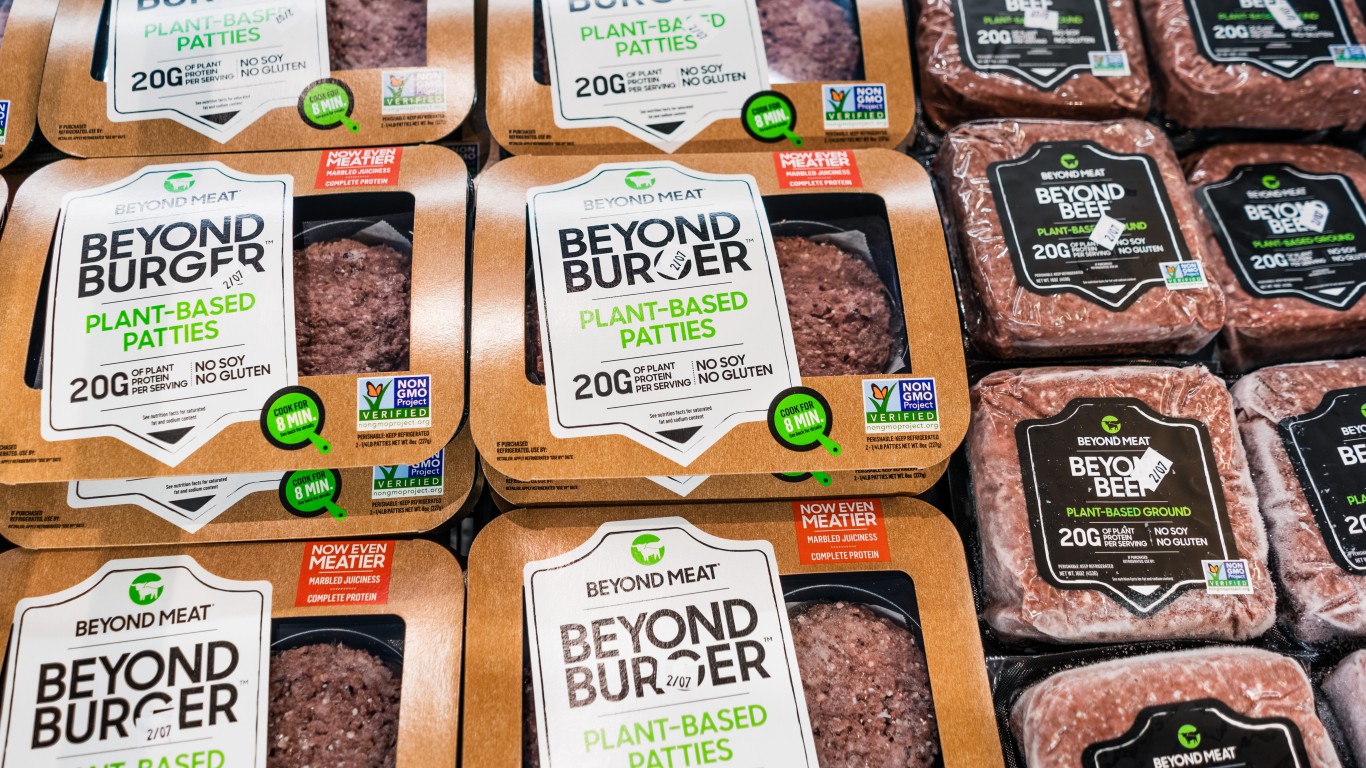
Once a high-flying $180 plant-based stock, Beyond Meat (NASDAQ: BYND) now struggles at $1.23 a share. For one, the industry has seen declining sales, layoffs, and a lack of interest, which decimated BYND. Two, BYND just sank to an all-time low after launching an exchange offer for convertible bonds to cut more than $800 million in debt.
That’s after the company’s poor earnings growth, thanks to poor U.S. demand. In its most recent quarter, the company’s EPS loss of 40 cents missed by a penny. Revenue of $75 million, down 19.5% year over year, missed by $8.69 million. Not helping, BYND added that it was still facing “an elevated level of uncertainty” and did not provide full-year estimates.
Beyond Meat President and CEO Ethan Brown added, “We are disappointed with our second quarter results, which primarily reflect ongoing softness in the plant-based meat category, particularly in the U.S. retail channel and certain international foodservice markets. We are responding by accelerating our transformation activities, including more rapidly and aggressively reducing our operating expenses to fit anticipated near-term revenues; prioritizing increased distribution of our core product lines; and investing in margin expansion initiatives across these core products,” as quoted in the company’s earnings press release.
In short, there are red flags all over shares of Beyond Meat.
Analysts at Argus recently downgraded BYND to a sell rating on weak demand and balance sheet issues. Argus said Beyond Meat shares “have underperformed over the past three months, falling 23% compared to a gain of 9% for the S&P 500 and a decline of 1% for the industry ETF IYK,” as quoted by Investing.com.
Contact [email protected] for any questions or corrections.
Ian Cooper is a veteran market analyst and investment strategist with more than 20 years of experience covering stocks, commodities, and macro trends. Since 1999, he has helped investors identify market opportunities using a blend of technical analysis, fundamental research, and market sentiment.
He is the creator of the ADD News Flow Strategy, which focuses on trading market reactions to major news events and investor psychology. Cooper was also among the analysts who warned about the 2008 financial crisis and major financial institution collapses ahead of the broader market.
Before joining 247 Wall St., Cooper wrote extensively for InvestorPlace and other financial publications, covering market trends, trading strategies, and investment opportunities.