SCHD is Great, But I Like These 2 Income ETFs More
The Schwab US Dividend Equity ETF (NYSEARCA:SCHD) is a terrific ETF for investors who want to bet on the broad markets with more of an emphasis on high-quality dividend payers. Still, I think the SCHD is more suitable for those…


The Schwab US Dividend Equity ETF (NYSEARCA:SCHD) is a terrific ETF for investors who want to bet on the broad markets with more of an emphasis on high-quality dividend payers. Still, I think the SCHD is more suitable for those income investors out there who view the 4% yield range as their sweet spot. Arguably, the 4% yield level marks a good balance between dividends and capital gains.
Though, I’m sure there are many investors out there who’d rather have more capital appreciation and dividend growth than upfront yield. At the same time, some investors might want to extend beyond the 4% yield mark, especially for retirees who want to give themselves a bit of a raise. While the SCHD is an ideal balance that would be right for many (it’s one of the most popular income ETFs for a reason, after all), it may not be the Goldilocks ETF for all classes of income investors.
In this piece, we’ll have a closer look at a pair of alternatives that may have slightly lower dividend yields than the likes of the SCHD but are still worth checking out for a bit of a different take on the broad basket of U.S. dividend payers.
Vanguard Dividend Appreciation ETF
If you can afford to downgrade your yield to upgrade your dividend-growth prospects, you should probably go for it, at least in my humble opinion. The Vanguard Dividend Appreciation ETF (NYSEARCA:VIG) is a great dividend growth ETF that’s arguably even more popular than the SCHD. The low-cost Vanguard ETF doesn’t have a fat dividend yield, which currently sits at just shy of 1.7%.
However, it is a Morningstar gold-rated ETF that can consistently give back (in terms of dividend growth) every single year. The ETF tracks the S&P U.S. Dividend Growers Index, which is comprised of dividend payers that have hiked their payouts in each of the last 10 years at a minimum.
Over the past five years, the VIG has beaten the SCHD, with 62% in capital gains versus the mere 37% posted by the SCHD. While the VIG still trails the S&P, I must say that I’m a fan of the lower correlation (0.86 beta) and a more even spread across some steady blue chips that may be on a steadier footing once the next bear market comes knocking.
Of course, there is quite a bit of overlap with the S&P in the top holdings, but with less concentration risk and more of a focus on income appreciation, I favor the name for investors looking for a more defensive positioning and near-guaranteed dividend hikes.
ProShares S&P 500 Dividend Aristocrats ETF
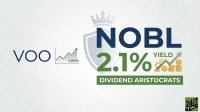
The ProShares S&P 500 Dividend Aristocrats ETF (NOBL) stands out as one of the more underrated dividend growth ETFs in the market right now. The 2.1% yield is slightly richer than the VIG, but is much lower than the 3.8% of the SCHD. For investors who want dividend growers that have grown their payouts every year in the past 25 or more years (instead of just 10 for the VIG), the NOBL really stands out as a more exclusive class of dividend growers.
Additionally, the NOBL has less than 2% allocated to a single holding, making it far more diversified, especially compared to the likes of the S&P, which is now quite top-heavy compared to most dividend ETFs. For investors seeking extra dividend growth certainty, I’d say it’s tough to get any better than the NOBL.
Of course, investors should be aware that the expense ratio (0.35%) is quite a bit higher than the VIG (0.05%). If you’re growing cautious about rising S&P multiples, I’d say that it’s a toss-up between the NOBL and VIG, with the former exhibiting a hair more volatility than the latter.
Contact [email protected] for any questions or corrections.
Joey is a 24/7 Wall St. contributor and seasoned investment writer whose work can also be found in publications such as The Motley Fool and TipRanks. Holding a B.A.Sc in Computer Engineering from the University of British Columbia (UBC), Joey has leveraged his technical background to provide insightful stock analyses to readers.
Joey's investment philosophy is heavily influenced by Warren Buffett's value investing principles. As a dedicated Buffett disciple, Joey is committed to unearthing value in the tech sector and beyond.