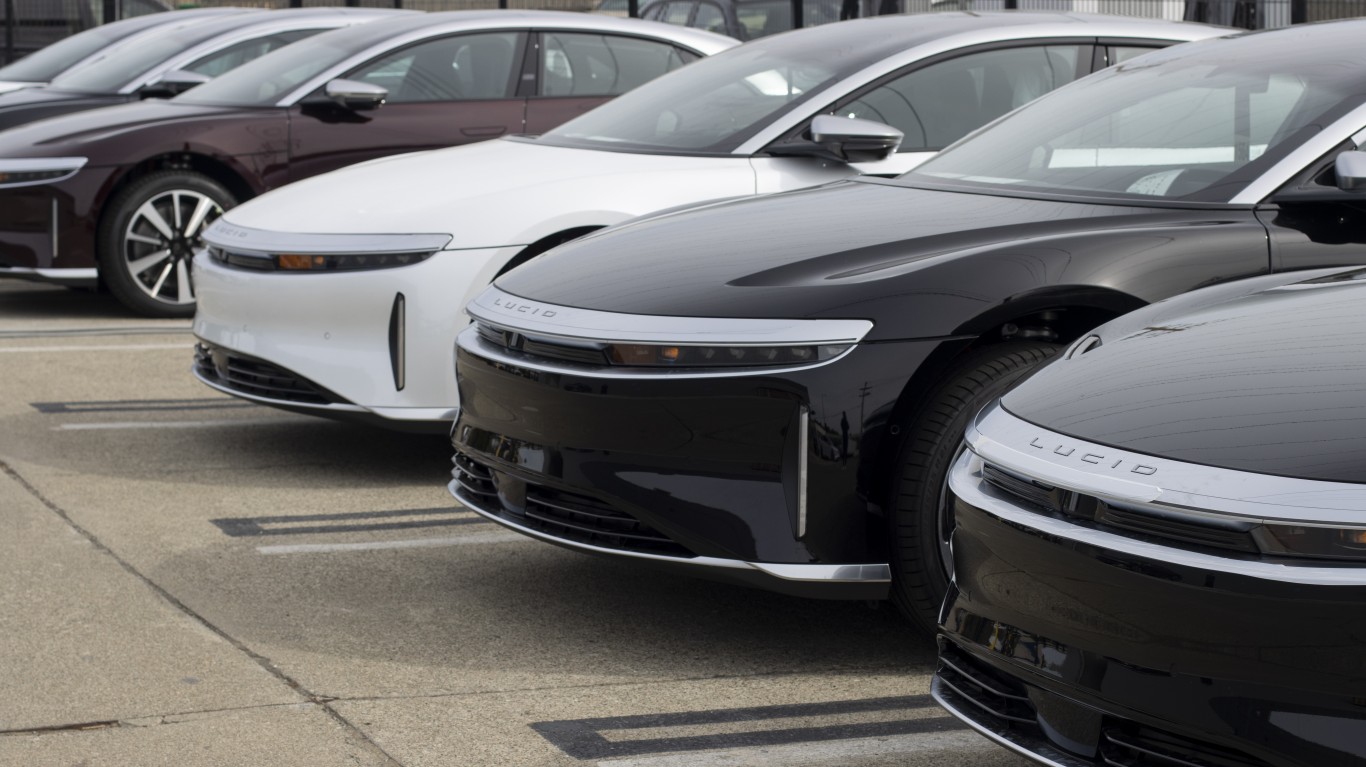
Lucid Group Tumbles After Missing on Q3 Earnings and Revenue
Lucid Group (NASDAQ: LCID | LCID Price Prediction) missed revenue and earnings expectations in Q3 2025, posting a $1.03 billion net loss on $336.6 million in revenue. The stock traded near $17.27 after the release, down sharply from its 52-week…

This post may contain links from our sponsors and affiliates, and Flywheel Publishing may receive compensation for actions taken through them.

Lucid Group (NASDAQ: LCID | LCID Price Prediction) missed revenue and earnings expectations in Q3 2025, posting a $1.03 billion net loss on $336.6 million in revenue. The stock traded near $17.27 after the release, down sharply from its 52-week high of $36.40. What kept investors from panicking entirely was news that the company secured an increase in its Saudi Arabia-backed credit facility from $750 million to approximately $2 billion, raising potential liquidity to $5.5 billion. That lifeline matters because Lucid is burning cash at a rate that makes survival the immediate question, not profitability.
Production Gains Can’t Offset Margin Reality
Lucid did deliver operational progress on the factory floor. Vehicle production jumped 116% year over year to 3,891 units, while deliveries rose 47% to 4,078 vehicles. These are the numbers management wanted investors to see. But production volume doesn’t translate to profit when you’re selling vehicles at a loss. Q2 gross margin was negative 105%, meaning the company lost more than a dollar for every dollar of revenue. Q3 gross profit came in at negative $942 million, a signal that the company is still underwater on unit economics. You can scale production all you want, but if each sale bleeds cash, volume becomes a liability, not an asset.
Cash Burn Remains the Core Problem
Operating cash flow deteriorated to negative $756.7 million in the quarter. Free cash flow was negative $955.5 million. At that burn rate, even a $5.5 billion liquidity cushion has a finite runway. The company ended the quarter with $1.67 billion in cash. Do the math: without meaningful revenue growth or a path to positive unit economics, that cash position could evaporate within two to three years if burn rates persist. The Saudi funding increase buys time, but it doesn’t solve the fundamental problem that Lucid is spending far more to build cars than it’s collecting in revenue.
Strategic Partnerships Offer a Lifeline
Management highlighted two partnerships that could reshape the company’s trajectory. Lucid announced a collaboration with Nvidia on Level 4 autonomous driving technology and a $300 million investment from Uber for an autonomous fleet expansion. These deals signal that third parties still see value in Lucid’s technology and brand, even as the core business struggles. That’s worth noting. However, partnerships are not revenue. They’re optionality. The company needs to prove it can deliver profitable vehicles at scale before these collaborations move the needle on the income statement.
Key Figures
Revenue: $336.6M (vs. $386.7M expected); up 68% year over year
Adjusted EPS: -$2.65 (vs. -$2.32 expected); worse than anticipated
Net Loss: $1.03B
Gross Profit: -$942.0M
Operating Cash Flow: -$756.7M
Free Cash Flow: -$955.5M
Cash Position: $1.67B
Vehicle Production: 3,891 units (up 116% year over year)
Vehicle Deliveries: 4,078 units (up 47% year over year)
The revenue miss was significant. Lucid fell short of expectations by $50.1 million, or roughly 13%. The EPS miss was wider in percentage terms. The company lost $2.65 per share against expectations of negative $2.32. I’d focus on cash burn here. It’s the metric that determines whether Lucid survives the next 18 months.
Management Strikes a Cautious Tone
CFO Marc Winterhoff said the company “maintained strong operational momentum this quarter, delivering solid results in both production and customer deliveries.” That’s the optimistic framing. But Winterhoff also acknowledged supply chain disruptions impacting the entire industry. The messaging was measured. Management didn’t promise a path to profitability. They emphasized execution on production and pointed to the Saudi funding as proof of institutional confidence. That’s appropriate given where the company stands.
What Matters Next
Watch the earnings call for any updates on the Gravity SUV launch timeline. That vehicle is critical to revenue growth, and delays or production issues would be a red flag. Also listen for commentary on gross margin trajectory. If management can articulate a credible path to breakeven unit economics within the next two to three quarters, that would shift the conversation. Right now, the story is survival. Everything else is secondary.
Contact [email protected] for any questions or corrections.
Joel South covers large-cap stocks, dividend investing, and major market trends, with a focus on earnings analysis, valuation, and turning complex data into actionable insights for investors.
He brings more than 15 years of experience as an investor and financial journalist, including 12 years at The Motley Fool, where he served as an investment analyst, Bureau Chief, and later led the Fool.com investing news desk. He has also co-hosted an investing podcast and appeared across TV and radio discussing market trends.