4 Highest Yielding Dividend Stocks in the Nasdaq Composite
Dividend stocks might not sound like an exciting investment in your portfolio, but if you can invest in the right ones, they can generate years of passive income. The Nasdaq Composite index includes the stocks listed on the Nasdaq stock…

Dividend stocks might not sound like an exciting investment in your portfolio, but if you can invest in the right ones, they can generate years of passive income. The Nasdaq Composite index includes the stocks listed on the Nasdaq stock exchange and has some of the biggest and the best U.S. companies. The government uncertainty has led to a shaky stock market, but some of the most exciting investments can be made in the Nasdaq index. Kraft Heinz Co. (NYSE: KHC | KHC Price Prediction), Kimberly-Clark (NYSE:KMB), Comcast Corp. (NYSE: CMCSA) and PepsiCo (NASDAQ:PEP) are four of the highest-yielding dividend stocks in the index.
These stocks have rewarded investors for years and can generate solid dividend income in the future. Together, these stocks can help diversify your portfolio while allowing you to generate more cash than if you were to invest in S&P 500. Plus, these companies have maintained a terrific track record of dividend payment. Let’s take a look at them.
Kraft Heinz
Dividend yield: 6.49%
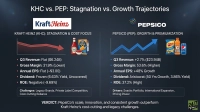
Kraft Heinz is a popular multinational food company with a market cap of $29.20 billion. It is the highest-yielding dividend stock in the Nasdaq Composite with a yield of 6.49%. The company has a payout ratio of 57.97% and has made consecutive dividend payments for 12 years. Berkshire Hathaway Inc. (NYSE: BRK-B) is the largest shareholder with a 27.5% stake in the company.
It has recently announced a split that will separate Kraft Heinz into two companies; one will focus on sauces, spreads, and shelf-stable meals, while the second one includes the North American staples like Kraft Singles, Lunchables, and Oscar Mayer. The stock has dropped 19% in value this year and is exchanging hands for $24.67. It is at its 52-week low currently.
In the third quarter, it saw a net sales drop of 2.3% and an organic sales drop of 2.5%. The net sales stood at $6,237 million, while the adjusted operating income came in at $1,106 million, down 16.9% year-over-year. The management has lowered its full-year outlook after the results.
The company’s global reach and brand strength can help offset the declining sales. Its split is set to complete in 2026, and the management has announced new partnerships and product launches to draw attention and boost sales.
Kimberly Clark
Dividend yield: 4.89%
Kimberly Clark is a multinational consumer goods and personal care company, and it is the second highest-yielding dividend stock in the Nasdaq Composite with a yield of 4.89%. The shares of Kimberly-Clark have dropped 21% this year. This is the lowest they have been since 2020. Known for brands like Huggies and Cottonelle, Kimberly Clark saw this dip after it announced plans to acquire Kenvue (NYSE:KVUE) for $48.7 billion.
Kimberly Clark is ready to take on challenges with Kenvue, including Tylenol, which is under controversy recently. The acquisition could benefit Kenvue more than Kimberly Clark, which is why the stock is the worst hit since the announcement.
Exchanging hands for $103.03, the stock is very close to the 52-week low of $99. If the company can manage to turn things around with Kenvue, we could see the stock gain momentum. Kimberly Clark is aiming at about $500 million in incremental profit from the deal.
The merger will create a global leader in the health and wellness industry by revenue, with about 10 brands generating more than $1 billion in sales annually. It anticipates a $2.1 billion net benefit in four years after closing the deal. The company has a payout ratio of 72.67% and a 5-year dividend growth rate of 3.35%. It has increased dividends for over 50 years, making it a highly reliable dividend stock.
Comcast Corporation
Dividend yield: 4.81%
Comcast Corporation is a multinational mass media, entertainment, and telecommunications company headquartered in Philadelphia. The stock has a yield of 4.81% and is exchanging hands for $27.45. It is a diversified business that owns TV networks like NBC, the Peacock streaming service, and Sky Group in Europe. It also owns movie studios like Universal and DreamWorks.
The cable business is seeing several challenges, and the company had to pivot to broadband, but the business is not gaining traction. It is losing broadband customers but has managed to grow wireless customers.
In the third quarter, the company posted upbeat quarterly results, and the revenue was up 2% at $31.2 billion, while the EPS stood at $1.12. The company lost domestic broadband customers for the fourth quarter in a row. However, it continues to remain profitable. It is moving towards mobile and saw a rise in its consumer base. It added a record 414,000 mobile customers in the quarter.
The company has a dividend payout ratio of 29.41% and has increased dividends for 16 consecutive years. Its 5-year dividend growth rate is 7.63%. For now, the dividend looks safe.
A Citigroup analyst has a “Buy” rating for the stock with a price target of $35, while a Goldman Sachs analyst has a neutral rating with a price target of $30.
PepsiCo
Dividend yield: 3.92%
Global giant Pepsi is a household name with a solid product portfolio. It has a global footprint, an impressive distribution network, and the right marketing strategies to scale up the business. PepsiCo is a dividend aristocrat with a yield of 3.92%.
In the third quarter, the company saw a 1.3% rise in organic revenue while the adjusted earnings per share dropped 2%. Inflationary pressures, tariffs, and resistance to price hikes have impacted the company’s sales. However, the management is taking steps to remain relevant and meet the changing demands of consumers. Earlier this year, it acquired Poppi, a gut-healthy soda brand, for $1.65 billion. It also plans to optimize the cost structure to achieve product growth.
PepsiCo has been around for many years and has gone through several cycles of ups and downs. The management has the ability to come out of a slump. Out of all the dividend stocks mentioned here, PepsiCo is the most promising and reliable stock to own.
The stock is down 3.4% in 2025 and is exchanging hands for $145.08. The dip is a chance to buy. Pepsi stock offers an ideal blend of value, income, and growth with little risk.
Contact [email protected] for any questions or corrections.
Vandita Jadeja is a financial publisher with over a decade of experience writing about financial topics, including investment, savings, retirement, insurance and banking. Vandita is a Chartered Accountant who loves to debunk financial concepts for readers.
Her work has appeared on sites that include The Motley Fool, InvestorPlace, and Benzinga. She covers investing and focuses on stock picks and price prediction for 24/7 Wall St.
When not looking for the next stock investment opportunity, she can be found traveling, reading, chasing sunsets and enjoying her iced latte.