This Is Nvidia’s Price Prediction Heading Into 2026 According To This Market
Nvidia (NASDAQ:NVDA | NVDA Price Prediction) has ridden the AI wave to extraordinary heights. Since late 2022, when generative AI tools like ChatGPT ignited the revolution, Nvidia’s shares have surged 1,000%, transforming the chipmaker from a gaming graphics leader into…


Nvidia (NASDAQ:NVDA | NVDA Price Prediction) has ridden the AI wave to extraordinary heights. Since late 2022, when generative AI tools like ChatGPT ignited the revolution, Nvidia’s shares have surged 1,000%, transforming the chipmaker from a gaming graphics leader into a $4 trillion powerhouse.
Its stock climbed from a split-adjusted price around $15 to a peak of $212 per share last month, fueled by insatiable demand for its GPUs in data centers worldwide. But the momentum has stalled. Since August, Nvidia has largely traded sideways, hovering between $170 and $180 per share amid broader market rotations out of tech.
It’s now down 16% from those October highs as investors digest lofty valuations and emerging headwinds. Prediction markets, however, see more of the same: lackluster action through the end of the year with little conviction for a breakout.
A Sideways Bet on the AI Leader
Polymarket is a decentralized prediction market platform built on blockchain, where users bet cryptocurrency on real-world outcomes — from elections to stock prices — using yes/no shares that trade like options. Payouts come from a shared pool, making it a crowd-sourced gauge of probabilities.
On this market, titled “What will NVIDIA (NVDA) hit before 2026?,” traders wager on whether Nvidia’s stock will touch specific thresholds by Dec. 31, based on Yahoo Finance highs during trading hours.
The market shows a clear consensus. The “Yes” share for hitting $190 trades at $0.71 implies a 71% chance of making it — strong but not overwhelming. For $185 per share, it’s 84%, while a $200 bet sits at 43%.
Although that’s not holding out much hope for gains, the downside bets are even milder: the odds are only 44% that the AI chipmaker dips to $165, with 32% predicting $160 per share. Extreme moves in either direction, such as $260 to the upside or $125 downside, languish below 5%. Most bets cluster around the $180 per share range — Nvidia’s current trading level, indicating an uninspired outlook, though some apparently hope for a burst of holiday tech buying or AI hype cycles. Still, traders aren’t betting on fireworks; they’re pricing in a quiet close.
Why Nvidia Is Stalled
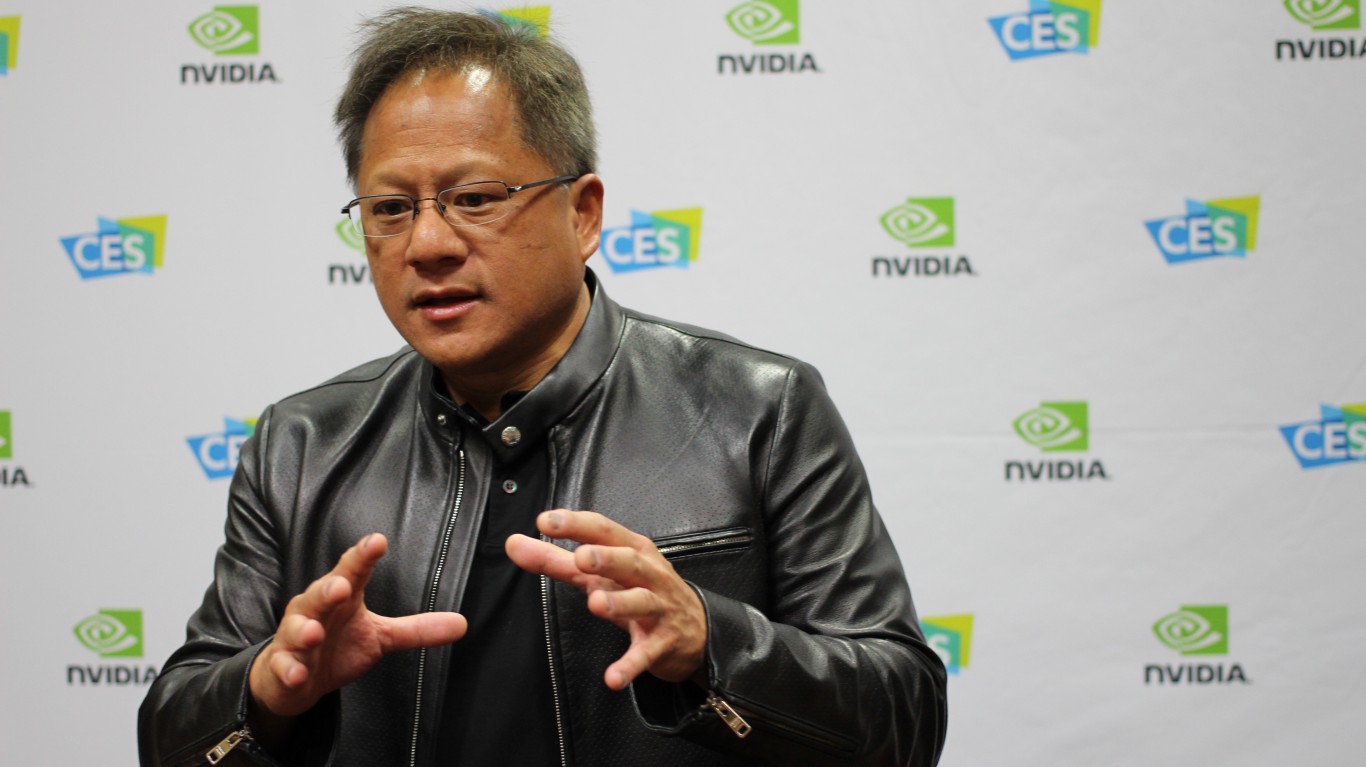
Nvidia’s fiscal third-quarter earnings last week should have been a catalyst. Revenue hit a record $57 billion, up 62% year-over-year, with earnings at $1.30 per share, topping estimates. CEO Jensen Huang called Blackwell GPU sales “off the charts,” and cloud providers sold out. CFO Colette Kress confirmed visibility into $500 billion in AI chip orders through 2026, spanning Blackwell and next-generation Rubin architectures.
Demand for AI data center buildouts also remains outsized, with hyperscalers like Microsoft (NASDAQ:MSFT) and Amazon (NASDAQ:AMZN) snapping up GPUs for training massive models. Huang dismissed AI bubble fears, noting the ecosystem’s expansion into enterprises and sovereign projects.
So why the post-earnings slide and persistent sideways grind? Competition is biting harder. Alphabet (NASDAQ:GOOG)(NASDAQ:GOOGL) is negotiating a multi-billion-dollar deal with Meta Platforms (NASDAQ:META) to integrate its Tensor Processing Units (TPUs) into the social media giant’s data centers starting in 2027, with rentals via Google Cloud as early as next year, potentially eating into Nvidia’s market share.
Amazon’s Trainium2 powers half a million chips in its Indiana AI facility, reducing dependence on Nvidia, and Microsoft’s Maia chips, though delayed, aim to fill Azure data centers by 2026. Arm Holdings (NASDAQ:ARM) is also entering full chipmaking, hiring ex-Amazon AI execs to build custom CPUs and accelerators. This pits Arm directly against Nvidia in data centers and PCs, where Nvidia itself plans Arm-based consumer chips for AI graphics.
Broader pressures include ongoing U.S.-China trade tensions crimping H20 chip sales and valuation fatigue — although Nvidia trades at only 28x forward earnings the runup in its stock has worried the market. That’s been compounded by short sellers saying the ghost of Enron and Lucent hover over its AI chip demand through circular financing deals.
Overall, the market is pricing in a maturing AI landscape. Demand is robust, but no longer a monopoly sprint.
Key Takeaway
Prediction markets look like they’ve nailed the short term outlook. Without a specific catalyst, the stock is likely to remain muddled around $180 per share through the end of the year. By the end of 2026, however, I see the Rubin chip ramp and Nvidia’s $500 billion backlog pushing its stock much higher.
Although competitors are nibbling around the edges, none match Nvidia’s full-stack software-hardware moat. Sure, it will experience volatility from capex cycles, but the long-term outlook means Nvidia’s stock will double from here as AI everywhere becomes a reality.
Contact [email protected] for any questions or corrections.
After two decades of patrolling the dark corners of suburbia as a police officer, Rich Duprey hung up his badge and gun to begin writing full time about stocks and investing. For the past 20 years, he’s been cruising the markets looking for companies to lock up as long-term holdings in a portfolio while writing extensively on the broad sectors of consumer goods, technology, and industrials. Because his experience isn’t from the typical financial analyst track, Rich is able to break down complex topics into understandable and useful action points for the average investor. His writings have appeared on The Motley Fool, InvestorPlace, Yahoo! Finance, Money Morning, and, of course, 24/7 Wall St. He has been featured in both U.S. and international publications, including MarketWatch, Financial Times, Forbes, Fast Company, and USA Today.