Monopoly No More? ASML May Suddenly Have a New Competitor
ASML Holding (NASDAQ:ASML | ASML Price Prediction) has long dominated the semiconductor world with its stranglehold on extreme ultraviolet (EUV) lithography machines. These behemoths are the gold standard for etching nanoscale patterns onto silicon wafers, enabling the production of advanced…

This post may contain links from our sponsors and affiliates, and Flywheel Publishing may receive compensation for actions taken through them.
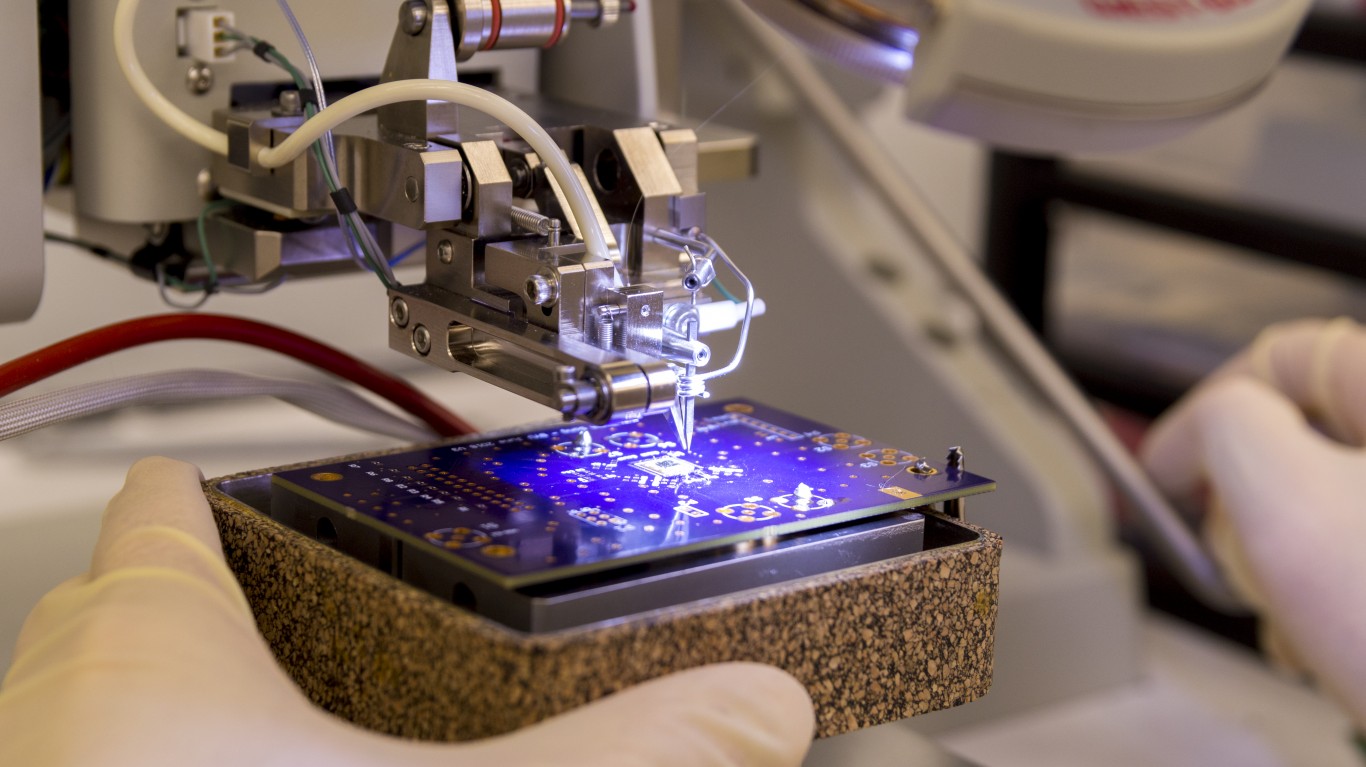
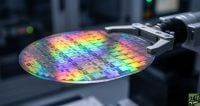
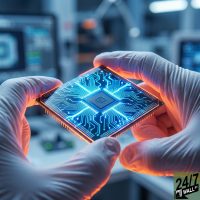
ASML Holding (NASDAQ:ASML | ASML Price Prediction) has long dominated the semiconductor world with its stranglehold on extreme ultraviolet (EUV) lithography machines. These behemoths are the gold standard for etching nanoscale patterns onto silicon wafers, enabling the production of advanced chips packed with billions of transistors.
Without EUV, the explosive growth in artificial intelligence — from training massive models like those powering ChatGPT to deploying edge devices — would grind to a halt. The precision of ASML’s tech allows for chips at 3 nanometers (nm) and below, packing more power into smaller spaces while slashing energy use.
Chip giants like Taiwan Semiconductor Manufacturing (NYSE:TSM) and Samsung rely almost exclusively on ASML’s machines, which cost up to $400 million apiece and take years to build. This setup has created what amounts to a monopoly: ASML controls over 90% of the EUV market, with no scalable alternatives in sight. Until now, there has been no real rival to its business, but that may be changing.
A Former Intel Exec’s Bold Swing
Pat Gelsinger, the ousted CEO of Intel (NASDAQ:INTC) after a tenure marked by manufacturing stumbles and weak earnings, isn’t fading quietly. As executive chairman of xLight — a stealthy startup founded last year — he’s gunning to disrupt the EUV status quo.
xLight targets the heart of lithography: light sources. While ASML’s EUV relies on laser-produced plasma at 13.5 nanometers, xLight is developing free-electron lasers driven by compact particle accelerators. These could hit wavelengths as low as 2nm, potentially doubling transistor density every two years and reviving Moore’s Law from its “nap,” as Gelsinger puts it.
The real jolt came in February, when Gelsinger pitched Commerce Secretary Howard Lutnick on the idea during a pre-confirmation call. Fast-forward to now, and the Trump administration announced it is injecting up to $150 million into the company from the 2022 CHIPS and Science Act — the first such award in Trump’s second term. In return, the U.S. government snags an equity stake, positioning it as xLight’s largest shareholder.
This isn’t just seed money; it’s a strategic bet to onshore critical tech amid tensions with Asia, where most advanced chips are fabbed. xLight, led by CEO Nicholas Kelez (a quantum computing vet), already raised $40 million from Playground Global and others this summer. The funds will push toward producing the first silicon wafers by 2028, with plans to slot these lasers into existing ASML machines for upgrades.
ASML Disruption or Sideshow?
For ASML, this isn’t an overnight apocalypse, but it’s a wake-up call. xLight isn’t building full lithography scanners — it’s enhancing the light engine, a key bottleneck in EUV efficiency. Success could slash wafer processing costs by 30% to 40% and cut energy demands, making chips cheaper and greener.
ASML might even welcome integrations, as Gelsinger has hinted at collaboration. But if xLight scales independently, it could erode ASML’s pricing power and force R&D accelerations, especially with U.S. export curbs already pinching sales to China. Analysts peg the threat as medium-term: ASML’s moat — decades of IP and a $300 billion backlog — remains vast.
xLight is not an immediate threat to ASML. The 2028 silicon milestone is ambitious as particle accelerators are finicky and have historically been confined to labs like CERN. Scaling to fab-ready, “utility-scale” units outside cleanrooms demands breakthroughs in compactness and reliability, though xLight’s private backers see upside in a market projected to hit $100 billion by 2030.
Key Takeaway
ASML investors shouldn’t tremble yet at the prospect of a rival stealing market share. The Dutch giant continues to benefit from the AI boom, even as the market has worries about growth amid significantly declining sales in China. Still, ASML expects 15% growth this year, but 2026 is cloudy, though the equipment maker doesn’t think sales will fall year over year.
xLight’s government-fueled assault on EUV lasers signals a pivotal shift, injecting U.S. muscle into a Dutch-dominated industry. Backed by Gelsinger’s determination and $150 million in federal funding, the upstart promises efficiency leaps that could supercharge AI chips while denting ASML’s fortress.
Contact [email protected] for any questions or corrections.
After two decades of patrolling the dark corners of suburbia as a police officer, Rich Duprey hung up his badge and gun to begin writing full time about stocks and investing. For the past 20 years, he’s been cruising the markets looking for companies to lock up as long-term holdings in a portfolio while writing extensively on the broad sectors of consumer goods, technology, and industrials. Because his experience isn’t from the typical financial analyst track, Rich is able to break down complex topics into understandable and useful action points for the average investor. His writings have appeared on The Motley Fool, InvestorPlace, Yahoo! Finance, Money Morning, and, of course, 24/7 Wall St. He has been featured in both U.S. and international publications, including MarketWatch, Financial Times, Forbes, Fast Company, and USA Today.