Exxon SVP Warns Oil Could Spike to $150-160 Per Barrel in ‘Coming Weeks’
An Exxon executive just went on record with a crude price target that would reshape every energy balance sheet on Wall Street, and five Permian-linked stocks sit directly in the path of that repricing.


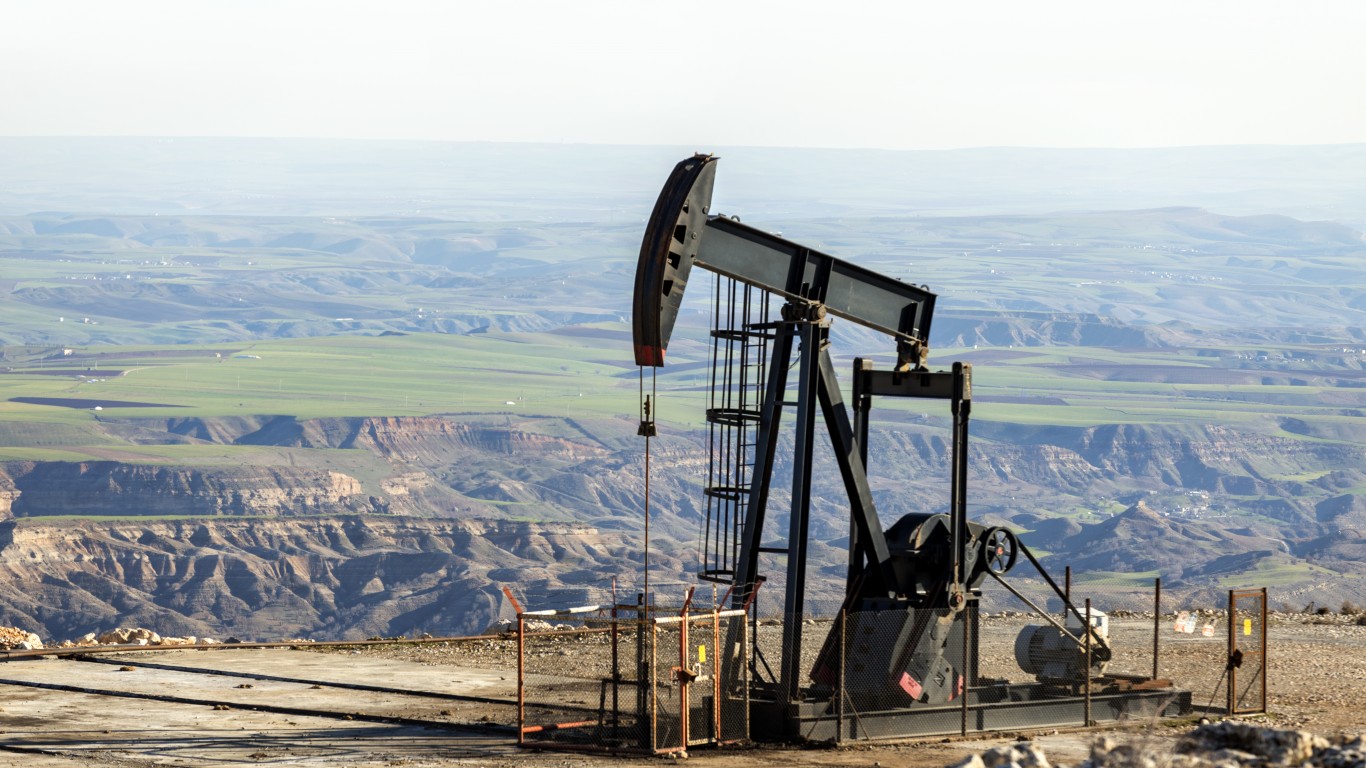
An Exxon senior vice president just told Tom Bilyeu’s Impact Theory podcast that physical Brent cargoes are heading to $150 to $160 per barrel in the coming weeks as global inventories approach all-time lows. Brent closed last Tuesday at $102.75. If that warning lands, every barrel-levered name on US exchanges reprices by the end of summer, and the window to position is closing now.
I’ve been covering energy equities through three crude cycles, and the setup heading into June 2026 is the most asymmetric I’ve seen since the 2022 spike. Below are the five names I’d own if the SVP’s call cashes.
1. Texas Pacific Land Corp (TPL): The Royalty Cheat Code
Start here, because almost nobody outside energy circles understands what Texas Pacific Land Corporation (NYSE:TPL | TPL Price Prediction) actually is. TPL owns the dirt under one of the most productive stretches of the Permian Basin. The business model is pure royalty: every barrel pumped on its acreage by someone else flows back as a royalty check at near-100% margin, with no drilling and no hedging. When crude rips 40% higher, TPL’s cash flows rip with it, no capex required. CEO Tyler Glover said it plainly: "With our unhedged commodity position, we will fully capture the upside from elevated commodity prices."
Q1 2026 was already a record before the spike hits. Revenue came in at $236.82 million against $195.98 million a year earlier, oil and gas royalty production jumped 19.3% to 37.1 thousand Boe/d, and adjusted EBITDA margin sat at a stunning 77%. The balance sheet carries $247.6 million in cash and zero debt. There is no operational drag on a price spike here. The stock has cooled 15% over the past month from its May peak, which is exactly the kind of pause that frustrates late buyers and rewards the early ones.
The royalty model is the cleanest setup on this list. The next name is the one waving the red flag in the first place.
2. ExxonMobil (XOM): The Company Sounding Its Own Alarm
The irony of stock #2 is that the warning came from inside this house. Exxon Mobil Corporation (NYSE:XOM) is the largest US integrated, with Permian dominance upstream and a refining footprint that captures margin on both ends of a price spike. When crude goes vertical, Exxon captures wellhead realizations, refining crack spreads, and trading desk optimization in the same quarter. CEO Darren Woods told investors after Q1 that "Events in the Middle East tested that strength… underscored the importance of reliable, affordable energy products."
Q1 2026 already showed the earnings engine working through chaos. Underlying earnings hit $8.77 billion versus $7.58 billion a year ago, even after stripping out $3.88 billion in mark-to-market derivative losses and $706 million in Middle East disruption losses. Adjusted EPS of $1.16 beat consensus, the fourth straight beat. Management plans $20 billion in buybacks for 2026 against $27 to $29 billion of capex. The stock has already done work, up 26% year to date and 51% over the past year, yet retail is still piling in. A single Reddit post titled "Exxon warns oil inventories near record lows, price spike ahead" pulled 596 upvotes and 93 comments on June 1. The narrative is going mainstream.
Exxon is the bellwether. The next name is the Permian pure-play with a famous shareholder.
3. Occidental Petroleum (OXY): The Buffett-Backed Crude Beta
Berkshire Hathaway’s largest energy holding is also the cleanest Permian operator on the list. Occidental Petroleum Corporation (NYSE:OXY) just stripped the OxyChem business off its balance sheet in a sale to Berkshire that closed January 2, 2026, using proceeds to crush principal debt by $5.8 billion to $15 billion total. A delevered Permian operator going into a $150 print is exactly the asymmetric setup Buffett tends to want to own.
The stock has already moved 44% year to date and 48% over the past year, yet still trades at a forward P/E of 12. Q4 2025 production exceeded the high end of guidance at 1,481 Mboed, and management hiked the dividend 8% to $0.26 per share quarterly, a payout that has doubled over four years. With debt cut and OxyChem off the deck, every dollar of crude upside flows straighter to free cash than at any point in Occidental’s recent history.
OXY is the deleveraging play. Stock #4 wins regardless of which producer drills the next well.
4. Schlumberger (SLB): The Picks and Shovels
When producers scramble to add capacity into a price spike, demand for drilling, completions, and services explodes. Schlumberger Limited (NYSE:SLB) is the global infrastructure trade. The company gets paid whether ExxonMobil or Diamondback or Aramco is pulling the next barrel out of the ground. CEO Olivier Le Peuch already told investors he expects "postconflict liquid commodity prices to remain above preconflict levels due to near-term supply disruptions" with a sustained geopolitical risk premium.
Q1 2026 revenue came in at $8.72 billion, up 2.7% year over year, with the ChampionX acquisition contributing $838 million in revenue. Digital ARR crossed $1 billion, up 15% year over year, with Data Center Solutions up 45%. Management committed to $4 billion-plus in shareholder returns for 2026. Shares are still up 71% over the past year and 43% year to date, and a recent 4% weekly pullback looks like a gift if the SVP’s call cashes.
SLB is the diversified bet. Stock #5 is the undiluted one, and it has been the most beaten up of the bunch.
5. Diamondback Energy (FANG): The Pure Permian Punchline
This is the payoff. Diamondback Energy (NASDAQ:FANG) is a Permian pure-play with some of the lowest break-evens in the basin and maximum operational torque to crude. Q4 2025 was ugly: a $3.65 billion non-cash impairment from the SEC ceiling test crushed GAAP earnings to a $5.11 per share loss, and Q4 realized oil prices collapsed to $58.00 per barrel from $69.48 a year earlier. That impairment is exactly the kind of mark that reverses violently when crude reprices higher.
The cleanest expression of the trade lives here. Diamondback repurchased roughly 5% of its shares in 2025 ($2.0 billion across 13.84 million shares), with $2.3 billion remaining on the $8 billion authorization, and CEO Kaes Van’t Hof said "We expect to continue to be aggressive buyers of our stock until commodity prices recover." Forward P/E sits at 9 against an analyst target of $232.86, with the current price near $200.60. Q1 oil production guided to 500 to 510 MBO/d for 2026, unhedged enough to mean every $10 move on the barrel hits the income statement with force.
The Bottom Line
Brent at $102.75 versus an Exxon insider calling for $150 to $160 is the kind of asymmetric setup the market rarely telegraphs in advance. The EIA already estimates global oil inventories will fall by an average of 8.5 million barrels per day in Q2 2026, and Bilyeu warned on the same podcast that "any company that’s in a weakened position or is extremely exposed to energy costs, poof, they just stop existing," pointing to Spirit Airlines as the early warning. Royalties, integrateds, Permian pure-plays, and services each capture the spike differently. The window to choose is the next few weeks, not the next few quarters.
Contact [email protected] for any questions or corrections.
I've been writing about stocks and personal finance for 20+ years. I believe all great companies are tech companies in the long run, and I invest accordingly.