Wingstop Expands Through Consumer Weakness While Chipotle Fights Margin Compression
Chipotle Mexican Grill (NYSE: CMG | CMG Price Prediction) and Wingstop (Nasdaq: WING) just reported Q3 2025 earnings revealing two fast-casual chains navigating very different paths through a challenging consumer environment. Chipotle relied on modest comp sales growth and Chipotlane…


Chipotle Mexican Grill (NYSE: CMG | CMG Price Prediction) and Wingstop (Nasdaq: WING) just reported Q3 2025 earnings revealing two fast-casual chains navigating very different paths through a challenging consumer environment. Chipotle relied on modest comp sales growth and Chipotlane expansion while fighting margin pressure. Wingstop bet on aggressive unit growth to offset a 5.6% domestic same-store sales decline.
One Grinds on Comps. The Other Expands Through the Pain.
Chipotle posted $3.00 billion in revenue, up 7.5% year-over-year, with comparable sales rising just 0.3%. The company opened 84 new restaurants, 64 featuring Chipotlanes. Digital sales represented 36.7% of revenue. Operating margin compressed to 15.9% from 16.9% the prior year as labor costs and inflation bit into profitability. Net income fell 1.4% to $382.1 million despite revenue growth.
CEO Scott Boatwright acknowledged the headwinds: “While we continue to see persistent macroeconomic pressures, our extraordinary value proposition and brand strength remain strong.” The company expects low-single-digit comp sales declines for full-year 2025 and plans to open 315 to 345 new units this year, accelerating to 350 to 370 in 2026.
Wingstop took a different approach. Revenue of $175.7 million missed estimates of $189.6 million, but EPS of $1.09 crushed the $0.95 consensus by 14.7%. Domestic comp sales dropped 5.6%, yet system-wide sales grew 10.0% to $1.4 billion thanks to 114 net new restaurants, a 19.3% unit expansion rate. Adjusted EBITDA surged 18.6% to $63.7 million even as traffic softened.
CEO Michael Skipworth emphasized the franchise model’s resilience: “Our third quarter results highlight the strength and resiliency of our business model delivering 18.6% Adjusted EBITDA growth — supported by best-in-class unit economics.” Digital sales dominated at 72.8% of system-wide sales, nearly double Chipotle’s penetration. Wingstop expects to open 475 to 485 global units in 2025.
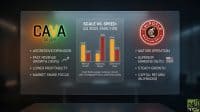
| Business Driver | CMG | WING |
| Main Growth Lever | Same-store sales + selective expansion | Aggressive unit growth (19.3%) |
| Operating Model | Company-owned (high capex) | Franchise-driven (asset-light) |
| Digital Penetration | 36.7% | 72.8% |
| Margin Direction | Compressing (15.9%) | Expanding (18.6% EBITDA growth) |
The Capital Structures Tell Opposite Stories
Chipotle spent $686.5 million on share buybacks at $42.39 per share and $163.5 million on capital expenditures to support company-owned restaurant expansion. Wingstop returned $151.3 million through buybacks and pays a quarterly dividend of $0.30 per share while spending just $2.2 million on capex. The franchise model requires minimal capital while generating strong cash flow.
Why I Would Wait on Chipotle and Watch Wingstop Closely
Chipotle faces a fundamental problem: operating margin compression during revenue growth signals pricing power erosion and cost structure challenges. The 0.3% comp sales growth barely moved the needle, and management’s guidance for low-single-digit comp declines through 2025 suggests consumer weakness persists. The stock has fallen 43% year-to-date from $59.89 to $34.15, and I would need to see stabilizing margins before considering it attractive.
Wingstop’s negative comp sales worry me, but the franchise model’s ability to expand EBITDA 18.6% while traffic declined demonstrates operational discipline. The 72.8% digital penetration and asset-light structure give management flexibility to weather consumer softness. At $275, down 5.84% year-to-date, the stock has held up far better than Chipotle’s collapse. Chipotle trades at a significant discount following its 43% year-to-date decline, reflecting investor concerns about margin compression and weak comp sales. Wingstop has held up better with only a 5.84% decline, as the market appears to value its franchise model’s ability to expand EBITDA during traffic softness. The two stocks represent different risk-reward profiles: Chipotle offers potential recovery upside if margins stabilize, while Wingstop demonstrates operational resilience through current challenges.
Contact [email protected] for any questions or corrections.
I write to invest, and I invest to spend more time with nature. Usually all at the same time. I'm a retired equities guy who saw a recession or four, and lives for what comes out of the other side of them.
I cover stocks across the board cause even though I feel like I've seen it all, there's always another way out there to make, and lose money. I want to help you do more of the former, and none of the latter. Making money with friends is my oxygen.
Let's go!