Dave Ramsey to Baby Boomers: ‘Start Social Security at 62 and Invest Wisely’ – Why This Is Your Best Move
Dave Ramsey wants Baby Boomers to make an unconventional move when it comes to Social Security. He wants retirees to claim benefits at 62 and invest the money. This is a sharp departure from standard advice on claiming Social Security…


Dave Ramsey wants Baby Boomers to make an unconventional move when it comes to Social Security. His advice is to claim benefits at 62 and invest every check. That puts him squarely at odds with conventional wisdom, which tells retirees to delay as long as possible in order to lock in the largest monthly payment. The disagreement is genuine, and the stakes are high.
The strategy carries real risks, but it also has real merit for retirees who have the financial cushion to pull it off. The central question is simple: can you invest those checks productively, or will you need them to pay the bills?
Why Ramsey recommends starting Social Security at 62
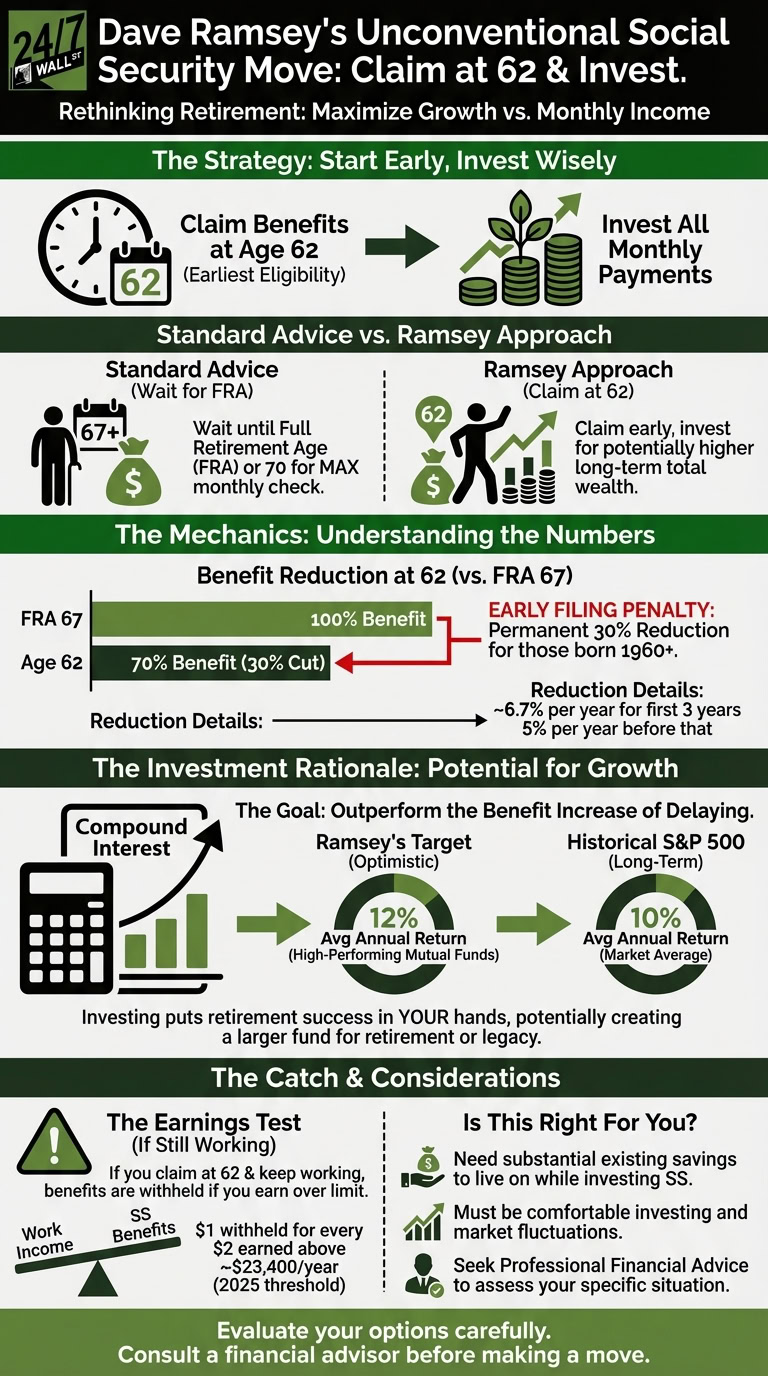
Ramsey recommends claiming Social Security at the earliest eligible age, even though filing well before a worker’s full retirement age (FRA) triggers a permanent reduction in monthly benefits. Anyone born in 1960 or later has an FRA of 67, so filing at 62 means claiming five years early and accepting a 30% cut to the monthly check.
Ramsey’s counter to that reduction is direct: put every dollar into a high-performing mutual fund. His view is that a well-invested portfolio can grow faster than the additional income gained by waiting. He has also made a longevity argument on his show and blog, saying that “your retirement payments die when you die, so you might as well take the money and make the most of it while you can.” A retiree who passes away earlier than average may collect more total lifetime income over five extra years, even at the reduced rate.
There is also a program-solvency dimension that has grown more urgent. The 2026 Social Security Trustees Report, released June 9, 2026, projects the OASI Trust Fund will be depleted in the fourth quarter of 2032, one quarter earlier than the prior year’s projection. At that point, ongoing payroll tax revenue would cover only about 78% of scheduled benefits. The accelerated timeline is partly attributed to the 2025 “One Big Beautiful Bill Act,” which reduced the income-tax revenues flowing into Social Security. The program’s 75-year funding shortfall also widened, reaching 4.42% of taxable payroll, up from 3.82% a year earlier. For retirees who place any weight on that risk, collecting payments now and investing them carries added appeal.
The math behind Ramsey’s argument
Ramsey’s case has genuine mathematical support. Filing early shrinks monthly benefits by 5/9 of 1% for each of the first 36 months before FRA, and by 5/12 of 1% for each additional month beyond that. In practical terms, that works out to roughly 6.7% per year for the first three years and about 5% per year for years four and five, producing that combined 30% reduction for a claim at 62.
The flip side is that an early filer collects checks for five years before a delayed claimer receives a single dollar. The average monthly retirement benefit in 2026 is $2,071, according to the Social Security Administration. On a standard $2,000 benefit at FRA, claiming at 62 yields roughly $1,400 a month, while waiting until 70 (which earns an 8% annual delayed-retirement credit above FRA) pushes the check to around $2,480. That income gap of more than $13,000 per year is the reward for patience, but only if the retiree lives long enough to recoup the years of missed payments. The break-even point typically falls somewhere between ages 80 and 82.
Ramsey argues that investing early checks can close or exceed that gap. He points to expected annual returns of 10% to 12% from diversified mutual funds. The 12% figure is optimistic for a retiree who needs a relatively conservative allocation, but a 10% average annual return is historically defensible for a long-term equity investor given the S&P 500’s track record. The core logic is that compounding over a 15-plus-year horizon can turn smaller early checks into a larger pool of capital than a delayed benefit would have provided.
Collecting those funds early also shifts control of your retirement outcome away from a government program and toward assets you manage directly. For retirees who worry about benefit cuts or means-testing down the road, that autonomy has genuine value.
The important catches to understand
Ramsey’s strategy works only if every Social Security check goes into investments rather than toward monthly bills. Retirees who claim at 62 and need that money for groceries and rent are simply locking in a smaller lifetime benefit with nothing to show for the trade-off. To execute the plan as Ramsey intends, you need to be fully retired and have enough in savings to cover living expenses independently. That is a higher bar than many 62-year-olds can clear: Fidelity’s Q1 2026 data shows the average 401(k) balance for workers aged 60 to 64 is $257,400, and median balances run considerably lower.
A second obstacle applies to anyone still working. The Social Security earnings test withholds $1 in benefits for every $2 earned above the annual limit, which stands at $24,480 in 2026. That translates to a monthly threshold of roughly $2,040. Benefits withheld under this rule are not lost permanently: Social Security recalculates your payment upward at FRA to credit those months. In the meantime, the checks you planned to invest may never arrive, which breaks the strategy’s logic entirely.
There is also a tax dimension worth understanding. If your provisional income exceeds $34,000 as a single filer (or $44,000 for a married couple filing jointly), up to 85% of your Social Security benefits become subject to federal income tax. Stacking investment returns on top of early benefits can push you past those thresholds and shrink your real net return.
For those who can genuinely invest the funds and live on other savings in the meantime, Ramsey’s approach deserves serious consideration. A financial advisor can help you model the numbers for your specific situation, including the impact on survivor benefits for a spouse, before you file.
Editor’s note: This article has been updated to reflect Fidelity’s Q1 2026 figure of $257,400 for the average 401(k) balance among workers aged 60 to 64, the 2026 Social Security Trustees Report’s finding that the 75-year actuarial deficit widened to 4.42% of taxable payroll (up from 3.82%), and context on the role of the 2025 “One Big Beautiful Bill Act” in accelerating the OASI Trust Fund’s projected depletion timeline. The 2026 average monthly Social Security retirement benefit of $2,071 has also been added.
Contact [email protected] for any questions or corrections.
Christy Bieber has been a personal finance and legal writer since 2008. She has a JD from UCLA School of Law and a BA in English, Media and Communications with a certification in business from the University of Rochester.
Christy has been published by a wide variety of sites, including WSJ Buy Side, Forbes, Kiplinger, Fox Business, Credit Karma, Insurify, and Annuity.org. In addition to writing for the web, she has also ghostwritten textbooks on business and law and served as a subject matter expert for course design.