What $6,200 a Month Really Looks Like in Retirement at Age 67
A retired couple living on $6,200 monthly ($74,400 annually) with average Social Security benefits of around $2,083 each (totaling roughly $4,166) withdraws approximately $2,034 from their portfolio to cover the gap. That suggests a nest egg around $611,000 using the…


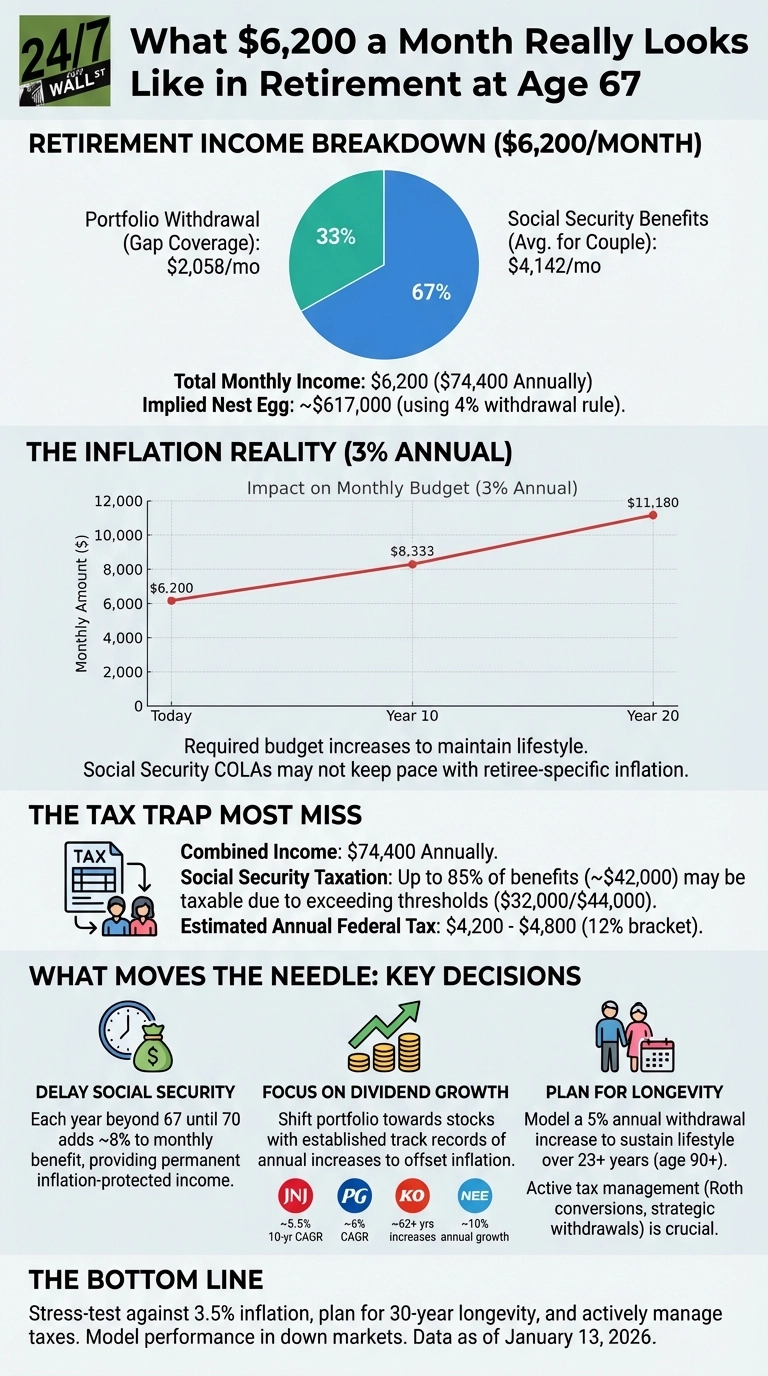
A retired couple living on $6,200 monthly ($74,400 annually) typically combines average Social Security benefits of roughly $2,083 each ($4,166 total) with portfolio withdrawals of about $2,034 to cover the gap. Under the traditional 4% withdrawal rule, that portfolio draw points to a nest egg near $611,000. The real question is whether that income structure holds together over 20 or 30 years of inflation, market volatility, and rising healthcare costs — and recent data suggests the stakes are higher than most retirees expect.
The Inflation Math Nobody Wants to Run
Assume 3% annual inflation. That $6,200 monthly budget climbs to $8,333 in ten years and $11,180 in twenty years, simply to maintain the same purchasing power. Social Security includes cost-of-living adjustments (the 2026 COLA was 2.8%), but those adjustments consistently trail retiree-specific inflation, particularly in healthcare. The Senior Citizens League’s 2026 Loss of Buying Power report found that the average Social Security payment has lost approximately 13.7% of its purchasing power since 2010. When Social Security grows at 2.5% annually while actual costs rise at 3.5%, the gap compounds year after year with no automatic correction.
Looking ahead, the 2027 COLA is currently projected at around 3.6% by both the Senior Citizens League and AARP, based on July 2026 inflation data. That would be the largest annual adjustment since 2023 and would push the average retired worker’s monthly check by roughly $75. The official figure will not be confirmed until mid-October, when the Social Security Administration releases third-quarter CPI data. Even a 3.6% adjustment may still trail actual spending growth for retirees, whose budgets are disproportionately weighted toward healthcare and housing.
Portfolio withdrawals must grow faster than the 4% rule originally anticipated. A nest egg of roughly $611,000 generating modest returns could stretch 15 years under calm conditions, but sequence-of-returns risk can shorten that timeline dramatically. When markets fall hard in the early years of retirement, the retiree is forced to sell assets at depressed prices to cover living expenses. That depletes the share count available to participate in any subsequent recovery, permanently weakening the portfolio’s long-run capacity. Adding to that pressure: the 2026 Social Security trustees’ report projects the program’s reserves will be depleted by 2033, after which benefits could be cut to about 77% of earned amounts without congressional action.
Social Security Taxation: The Threshold Trap
At $74,400 in combined income, this couple almost certainly pays federal tax on up to 85% of their Social Security benefits. The provisional income thresholds that trigger taxation sit at $32,000 (for any taxation) and $44,000 (for maximum taxation) for married couples filing jointly. Both thresholds have been frozen since 1984 and have never been indexed to inflation. With roughly $50,000 in Social Security and $25,000 in portfolio withdrawals, provisional income clears $44,000 easily, pushing about $42,000 of Social Security benefits into taxable territory.
One meaningful piece of new relief comes from the One Big Beautiful Bill Act, signed into law on July 4, 2025. For tax years 2025 through 2028, taxpayers aged 65 and older can claim an additional $6,000 deduction per qualifying person, on top of the regular standard deduction and regardless of whether they itemize. A couple where both spouses are 67 could claim up to $12,000 in extra deductions, subject to a phase-out that begins above $150,000 in modified adjusted gross income for joint filers. Combined with the $32,200 standard deduction for married couples filing jointly in 2026, total deductions for this couple could reach $44,200 or more, substantially shrinking taxable income. Even with that benefit, their estimated federal tax bill likely falls in the range of $2,500 to $3,500 annually, well below earlier projections that did not account for the new senior deduction. The senior deduction expires after the 2028 tax year unless Congress extends it, so the window for capturing its full value is limited. Strategic moves still matter throughout: Roth conversions in early retirement years (before required minimum distributions begin), careful withdrawal sequencing to stay beneath taxation tiers, and qualified charitable distributions after age 70½ to satisfy RMDs without adding to adjusted gross income.
Building Income That Grows
Three strategies separate a retirement plan that survives volatility from one that quietly fails. The first is delaying Social Security past 67 whenever health and finances allow. Each year of delay through age 70 adds roughly 8% to the monthly benefit permanently, producing inflation-protected income that requires no portfolio drawdown to fund. Given that a 67-year-old couple has a 53% chance that at least one spouse reaches 90 or beyond, that permanent boost carries outsized value over a long retirement.
The second strategy is tilting the portfolio toward dividend growth rather than raw yield. Companies with multi-decade records of annual payout increases deliver rising income without forcing asset sales during downturns. Johnson & Johnson (NYSE:JNJ | JNJ Price Prediction) raised its quarterly dividend by 3.1% in April 2026 to $1.34 per share, marking its 64th consecutive year of increases, with an annual rate now at $5.36 per share and a current yield around 3.2%. Procter & Gamble (NYSE:PG) reached its 70th consecutive year of dividend increases in April 2026, raising its quarterly payout to $1.0885 per share, and currently yields approximately 2.9%. Coca-Cola (NYSE:KO) extended its streak to 64 consecutive years of increases in 2026 and carries a yield near 2.7%. NextEra Energy (NYSE:NEE) has grown its dividend at double-digit annual rates for years and currently yields around 2.8%. These Dividend Kings and Dividend Aristocrats allow the income stream to rise organically, helping offset inflation over time without forcing principal sales when markets fall.
The third strategy is planning for longevity well beyond average life expectancy. A couple both aged 67 faces real odds that one spouse will need income for 25 or 30 more years. That extended timeline amplifies inflation’s effect, multiplies healthcare costs, and can eventually trigger long-term care expenses that dwarf every other budget line. Building a 5% annual spending increase into retirement projections reveals whether the portfolio can truly sustain the lifestyle, rather than assuming static expenses and hoping for favorable conditions.
Making the Numbers Work
This $6,200 monthly scenario remains viable only when stress-tested against realistic conditions: 3.5% inflation or higher in healthcare categories, a 30-year joint life expectancy, and active tax management. Morningstar’s 2025 State of Retirement Income report sets the safe starting withdrawal rate at 3.9% for new retirees targeting inflation-adjusted spending over a 30-year horizon. That figure is up from 3.7% in the prior year’s report, reflecting improved capital markets assumptions. It applies to portfolios holding between 30% and 50% in equities, with the remainder in bonds and cash.
The most common planning mistake is treating today’s comfort as a proxy for tomorrow’s security. A sound plan models portfolio performance during bear markets, not just long-run average returns. Consider whether two or three years of part-time work at the start of retirement could postpone portfolio withdrawals long enough to let compounding work in the background. Running the numbers with the assumption that Social Security COLAs consistently trail actual spending growth is also worth the exercise. Those conservative inputs transform a plan that merely works today into one built to absorb volatility, inflation spikes, and the longevity that modern healthcare makes increasingly common.
Editor’s note: This update adds the current 2027 Social Security COLA projection of approximately 3.6% (TSCL and AARP, August 2026), notes the 2026 trustees’ report finding that Social Security reserves are projected to be depleted by 2033, updates Procter & Gamble’s dividend yield to 2.9% and confirms its 70th consecutive annual increase in April 2026, and clarifies that Morningstar’s 3.9% safe withdrawal rate is up from 3.7% in its prior report.
Contact [email protected] for any questions or corrections.
I am a long time investor and student of business, and believe finding good companies that can become great investments is the best game on earth. After 20 years of writing and researching the public markets it is clear that individuals have never had more tools and information to take control of their financial lives. From ETFs and $0 commissions to cryptos and prediction markets there has never been a greater democratization of access to investing.
I write to help people understand the investments available to them so they can make the best choice for their portfolio, whether they're starting out or looking for income in retirement.