A Couple’s $1.2 Million Portfolio Faces a 3.9% Withdrawal Rate Reality
A couple with $1.2 million saved and two Social Security checks coming looks financially set, but one miscalculation in claiming sequence or withdrawal timing could quietly drain the portfolio decades before they expected.


A dual-income couple approaching retirement with $1.2 million in savings and Social Security benefits faces a critical question: Will this be enough? The answer depends heavily on coordinating Social Security claims and structuring portfolio withdrawals around a realistic spending target.
The Financial Snapshot
- Portfolio: $1.2 million in retirement savings
- Income source: Social Security benefits from dual earners
- Key challenge: Coordinating spousal benefits with uneven earnings histories
- Critical decision: Withdrawal strategy and claiming timing
The Withdrawal Rate Reality
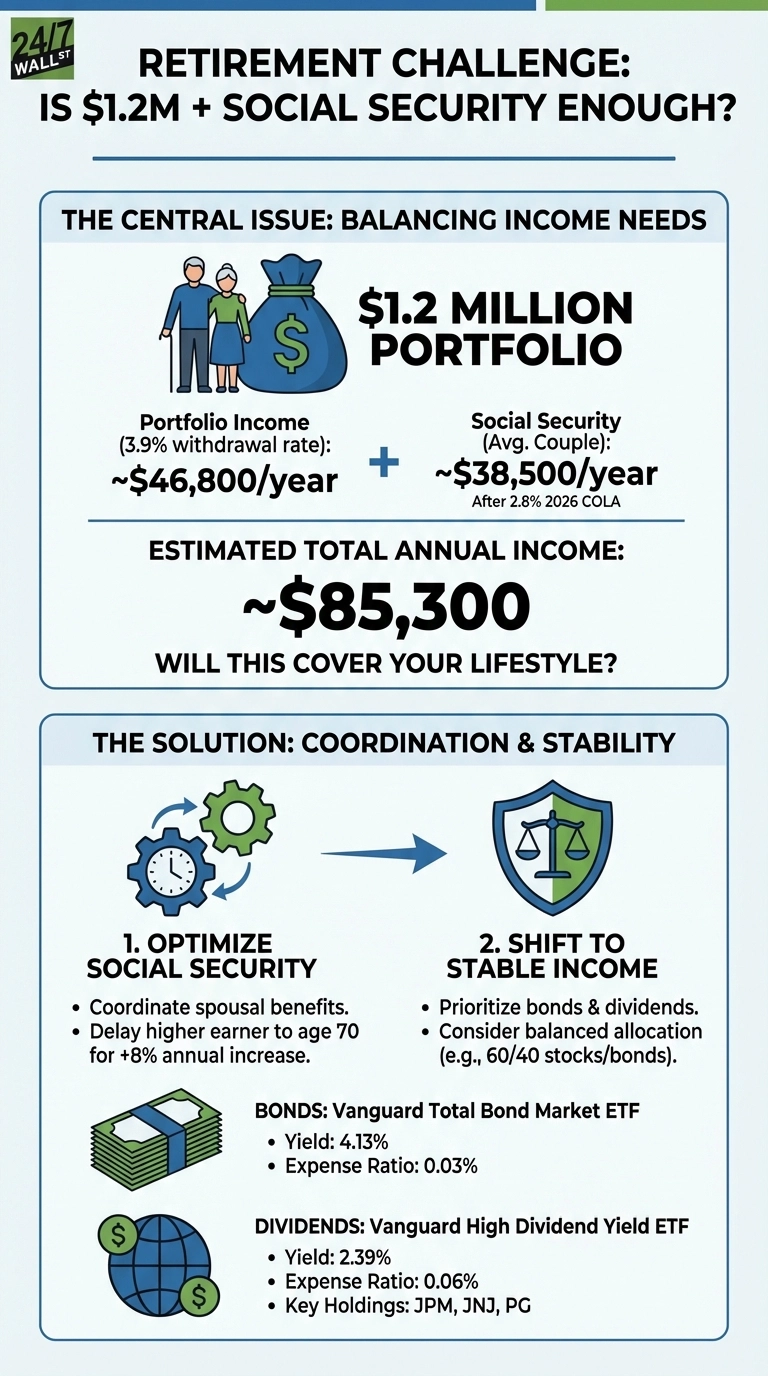
Morningstar’s 2025 State of Retirement Income research, published in December 2025, identifies 3.9% as the highest safe starting withdrawal rate for new retirees seeking consistent, inflation-adjusted spending over a 30-year retirement, assuming a 90% probability of success. That figure rose from 3.7% the prior year, reflecting improved capital markets assumptions. Applied to a $1.2 million portfolio, a 3.9% rate generates approximately $46,800 annually, or about $3,900 monthly from the portfolio alone.
Social Security adds substantial income for dual-earner couples. According to the SSA’s 2026 COLA fact sheet, the average aged couple receiving benefits collects approximately $3,208 monthly after the 2.8% cost-of-living adjustment, or roughly $38,500 annually. Combined with portfolio withdrawals, total annual income lands around $85,300, or about $7,100 monthly before taxes.
For couples with uneven earnings histories, spousal benefits become a meaningful lever. The lower-earning spouse can claim up to 50% of the higher earner’s full retirement age benefit, even when their own work record would produce a smaller payment. Coordinating this effectively can lift total household income well above what either spouse would receive independently.
Strategic Paths Worth Considering
Claiming sequence is one of the most consequential decisions a couple can make. When one spouse earned significantly more, delaying that benefit until age 70 while the lower earner claims earlier can maximize lifetime payouts for the household as a whole. Each year of delay past full retirement age adds 8% to the monthly benefit, a guaranteed, inflation-adjusted increase with no market risk attached.
Portfolio allocation should shift toward income and stability as withdrawals begin. Morningstar’s own research found that equity allocations of 30% to 50% support the highest safe withdrawal rates, since heavier stock weightings introduce sequence-of-returns risk that can erode a portfolio in the critical early years. A 60/40 stocks-to-bonds split falls within a reasonable range for couples seeking moderate growth alongside income. On the fixed-income side, Vanguard Total Bond Market ETF (NASDAQ:BND) yields approximately 3.9% with a 0.03% expense ratio. For dividend-focused equity exposure, Vanguard High Dividend Yield ETF (NYSEARCA:VYM) yields approximately 2.35% as of mid-2026, with Broadcom now its largest holding, followed by JPMorgan Chase, Johnson & Johnson, and Procter & Gamble among its prominent positions.
Tax planning deserves equal attention. Withdrawing from taxable accounts first, then tax-deferred accounts, and finally Roth accounts can minimize lifetime tax bills and preserve tax-free growth as long as possible. For couples with substantial traditional IRA or 401(k) balances, required minimum distributions starting at age 73 will force withdrawals whether needed or not, which can push income into higher brackets and complicate Medicare premium calculations.
What to Evaluate First
Request Social Security statements for both spouses to understand benefit amounts at different claiming ages. The gap between claiming at 62 versus waiting until 70 can exceed 75% for the higher earner. Running several coordinated scenarios across a 20-to-30-year retirement horizon will show how different sequences affect total household income and survivor income after one spouse passes.
Calculate actual spending needs rather than relying on percentage rules of thumb. The roughly $7,100 monthly income outlined above works comfortably for couples whose lifestyle costs $5,000 to $6,000 monthly, but falls short when ongoing expenses run to $8,000 or more. Healthcare costs before Medicare eligibility represent one of the largest variables: couples in their early 60s can face premiums and out-of-pocket costs of $1,500 to $2,000 monthly, an expense that disappears at 65 but must be funded from the portfolio in the interim.
Treat Social Security claiming as a joint household decision, not two separate ones. The choices interact directly through survivor benefits: when one spouse dies, the surviving partner receives the higher of the two monthly payments. Maximizing at least one benefit, even if the lower earner claims earlier for near-term cash flow, protects the surviving spouse’s income for the remainder of their life. That long-term insurance value is worth modeling carefully before either spouse files.
Editor’s note: This update corrects the attribution of Morningstar’s 3.9% safe withdrawal rate to their 2025 State of Retirement Income report (published December 2025), updates the Vanguard High Dividend Yield ETF yield to approximately 2.35% and the Vanguard Total Bond Market ETF yield to approximately 3.9% based on current data, and notes that Broadcom has become the largest VYM holding as of early 2026.
Contact [email protected] for any questions or corrections.
I am a long time investor and student of business, and believe finding good companies that can become great investments is the best game on earth. After 20 years of writing and researching the public markets it is clear that individuals have never had more tools and information to take control of their financial lives. From ETFs and $0 commissions to cryptos and prediction markets there has never been a greater democratization of access to investing.
I write to help people understand the investments available to them so they can make the best choice for their portfolio, whether they're starting out or looking for income in retirement.