





The artificial intelligence revolution is upon us, and plenty is bound to change in how we conduct ourselves in society. From work to play, the potential applications of AI are seemingly endless. The rise of large language models has driven a new paradigm around investing, and how investors think about the sort of exponential upside this trend can provide.
When most investors look to play surging AI demand, certain companies come to mind immediately. In the semiconductor sector, NVIDIA (NASDAQ:NVDA | NVDA Price Prediction) and its high-performance chips are integral to the rise of this technology. Data center stocks and companies building out AI applications and large language models, mostly big-tech names, are the other obvious candidates.
That said, there is a sector that could be more impactful for investors over the next five years. Here is why utilities stocks could ultimately be the biggest winners from this trade, relative to the likes of NVIDIA and other AI-related high flyers that currently have plenty of future growth priced into their valuations.
Power Is the Hard Constraint
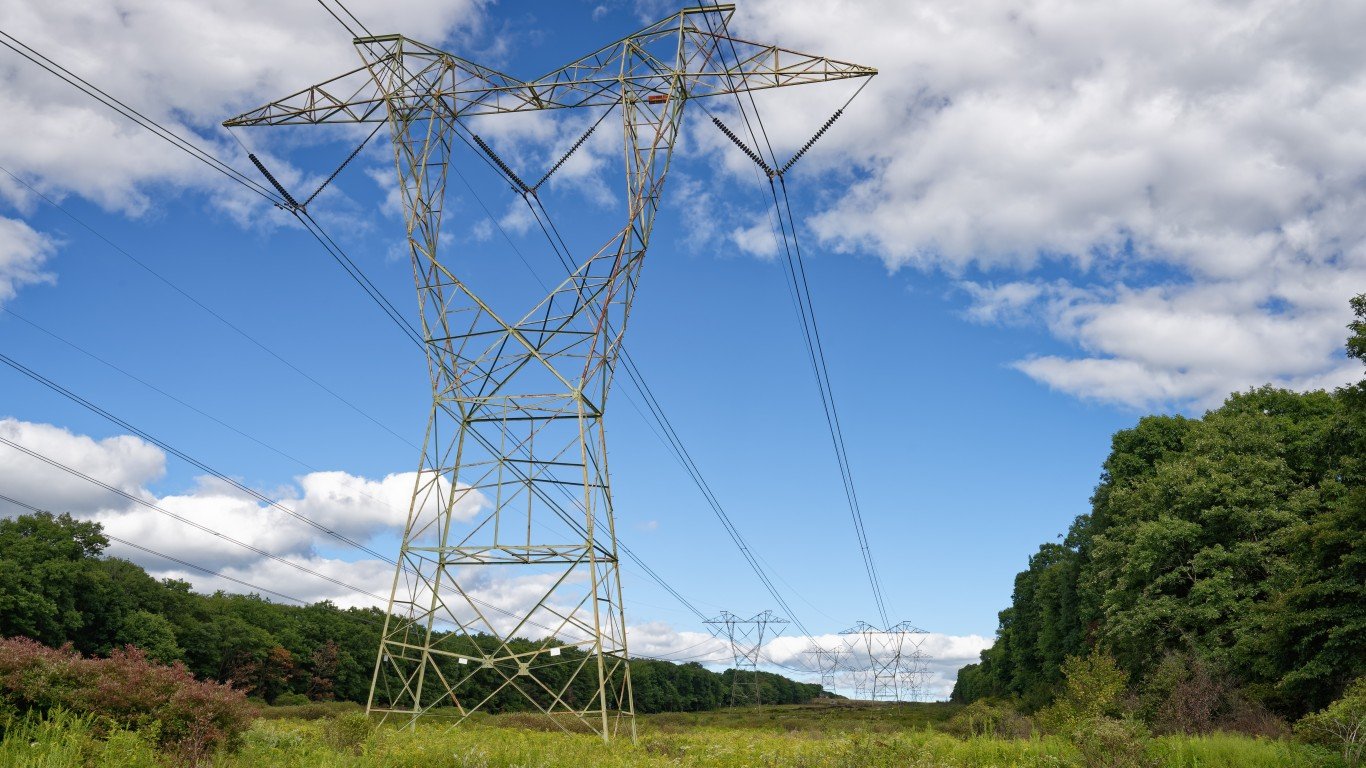
Transmission lines
To run any AI application, an LLM or otherwise, you need chips and data centers. That is well understood, and companies like NVIDIA and its peers have surged on the expectation that growth will remain robust and may even accelerate. The true bottleneck on AI’s growth rate boils down to power. Without electricity, chips and data centers are useless. Whether electricity comes from fossil fuels, renewables, or nuclear, there are plenty of utility stocks that look attractively priced given the scale of demand growth ahead.
The numbers make a compelling case. According to Goldman Sachs Commodities Research, U.S. data center power demand is forecast to climb from 31 GW in 2025 to 41 GW in 2026, then surge to 66 GW by 2027, more than double the current level, driven by an accelerating buildout of AI infrastructure. That trajectory, modeled on an assumed 70% capacity utilization rate and facility-level satellite data from Aterio, means data centers will account for 8.5% of total U.S. peak summer power demand by 2027, up from just 4.1% in 2025. The International Energy Agency projects that U.S. data center electricity consumption will grow roughly 130% from 2024 levels by 2030, with AI-focused accelerated servers expanding at 30% annually. Electricity demand from data centres globally soared 17% in 2025 alone, with AI-focused facilities climbing even faster, according to the IEA. Confirming the trend from a different angle, data centers were responsible for roughly half of all new U.S. electricity demand growth in 2025, according to the IEA’s Global Energy Review. That kind of trajectory is extraordinary by any measure.
A notable wrinkle in the power story is Big Tech’s push to secure firm power outside the traditional grid through direct nuclear partnerships. On May 6, 2026, NANO Nuclear Energy and Supermicro signed a non-binding memorandum of understanding to explore integrating NANO Nuclear’s KRONOS MMR microreactors, each designed to deliver around 15 megawatts of power, with Supermicro’s AI server and data center platforms. The collaboration targets on-site, grid-independent nuclear power for hyperscale and enterprise data centers. Over the longer term, deals like this could shift some demand away from centralized utility grids toward specialized small modular reactor players. For now, the scale of power need is so vast that broad utility infrastructure remains central to any realistic buildout scenario.
The Baseload Reality and the Gas Surge
Renewables remain the long-term goal, but the near-term reality is that Big Tech is leaning heavily on natural gas to fill the firm-power gap. According to company sustainability reports, Google’s emissions jumped nearly 50% over the first five years of its climate commitments, Amazon’s rose by 33%, Microsoft’s by more than 23%, and Meta’s by more than 60%. The cost to build a new combined cycle gas turbine power plant has itself risen 66% in the last two years, per BloombergNEF, yet demand for new gas generation keeps rising because the grid simply cannot wait for renewables to scale.
That dynamic creates a two-sided story for utilities. On one side, regulated utilities are being asked to plan and finance enormous new generation and transmission capacity. On the other, the regulatory framework is actively evolving to support that buildout. FERC issued Order 1920 in May 2024, the commission’s most significant action on transmission planning in more than a decade, requiring transmission providers to conduct long-term regional planning over a 20-year horizon and establishing new standards for cost allocation. Follow-up orders (1920-A in November 2024 and 1920-B in April 2025) have further refined the framework, giving state regulators a stronger voice and accelerating the process. That regulatory scaffolding reinforces the investment case for major transmission and generation players.
Adding further weight to the thesis: the four largest hyperscalers (Amazon, Google, Meta, and Microsoft) collectively plan to spend roughly $725 billion on capital expenditures in 2026, up approximately 77% from $410 billion in 2025. A substantial share of that goes directly to data center construction and power infrastructure. Every dollar spent on a new GPU cluster is, ultimately, a commitment to consume more electricity for years to come.
Evolving Economics Makes This Sector One to Watch for the Long Term

Red arrow heading higher, above three stacks of ascending coins
In practice, the limiting factor for AI capacity has already begun to shift from land and data center construction to megawatts and interconnection queues. That transition moves the scarcity from chips and racks to transmission and generation, directly benefiting utility companies operating at scale in the affected markets.
The valuation signal from the market is already apparent. According to Morningstar, the utilities sector’s average dividend yield has hit an all-time low of roughly 3%, a threshold that signals investors are pricing utilities more like growth stocks than traditional income plays. The Morningstar US Utilities Index was up 19% through late August 2025 and had surged 71% from its October 2023 low, including dividends. By April 2026, utilities had nearly doubled on a total return basis from that trough, marking the sector’s strongest two-year stretch in roughly two decades.
Data center growth is a direct and measurable catalyst at the utility level. American Electric Power signed customer commitments for 24 GW of new load by 2030 as of its July 2025 earnings call, with 18 GW of that total (75% of the committed pipeline) coming from data centers, backed by executed energy service agreements. That figure has since expanded dramatically: by its Q2 2026 earnings in late July, AEP reported total contracted load growth through 2030 had reached 69 GW, nearly three times the level from a year earlier, with hyperscalers, data centers, and industrial customers all signing on. CEO William Fehrman has described it as demand growth at a pace he has not seen in his 45-year energy career.
Why Utility Companies Could Outperform Large-Cap Chips and Data Center Stocks

Person holding a blue microchip in a lab
The core of this thesis is a valuation argument. Semiconductor giants already have years of expected growth reflected in their share prices. Utility companies, historically valued as low-growth, bond-like instruments, face a much lower bar to surprise on the upside. As power demand transforms from a slow-moving regulated commodity into a structurally scarce resource, the sector’s re-rating could prove substantial. With their median price-to-earnings ratio now hovering above 20, well above the sector’s long-run average of roughly 16, utilities are no longer trading as pure yield instruments. They are being priced for growth. That shift, if the power demand forecasts prove even partially correct, could define the sector’s story for the rest of the decade. Utilities stocks may become considerably less boring in the years ahead, and that is exactly where the opportunity lies.
Editor’s note: AEP’s contracted load growth figure was updated to 69 GW through 2030 as reported at its Q2 2026 earnings, up from 24 GW at the July 2025 call cited in the previous version. The NANO Nuclear/Supermicro MOU was updated to include the KRONOS MMR’s 15-megawatt design spec. IEA data was added showing global data center electricity demand soared 17% in 2025, with AI-focused facilities growing even faster.
Contact [email protected] for any questions or corrections.











 Top Gaining Stocks
 Top Losing Stocks