5 Natural Gas Dividend Stocks to Play Frigid Weather and Huge AI-Data Center Demand
These five natural gas stocks are well-positioned to benefit from huge demand driven by frigid winter weather and electricity use by data centers. Plus, all are dividend-paying leaders.


The artificial intelligence (AI) boom is driving a huge increase in electricity demand, particularly from data centers. That is expected to significantly increase natural gas consumption in the United States in the coming years. Natural gas is a highly positive resource, as it is reliable, scalable, and relatively cleaner than other fossil fuels. That makes it an effective means to meet this demand, especially since renewable energy sources like solar and wind face intermittency and weather challenges.
Based on recent Wall Street analyst reports and market insights, several natural gas stocks are well-positioned to benefit from the trend, given their roles in production, transportation, and infrastructure. Toss in the massive demand from consumers as frigid winter weather heads to the United States, and despite an enormous rally, natural gas could be poised to go even higher.
We screened our 24/7 Wall St. energy stock research database for companies with the largest presence in the natural gas industry. We also looked for companies that, while not involved in exploration and production, were integral players in the transportation and storage of natural gas. Five top companies hit our screens, and all are dividend-paying leaders in their respective areas of the sector. Plus, all are rated Buy by top Wall Street firms that we cover.
Cheniere Energy
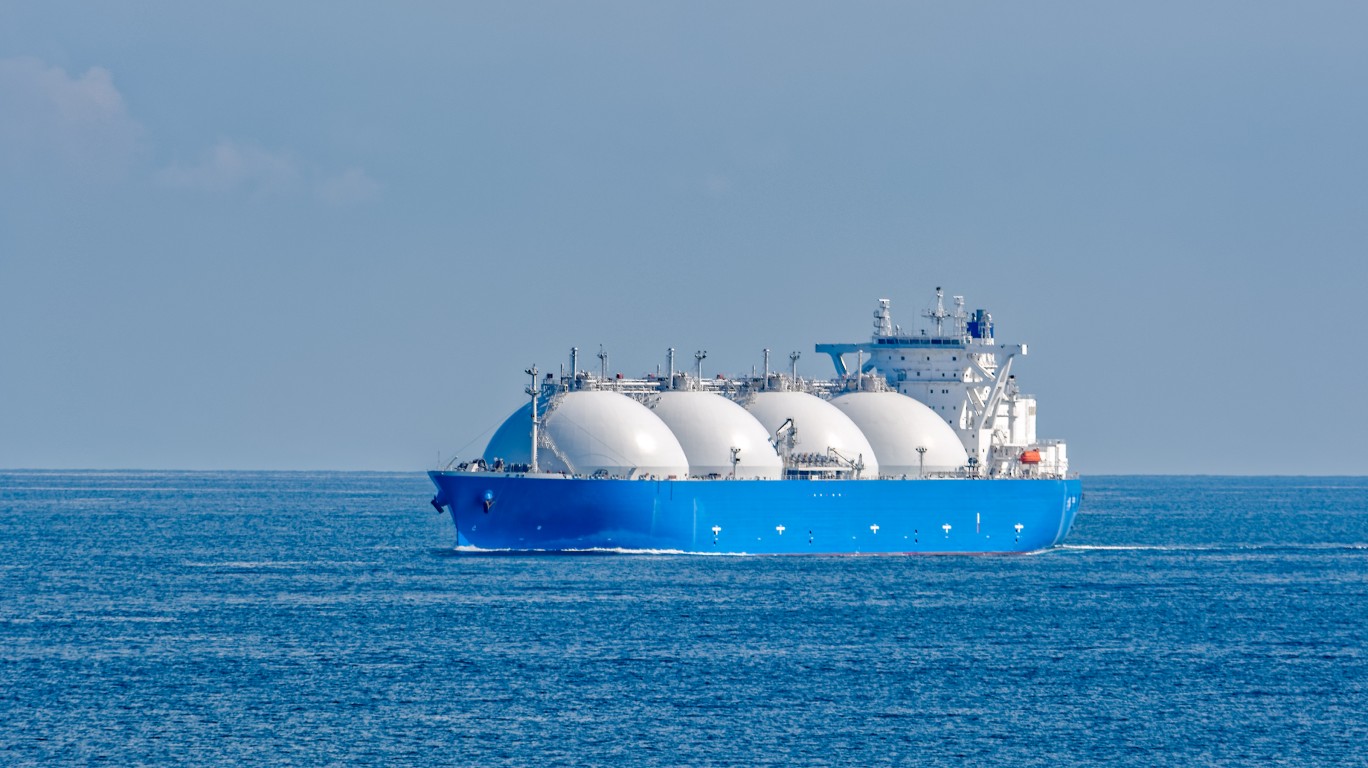
As the leading U.S. liquefied natural gas (LNG) exporter, and with a small 0.99% dividend, Cheniere Energy Inc. (NYSE: LNG | LNG Price Prediction) is positioned to benefit from both domestic AI-driven demand and international energy needs. Natural gas accounts for 43% of U.S. electricity production. So, Cheniere’s ability to scale operations quickly makes it a key player. The company’s export capabilities also provide a hedge against fluctuations in the domestic market. Some across Wall Street feel electricity demand growth could rise as much as 160% by 2030.
Cheniere Energy is a producer and exporter of LNG in the United States. The company provides clean and secure LNG to integrated energy companies, utilities, and energy trading companies worldwide. The company operates two natural gas liquefaction and export facilities.
The Sabine Pass LNG Terminal at Sabine Pass, Louisiana, features natural gas liquefaction facilities comprising six operational trains, and it has a total production capacity of approximately 30 million tons per annum (mtpa) of LNG.
The Corpus Christi LNG Terminal near Corpus Christi, Texas, consists of three trains for a total production capacity of approximately 15 mtpa of LNG, three LNG storage tanks, and two marine berths. It also owns and operates a 94-mile natural gas supply pipeline that interconnects the Sabine Pass LNG Terminal with several large interstate and intrastate pipelines.
Bank of America has a Buy rating with a $271 target price.
EQT
This top company is one of the largest U.S. natural gas producers, particularly in the Appalachian Basin, and is noted for being a low-cost producer. EQT Corporation (NYSE: EQT) has a 1.25% dividend. It is a premier, vertically integrated American natural gas company with production and midstream operations. The company has operations in Pennsylvania, West Virginia, and Ohio.
Its strategic location in the Southeast, especially near data center hubs in northern Virginia, makes it a key supplier for AI-driven energy needs. EQT has secured agreements to supply natural gas to major data center campuses, such as the redevelopment of a former coal plant in Homer City, Pennsylvania, into a natural gas-powered data center.
EQT owns or leases approximately 610,000 net acres in Pennsylvania. Most of the acreage is located in the southwestern region of the state, with the majority located in Greene and Washington Counties. The company is developing the Marcellus Shale and Upper Devonian Shale in this area. It also owns or leases 405,000 net acres in West Virginia. Most of the acreage is located in the northwestern region of the state, with the majority located in Doddridge, Marion, Tyler, and Wetzel Counties.
It owns or leases 65,000 net acres in eastern Ohio and is developing the Utica Shale in Belmont County. It operates Utica wells throughout its Ohio acreage. The Marcellus Shale lies nearly a mile or more beneath the surface throughout much of Ohio, Pennsylvania, New York, and West Virginia.
One of our top 24/7 Wall St. writers conducted a thorough review of EQT and explained in depth why the stock is a massive buy now.
UBS has a Buy rating and a $76 target price.
Kinder Morgan
Kinder Morgan Inc. (NYSE: KMI) is one of North America’s largest energy infrastructure companies, and it has a solid 4.17% dividend. This top energy stock remains a favorite on Wall Street for paying a solid and dependable dividend.
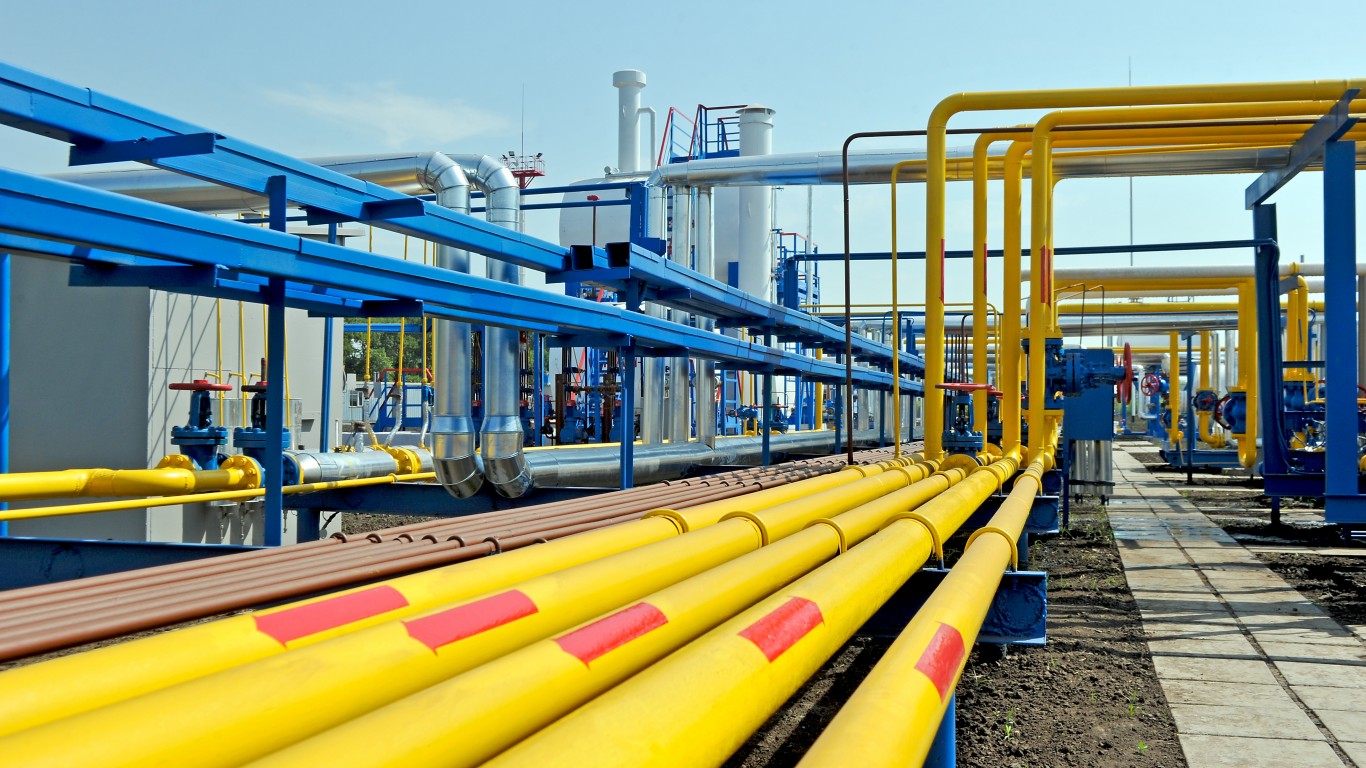
The company operates the largest natural gas transmission network in the United States, with about 66,000 miles of pipeline that transport 40% of the country’s gas production. It serves 20% of U.S. power demand, positioning it to benefit from the projected 15% to 20% of electricity demand from AI data centers by 2030. The company’s extensive gas storage capacity (15% of U.S. total) and fee-based revenue model provide stability and growth potential as gas volumes rise. Kinder Morgan operates through four segments.
The Natural Gas Pipelines segment owns and operates:
- Interstate and intrastate natural gas pipeline and underground storage systems
- Natural gas gathering systems and natural gas processing and treating facilities
- Natural gas liquids fractionation facilities and transportation systems
- Liquefied natural gas liquefaction and storage facilities
The Products Pipelines segment owns and operates refined petroleum products, crude oil, and condensate pipelines, associated product terminals, and petroleum OKE pipeline transmission facilities.
The Terminals segment owns and operates liquids and bulk terminals that store and handle various commodities, including:
- Gasoline
- Diesel fuel
- Chemicals
- Ethanol
- Metals
- Petroleum coke
It also owns tankers.
Lastly, the CO2 segment produces, transports, and markets CO2 to recover and produce crude oil from mature oil fields. It owns interests in/or operates oil fields, gasoline processing plants, and a natural oil pipeline system in West Texas. It holds and runs approximately 83,000 miles of pipelines and 144 terminals.
UBS has a Buy rating on the shares, as well as a $38 target price.
Energy Transfer
This is one of North America’s largest and most diversified midstream energy companies, and it offers a big 7.58% dividend yield. Energy Transfer L.P. (NYSE: ET) owns and operates one of the largest and most diversified portfolios of energy assets in the United States. It has a strategic footprint across all major domestic production basins. This top master limited partnership is a safe option for investors seeking energy exposure and income.
Energy Transfer operates nearly 107,000 miles of natural gas pipelines and 235 billion cubic feet of storage capacity. Its strong presence in Texas, particularly in the Permian Basin, gives it access to some of the country’s cheapest natural gas. The company is receiving significant inquiries for pipeline projects to serve power plants (45 plants across 11 states) and data centers (over 40 prospective projects). Potential demand exceeds 5 billion cubic feet per day for power plants. For data centers, demand exceeds 3 billion cubic feet per day.
The company is a publicly traded limited partnership with core operations that include:
- Complementary natural gas midstream, intrastate, and interstate transportation and storage assets
- Crude oil, natural gas liquids (NGL), and refined product transportation and terminalling assets
- NGL fractionation
- Various acquisition and marketing assets
Following the acquisition of Enable Partners in December 2021, Energy Transfer owns and operates over 114,000 miles of pipelines and related assets in 41 states, spanning all major U.S. producing regions and markets. This further solidifies its leadership position in the midstream sector.
Through its ownership of Energy Transfer Operating, formerly known as Energy Transfer Partners, the company also owns Lake Charles LNG Company; the general partner interests, the incentive distribution rights, and 28.5 million standard units of Sunoco L.P. (NYSE: SUN); and the public partner interests and 39.7 million standard units of USA Compression Partners L.P. (NYSE: USAC).
Barclays has a Buy rating with a $22 price target.
Exxon Mobil
Exxon Mobil Corp. (NYSE: XOM) manages an industry-leading portfolio of resources. It is one of the world’s largest integrated fuels, lubricants, and chemical companies. The decline in oil prices presents investors with an excellent entry point, and they will likely seize a strong 3.07% dividend yield. Exxon is the world’s largest international integrated oil and gas company. It explores for and produces crude oil and natural gas in North and South America, Europe, Africa, Asia, and elsewhere.
As a major natural gas producer, Exxon benefits from its 43% share of U.S. electricity generation from natural gas. Its scale and ability to ramp up production quickly make it a strong contender. However, its broader focus on oil may dilute its AI-specific upside compared to pure-play natural gas companies.
Exxon also manufactures and markets commodity petrochemicals, including olefins, aromatics, polyethylene, and polypropylene plastics, as well as specialty products. Additionally, the company transports and sells crude oil, natural gas, and petroleum products.
Top Wall Street analysts expect the company to remain a key beneficiary in a higher oil price environment, and most remain optimistic about the company’s sharp positive inflection in capital allocation strategy.
Upstream portfolio and leverage to a further demand recovery. ExxonMobil offers greater Downstream/Chemicals exposure than its peers.
Exxon completed its purchase of oil shale giant Pioneer Natural Resources in 2024 with an all-stock transaction valued at $59.5 billion. The deal created the largest U.S. oilfield producer and guarantees a decade of low-cost production.
Piper Sandler has an Overweight rating with a $142 target price.
Oil Is Surging Over $60: Grab These Large Cap High-Yield Dividend Energy Giants Now
Contact [email protected] for any questions or corrections.
Lee Jackson has covered Wall Street analysts' equity and debt research and equity strategy daily for 24/7 Wall St. since 2012. His broad, diverse career, including a stint as creative services director at an NBC affiliate in Austin, Texas, gives him unique insight into the financial industry.
Lee Jackson's journey in the financial industry spans more than 30 years, including nearly two decades as an institutional equity salesperson at Bear Stearns, Lehman Brothers, and Morgan Stanley. His career spanned pivotal sell-side Wall Street events, from the dot-com rise and bubble to the Long-Term Capital Management debacle, 9/11, and the Great Recession of 2008. This reflects his resilience and adaptability amid market volatility.
Lee Jackson’s practical financial industry experience, gained through a career at some of the biggest banks and brokerage firms, is complemented by a lifetime of writing across various platforms. This unique combination allows him to shed light on the intricacies of Wall Street in a way only someone with deep insider experience and knowledge can. Moreover, his extensive network across Wall Street continues to provide direct access for him and 24/7 Wall St., a privilege few firms enjoy.
Since 2012, Jackson’s work for 24/7 Wall St. has been featured in Barron’s, Yahoo Finance, MarketWatch, Business Insider, TradingView, Real Money, The Street, Seeking Alpha, Benzinga, and other media outlets. He attended the prestigious Cranbrook Schools in Bloomfield Hills, Michigan, and has a degree in broadcasting from the Specs Howard School of Media Arts.