Fact: Working Two More Years Could Add $200,000 to A 68-Year-Old’s Retirement
At 68 with strong savings, the question isn't whether you can retire but whether you should. This crossroads involves balancing financial security, personal fulfillment, and the reality that working years are finite. Understanding the Situation Age: 68 years old Financial…


At 68 with strong savings, the question isn’t whether you can retire but whether you should. This crossroads involves balancing financial security, personal fulfillment, and the reality that working years are finite.
Understanding the Situation
- Age: 68 years old
- Financial Position: Strong savings accumulated
- Key Question: When to stop working
- Core Tension: Desire for retirement vs. financial certainty and purpose
At 68, you are past full retirement age for Social Security, which is 67 for anyone born in 1960 or later. Each additional year of work generates delayed retirement credits worth 8% annually until age 70, potentially adding hundreds of dollars to your monthly benefit for life. Meanwhile, your portfolio continues to grow and you push back the start of withdrawals that may need to last 20 to 30 years.
The Critical Financial Calculation
The key tension is sustainable income versus longevity risk. With strong savings, you likely have enough to retire today, but the real question is whether your portfolio can generate reliable income without depleting principal across a retirement that could span three decades.
A diversified portfolio following the traditional 4% withdrawal rule generates $40,000 annually from a $1 million nest egg. Morningstar’s 2025 State of Retirement Income report, however, puts the baseline safe starting withdrawal rate at 3.9% for retirees seeking consistent inflation-adjusted spending over a 30-year horizon, up slightly from 3.7% in the prior year’s research as capital markets assumptions improved. On the equity side, the S&P 500 returned roughly 16% in price terms during 2025 (about 17% with dividends reinvested). Bonds recovered as well: the aggregate bond market posted a total return of approximately 7% in 2025, reversing several years of rate-driven losses.
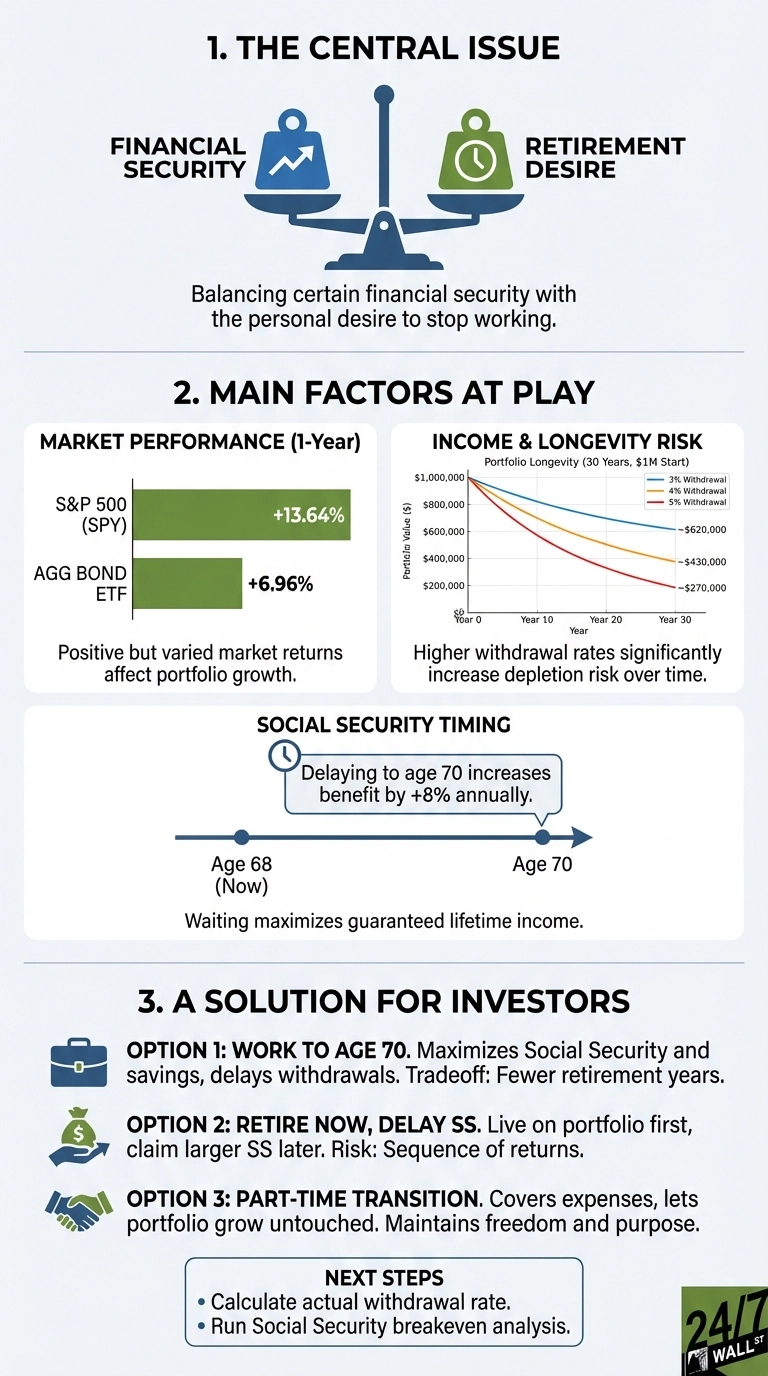
Working one or two more years creates a substantial buffer. If you earn $75,000 annually and save half while covering expenses with the rest, that is $37,500 less withdrawn from savings, plus continued portfolio growth on top of that. Over two years, this combination of avoided withdrawals and compounding gains could add $150,000 to $200,000 in total financial cushion.
Social Security timing matters significantly here. If you haven’t claimed yet, waiting until 70 maximizes your benefit. For someone with a $2,500 monthly benefit at full retirement age, delaying all the way to 70 increases it to roughly $3,100, an extra $7,200 per year for life. Because cost-of-living adjustments are applied to the full benefit amount, that gap between an early and a delayed claim actually widens over time.
Strategic Paths Forward
Option 1: Work Two More Years to Age 70. This maximizes Social Security, adds to savings, and delays portfolio withdrawals. It works best for those who find purpose in their work and are in good health. The tradeoff is two fewer years in retirement.
Option 2: Retire Now, Delay Social Security. Stop working immediately but draw on portfolio assets until 70, then claim the maximum Social Security benefit. This works if your savings can sustain a higher initial withdrawal rate (potentially 5% to 6%) for two years before the guaranteed income kicks in. The primary risk is sequence-of-returns: a steep market decline in the first year or two of retirement can permanently compromise a plan that depends on early portfolio draws.
Option 3: Transition to Part-Time Work. Reduce to part-time or consulting work that covers basic living expenses while your portfolio grows untouched. This approach maintains some earned income, delays full portfolio dependence, and preserves a sense of routine and purpose without the full demands of a career.
What to Do Next
Calculate your actual withdrawal rate. Divide your expected annual expenses by your total portfolio value. If the result is above 4%, you need either more savings, lower expenses, or continued income to make the math work comfortably.
Run a Social Security breakeven analysis. Visit ssa.gov to see your estimated benefits at different claiming ages. For most people in good health with family longevity, delaying to 70 produces more lifetime income, with the breakeven point typically falling in the late 70s to early 80s.
Avoid working purely out of fear. If your numbers work and you are staying employed only because stopping feels risky, you are trading guaranteed time for theoretical security. Strong savings exist to be used. The goal of this kind of planning is to retire with confidence, not just with enough.
The best choice depends on your health, your relationship with work, and whether your savings can realistically support your lifestyle for 25 to 30 years. No single formula applies to everyone, but getting the math right first removes the fear from the decision.
Editor’s note: This article corrects the previously cited AGG bond ETF return figure, which was listed as a loss of 2.5%; the fund posted a total return of approximately 7% in full-year 2025. The Morningstar safe withdrawal rate context was also updated to reflect that the 3.9% figure for 2026 retirees represents a slight increase from the prior year’s 3.7% baseline, driven by improved capital markets assumptions.
Contact [email protected] for any questions or corrections.
I am a long time investor and student of business, and believe finding good companies that can become great investments is the best game on earth. After 20 years of writing and researching the public markets it is clear that individuals have never had more tools and information to take control of their financial lives. From ETFs and $0 commissions to cryptos and prediction markets there has never been a greater democratization of access to investing.
I write to help people understand the investments available to them so they can make the best choice for their portfolio, whether they're starting out or looking for income in retirement.