




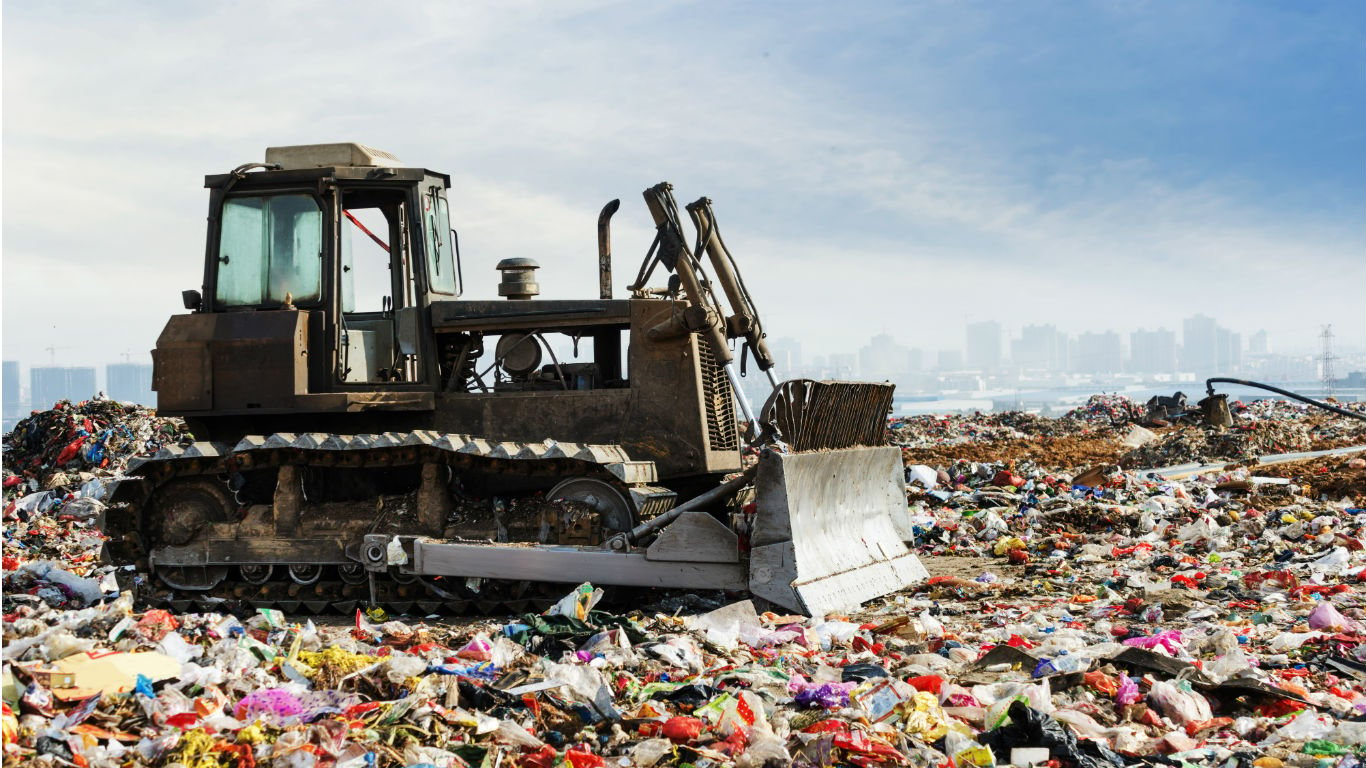
Nobody wants a landfill in their backyard, which is exactly why the companies that own them print money. The waste management industry is an oligopoly disguised as a utility. Garbage never stops, permits for new landfills are nearly impossible to obtain, and the handful of players controlling North America’s disposal infrastructure enjoy pricing power that makes telecom companies jealous. These stocks compound predictably through recessions, inflation cycles, and regulatory shifts.
5. GFL Environmental Holdings (NYSE:GFL)
GFL Environmental Holdings (NYSE:GFL) is the roll-up story. The Canadian giant went public in 2020 backed by private equity and has been aggressively acquiring smaller haulers across North America. Revenue hit $8.2 billion over the trailing twelve months with 9% year-over-year growth in Q3 2025. The company operates beyond basic trash collection, offering soil remediation, liquid waste services, and infrastructure support.
The challenge is execution. GFL trades at 261x trailing earnings despite a more reasonable 53x forward multiple. Operating margins sit at 10.5%, well below peers, and return on equity is just 1.6%. The levered balance sheet amplifies both upside and downside. Institutional ownership at 99.7% shows sophisticated money believes in the consolidation thesis. GFL is the highest-risk, highest-potential-reward play in the sector if management can integrate acquisitions and improve profitability.
4. Casella Waste Systems (NASDAQ:CWST)
Casella Waste Systems (NASDAQ:CWST) is the regional specialist. Focused on the Northeast US, the company generated $1.8 billion in trailing revenue with 17.9% year-over-year growth in Q3 2025. At $6.7 billion in market cap, it’s the smallest player here but growing faster than anyone. Quarterly earnings jumped 60% year-over-year, demonstrating operational leverage as the company scales.
The valuation is extreme. Casella trades at 441x trailing earnings, though the forward multiple of 106x suggests near-term improvement. Operating margins of 7% and profit margins under 1% show the company is still in development mode, investing heavily in route density and landfill capacity. President Edmond Coletta sold 7,000 shares at $100.07 in December, while CFO Bradford Helgeson sold 262 shares at $87.65 in November. The stock is up 8% year-to-date through January 23, 2026, but flat over the past year. Casella offers growth potential if consolidation in fragmented northeastern markets drives margin expansion.
3. Waste Connections (NYSE:WCN)
Waste Connections (NYSE:WCN) targets secondary and tertiary cities where it can operate without head-to-head competition from larger rivals. Revenue reached $9.4 billion with 19.3% operating margins. The Canadian-based company serves both US and Canadian markets, providing geographic diversification.
WCN trades at 71x trailing earnings despite earnings declining 6.7% year-over-year in Q3 2025. The forward multiple of 22x suggests the market expects a sharp rebound. Return on equity of 7.6% is modest for a company commanding this valuation. Dividends have grown consistently, with the quarterly payout increasing from $0.315 to $0.35 in late 2025, representing 11% growth. Four senior operations executives purchased shares at $166.59 on December 31, 2025, offset by significant selling, including 9,000 shares by Director Edward Guillet at $174.44 in October. The stock is down 4.4% over the past year. WCN’s exclusive markets provide a moat, but the valuation assumes flawless execution.
2. Republic Services (NYSE:RSG)
Republic Services (NYSE:RSG) is the disciplined operator. With $16.5 billion in trailing revenue and $67.9 billion in market cap, it’s the clear number two behind Waste Management. Operating margins of 19.9% and profit margins of 12.8% exceed larger rival WM. The company’s RISE digital platform generated $60 million in incremental revenue in its first year by identifying overfilled containers and recycling contamination through route cameras.
Republic is investing heavily in sustainability. Seven new renewable natural gas projects are expected online in 2025, contributing $70 million in incremental revenue and $35 million in EBITDA. The company operates 52 electric collection vehicles with plans to exceed 150 by year-end 2025. Management raised dividends from $0.58 to $0.625 per quarter in late 2025, marking 7.8% growth. The stock is up 3.6% over the past year and 3% year-to-date through January 23, 2026. Insider activity in January 2026 showed coordinated equity grants across the C-suite. Republic trades at 32x earnings with an analyst target of $244.21, offering steady compounding without WM’s premium.
1. Waste Management (NYSE:WM)
Waste Management (NYSE:WM) is the undisputed king. With $92.4 billion in market cap and $24.8 billion in trailing revenue, it owns over 250 landfills across North America. These are irreplaceable assets. Building new landfills near population centers is functionally impossible due to permitting opposition, giving existing operators monopoly-like pricing power. WM’s landfill volumes grew 5.2% in Q3 2025 with 6.7% pricing on municipal solid waste.
The company achieved record 38.4% operating EBITDA margins in its collection and disposal business during Q3 2025, with the legacy WM operation hitting 32% margins for the first time in company history. Management expects free cash flow approaching $3.8 billion in 2026 as sustainability investments wind down and fleet capital normalizes. Return on equity sits at 29.3%, far exceeding peers. WM pays $3.30 annually in dividends with over 10 consecutive years of increases, validating its Dividend Aristocrat status. The stock is up 10.7% over the past year and 4.3% year-to-date through January 23, 2026.
Renewable natural gas production doubled in the first nine months of 2025, with 45% of 2026 offtake presold. Recycling EBITDA grew 18% despite commodity prices falling 35%, proving automation investments are working. WM trades at 36x trailing earnings with a forward multiple of 27x. CFO David Reed acquired 2,628 shares and Director Sean Menke purchased 2,000 shares at $196.42 in November 2025.
The Landfill Advantage
Waste management isn’t sexy, but it’s structurally advantaged. Landfill scarcity creates pricing power. Essential service revenue streams survive recessions. Inflation-linked contracts provide automatic raises. The top three players control the game, and all five companies here benefit from ongoing consolidation of fragmented local haulers. Waste Management leads with irreplaceable assets and execution. Republic offers similar quality at a lower multiple. The others provide growth angles with corresponding risks.














 Top Gaining Stocks
 Top Losing Stocks