An AI ETF Soared 28% And Left QQQ In The Dust
Investors seeking dedicated AI exposure face a structural problem: the biggest AI beneficiaries aren’t always the household names dominating broad tech indexes. iShares Future AI & Tech ETF (NYSEARCA:ARTY) addresses this by constructing a portfolio around the full AI infrastructure…


Investors seeking dedicated AI exposure face a structural problem: the biggest AI beneficiaries aren’t always the household names dominating broad tech indexes. iShares Future AI & Tech ETF (NYSEARCA:ARTY) addresses this by constructing a portfolio around the full AI infrastructure stack, from memory chips to data platforms to power infrastructure, rather than simply reweighting toward mega-cap software names.
What ARTY Is Built to Do
ARTY targets thematic growth exposure, specifically companies enabling or benefiting from AI infrastructure buildout. With a 0.09% dividend yield, this is not an income vehicle. The fund is oriented toward price appreciation rather than income generation.
What distinguishes ARTY from a simple tech index is its global construction and tilt toward enablers over end-users. Top holdings include Micron, NVIDIA, AMD, SK Hynix, Marvell Technology, and Broadcom, all semiconductor or chip-adjacent names supplying the compute and memory AI systems require. International names like South Korea’s Naver, Japan’s Advantest, and France’s Schneider Electric add geographic breadth that Invesco QQQ Trust (NASDAQ:QQQ) doesn’t offer. Information Technology accounts for 59.7% of the fund, with the remainder spread across utilities, industrials, and real estate through power infrastructure plays like Constellation Energy.
Does It Deliver?
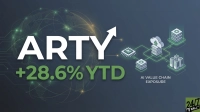
Over the past year, ARTY has meaningfully outpaced both major benchmarks. ARTY returned 28.3% over the trailing 12 months, compared to 14.3% for QQQ and 13.7% for SPDR S&P 500 ETF Trust (NYSEARCA:SPY), a meaningful premium for investors who specifically wanted AI infrastructure exposure.
The five-year picture tells a different story. ARTY gained just 8.7% over five years while QQQ returned 85.6%. That gap reflects the 2022 tech selloff and ARTY’s concentration in hardware-heavy names that bore the brunt of rate sensitivity and inventory cycles.
The Tradeoffs
Concentration amplifies volatility. With nearly 60% in a single sector and the top 10 holdings representing roughly 40% of the fund, drawdowns during tech selloffs can be severe. ARTY is down 4.3% over the past month versus a 3.4% decline for QQQ, consistent with its higher-beta, hardware-tilted composition.
Thematic timing risk is real. ARTY’s five-year lag behind QQQ shows that even a correct long-term thesis can punish investors through adverse cycles. Hardware and semiconductor names are cyclical, and AI infrastructure buildout could experience pause periods that weigh heavily on a concentrated fund.
Currency and geopolitical exposure add complexity. Holdings across South Korea, Japan, France, and Taiwan introduce foreign exchange and supply-chain geopolitical risk that a domestic tech ETF avoids entirely.
ARTY is structured as a targeted growth vehicle focused on AI infrastructure, carrying hardware cyclicality and global concentration risk that differs from the mega-cap tech names already embedded in most broad index funds. Investors researching thematic AI exposure can weigh those tradeoffs against their own risk profiles and time horizons.
Contact [email protected] for any questions or corrections.
I am a long time investor and student of business, and believe finding good companies that can become great investments is the best game on earth. After 20 years of writing and researching the public markets it is clear that individuals have never had more tools and information to take control of their financial lives. From ETFs and $0 commissions to cryptos and prediction markets there has never been a greater democratization of access to investing.
I write to help people understand the investments available to them so they can make the best choice for their portfolio, whether they're starting out or looking for income in retirement.