




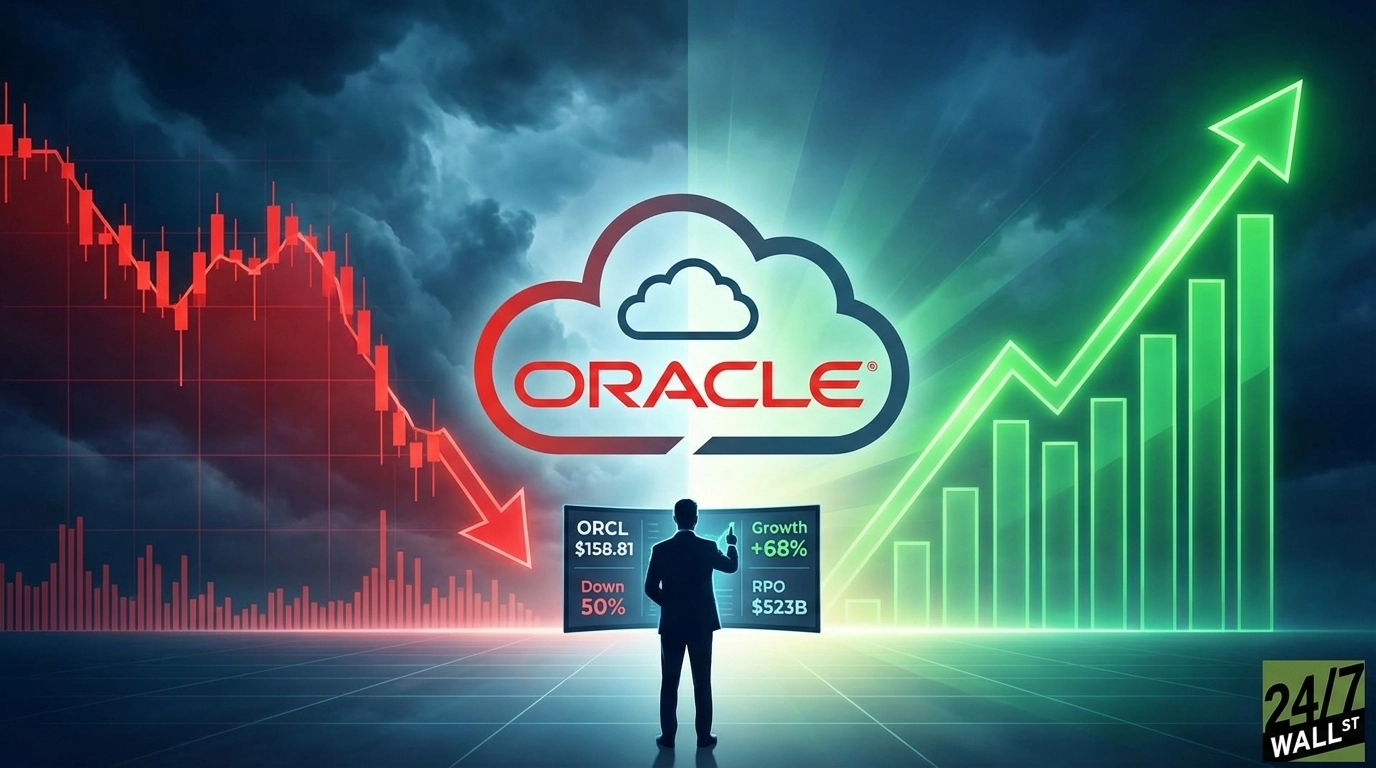
Oracle (NYSE:ORCL) has had a brutal run since its moment in the AI spotlight. But Jefferies analyst Brent Thill isn’t running away from it. He just reiterated his Buy rating on the stock, and while he trimmed his price target, his core thesis is actually getting stronger.
Here’s the tension worth understanding: the stock is down sharply, the fundamentals are accelerating, and almost nobody on Wall Street is paying attention.
The Setup
Thill lowered his price target to $320 from $400, but that’s not the headline. The headline is his framing of where Oracle sits right now. “The stock is down 50% from when they announced the OpenAI transaction. And we think ultimately Oracle is in a better, better spot. It’s one of the few accelerating growth stories in our sector.”
That’s a striking claim when you look at the price action. Oracle hit $308.70 at the time of its Q1 FY2026 filing in September 2025, and it’s trading around $158.81 as of March 6, 2026. The stock is down about 34% from that September filing date and roughly 18% year to date in 2026. Thill’s 50% figure reflects the drop from the peak surrounding the OpenAI announcement itself.
The Fundamentals Tell a Different Story
While the stock has cratered, the underlying cloud business is doing the opposite. Oracle’s infrastructure cloud revenue has been on a straight-line acceleration: up 49% in Q3 FY2025, 52% in Q4, 55% in Q1 FY2026, and 68% in Q2 FY2026. That’s not a company slowing down.
The more telling number is the Remaining Performance Obligations, which represent contracted future revenue. RPO jumped from $130 billion in Q3 FY2025 to $523 billion in Q2 FY2026, a surge of 438% year over year. That’s not a backlog. That’s a pipeline that most cloud companies would trade their entire market cap for.
The Valuation Math
Thill’s bull case rests on earnings power. He sees Oracle reaching $16 to $20 in earnings per share, and at a 20x multiple, that implies a range of roughly $300 to $400 per share. At today’s price, Thill sees a significant gap between market pricing and his earnings estimates.
Why Is Everyone Bearish?
Thill has been meeting with institutional investors across Europe, and the picture he paints is stark. Only 1 or 2 out of every 100 institutional investors he met are currently long software. He describes the environment as a “software apocalypse” in terms of sentiment.
With Q3 FY2026 earnings scheduled for March 10, 2026, Oracle has a near-term chance to prove the skeptics wrong. If the growth acceleration continues and RPO keeps climbing, the gap between what the market is pricing and what Thill sees as the earnings reality could close fast. Thill describes this as a contrarian setup – sentiment at an extreme, the stock beaten down, and fundamentals moving in the right direction.









 Top Gaining Stocks

 Top Losing Stocks