Live coverage has ended. The full story is below.
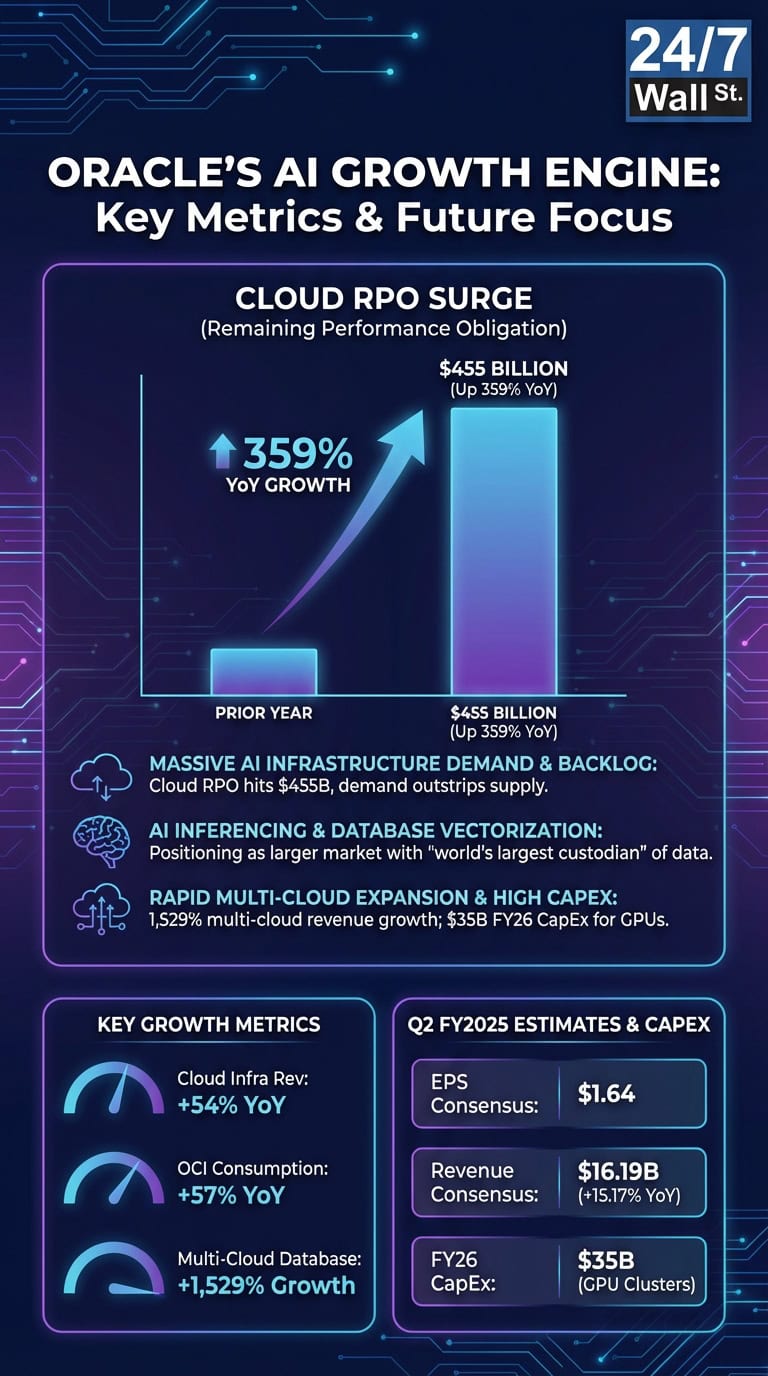
Oracle (Nasdaq: ORCL | ORCL Price Prediction) reports earnings after the close with perhaps the strongest AI narrative in enterprise software. The company has become a central infrastructure provider for the world’s largest AI model builders, with Larry Ellison and Safra Catz positioning Oracle as both a hyperscale cloud challenger and the de facto enterprise data backbone for the emerging AI inferencing economy. Last quarter’s results highlighted the step-change in demand: cloud RPO surged to $455 billion, up 359% year over year, signaling years of locked-in capacity growth and validating Oracle’s strategy to embed OCI across hyperscalers and enterprise data centers.
What to Expect
Estimates Snapshot
Current Quarter (Nov 2025) Consensus
- EPS: $1.64
- Revenue: $16.19B
- YoY Sales Growth: 15.17%
Next Quarter (Feb 2026) Consensus
- EPS: $1.72
- Revenue: $16.86B
FY2026 Consensus
- EPS: $6.82
- Revenue: $66.98B
FY2027 Consensus
- EPS: $8.00
- Revenue: $83.57B
Analysts expect steady double-digit sales growth and accelerating operating leverage as the AI mix increases.
Key Areas to Watch
1. AI Infrastructure Demand and Backlog Conversion- Catz highlighted that cloud RPO reached $455B, up 359% YoY, with cloud infrastructure revenue rising 54% and OCI consumption up 57%. Demand “continues to dramatically outstrip supply,” and Oracle expects additional multibillion-dollar customers ahead. The market wants clarity on how fast this backlog converts to revenue and how quickly new data halls come online.
2. AI Inferencing as Oracle’s Largest Future Market- Ellison stated directly that inferencing will be “much, much larger than the AI training market” and that Oracle is uniquely positioned due to its role as the “world’s largest custodian of high-value private enterprise data.” The introduction of the Oracle AI Database, enabling vectorization of all enterprise data, may be a major multi-year catalyst if adoption ramps quickly.
3. Multi-Cloud Database and Embedded Regions- Multi-cloud database revenue grew 1,529% last quarter, with 34 embedded regions already live inside Azure, AWS, and GCP and another 37 to come. Investors are watching whether multi-cloud accelerates OCI into enterprise workloads faster and drives database migrations long delayed by customers.
4. CapEx Intensity Versus Margin Trajectory- Oracle now expects FY26 CapEx of $35B, driven by rapid GPU cluster deployment. While this weighs on near-term free cash flow, both Catz and Ellison emphasized exceptionally fast customer acceptance and revenue activation, sometimes within a week. Investors will look for confirmation that margins can expand despite scale-up costs.
5. AI Application Generation and Suite-Level Integration- Ellison revealed that Oracle is now generating entire applications with AI and positioning its suites as deeply integrated, AI-native systems. This could build a competitive moat against pure-play SaaS vendors whose architectures lack database-level vectorization. Any update on ERP/HCM momentum could impact sentiment.
Contact [email protected] for any questions or corrections.