




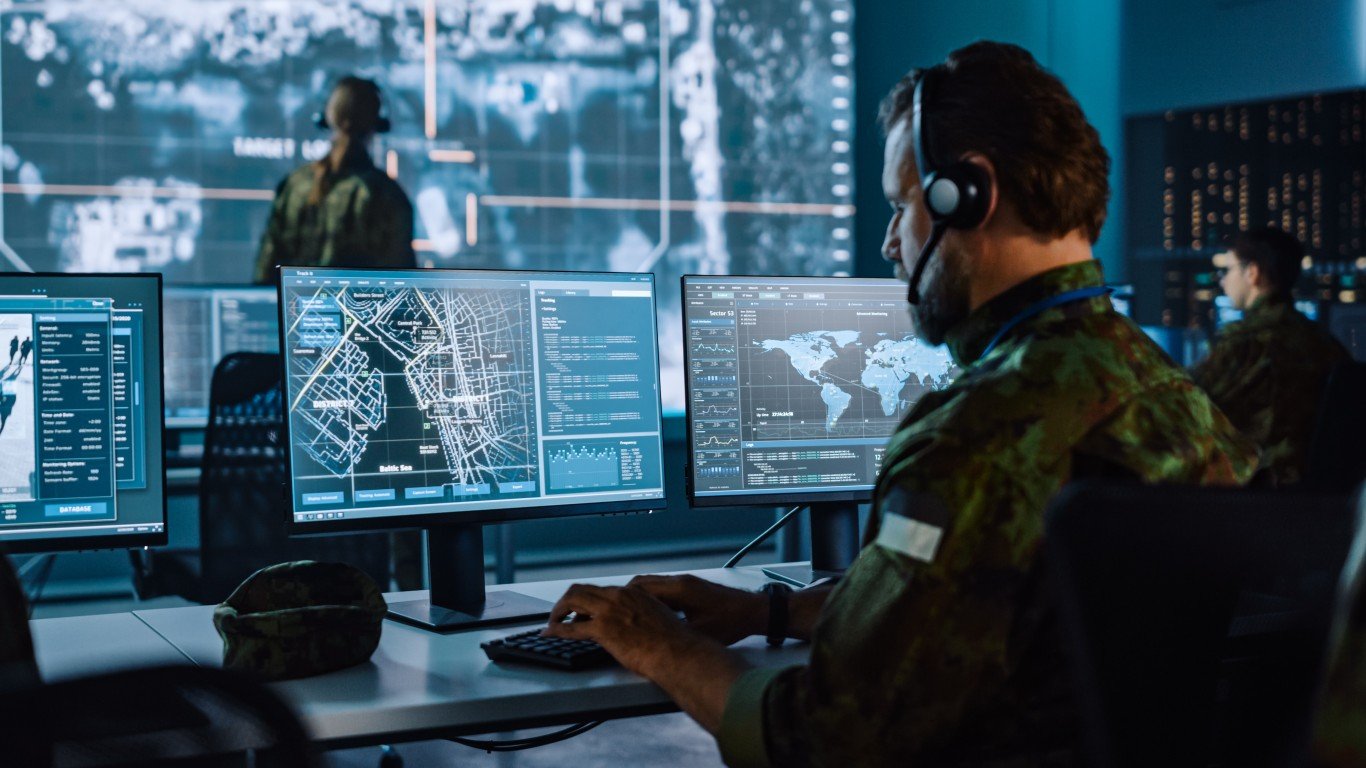
The War Dept. formally labeled Anthropic a national security threat, designating it a “supply-chain risk” under federal statute. This requires the Pentagon and every contractor doing business with the military to immediately stop using Anthropic’s Claude AI services for all defense-related work. Private-sector customers remain unaffected, and Anthropic continues serving commercial clients without interruption.
For Palantir Technologies (NYSE:PLTR | PLTR Price Prediction), however, the directive creates a genuine headache. The company’s Artificial Intelligence Platform (AIP) powers some of the Pentagon’s most sensitive, mission-critical operations — and Claude has been deeply embedded in those classified workflows. While Palantir’s platform supports multiple large language models, the specific integrations tied to high-stakes defense contracts relied on Anthropic as the sole provider. Unwinding that dependency will not be seamless.
The Rift That No One Saw Coming
As the controversy blew up over the past week, the public narrative lacked any context for what triggered it. Speculation swirled around Anthropic’s safety guardrails, its refusal to greenlight “all lawful purposes” (including mass domestic surveillance and fully autonomous lethal weapons), and broader tensions over AI control.
Yesterday, though, Under Secretary of Defense for Research and Engineering Emil Michael appeared on the All-In podcast and provided the missing context. Michael explained that the breaking point came after the U.S. raid to capture Venezuelan President Nicolas Maduro. Palantir served as the prime contractor, with Anthropic serving as the subcontractor supplying Claude through a government cloud.
After the raid, an Anthropic executive contacted Palantir to ask whether its model had been used in the operation — effectively probing for classified information and implying its use was a potential violation of its terms-of-service.
Michael took the concern to Secretary Pete Hegseth, which triggered immediate alarm inside the Pentagon: What if Claude suddenly refused to support a future mission? What if a guardrail fired or the model was altered? It exposed the risk of over-reliance on a single vendor that could theoretically shut down critical capabilities mid-operation. This led to a meeting with Anthropic CEO Dario Amodei, and the situation deteriorated from there.
The Blowback Hits Palantir
The revelation underscores why this matters so much for Palantir. Although AIP is deliberately multi-model — supporting Grok, Gemini, GPT variants, and others — Anthropic’s Claude was the sole model cleared and optimized for certain classified Maven Smart Systems workflows. Maven — Palantir’s flagship intelligence-analysis and targeting platform — powers real-world operations with billion-dollar contract potential. Those prompts, agents, and decision loops were built around Claude’s specific behavior.
The Pentagon has now authorized alternative models for classified use, but swapping them in is no simple dropdown exercise. Sources familiar with the platform describe the task as “painful,” requiring the rebuild of multiple custom prompts, agent chains, and evaluation pipelines. Reuters reported that the process “may need months” and carries “real execution risk” during the transition. Palantir must retest everything for accuracy, latency, and reliability on classified data — all while maintaining operational tempo for the warfighter.
The directive is unambiguous: no contractor doing business with the War Dept. may continue any commercial activity with Anthropic. That forces immediate disentanglement across Palantir’s defense lines. Short-term disruption to government revenue — which has been a key growth driver — now looks inevitable.
Key Takeaways
Anthropic’s official response leaves little ambiguity. Amodei stated the company sees “no choice but to challenge” the designation in court, calling the action legally unsound under the narrow supply-chain-risk statute. A lawsuit is inevitable, but even optimistic timelines suggest years of litigation before resolution.
For Palantir investors, the near-term picture is messy. Government work — a cornerstone of recent revenue acceleration — will likely face months of interruption while engineers rip out and replace Claude-dependent components. This delay comes at an awkward moment: Palantir’s stock has already absorbed pressure from broader AI-sector volatility, valuation concerns, and shifting defense budgets.
Yet, the long-term growth trajectory appears intact. Palantir’s core strength has never been any single model; it is the secure ontology, data integration, and orchestration layer that lets customers swap providers without losing institutional knowledge. With xAI’s Grok, Google’s Gemini, and OpenAI models already cleared or nearing clearance for classified environments, the platform is built for exactly this scenario. Commercial momentum remains strong, and the U.S. government’s insatiable demand for AI-driven decision superiority is not going away.
The Anthropic episode is a costly reminder of vendor concentration risk, but it is unlikely to derail Palantir’s multi-year runway. It may, however, delay the full recovery in investor sentiment that many shareholders had hoped to see in 2026. For a company whose entire value proposition is “we abstract the model so you don’t have to,” this is an expensive but ultimately survivable stress test.











 Top Gaining Stocks

 Top Losing Stocks