Forget YieldMax: These 4 High-Yield ETFs Are Paying Over 15% Right Now
YieldMax gets most of the attention when income investors go hunting for double-digit yields. But the options-premium income space is wider than one fund family, and several funds outside that universe are currently paying well above 15% annually, each using…


YieldMax gets most of the attention when income investors go hunting for double-digit yields. But the options-premium income space is wider than one fund family, and several funds outside that universe are currently paying well above 15% annually, each using a structurally distinct method to generate that income. Here are four worth a closer look.
SVOL: Selling Fear, Not Stocks
The Simplify Volatility Premium ETF takes a different path to income than most high-yield funds. Rather than writing covered calls on individual stocks, SVOL sells volatility itself by taking short positions in VIX-related derivatives. The logic is straightforward: implied volatility consistently trades above realized volatility, and that gap is the premium the fund harvests as income.
The current market environment works in this strategy’s favor. The VIX hit 29.49 on March 6, 2026, sitting in the 94.6th percentile of readings over the past year and running 54.5% above the 12-month average of 19.07. When implied volatility is elevated, volatility sellers collect larger premiums. The fund has maintained a consistent $0.30 monthly distribution throughout most of 2025 and into 2026, and the current dividend yield sits at 21.2% with $607 million in assets under management.
The tradeoff is the tail risk. Volatility-selling strategies can suffer sharp losses during sudden market dislocations. The VIX spiked to 52.33 on April 8, 2025, the kind of extreme reading that compresses the share price of any fund short volatility. SVOL is down about 5.7% year-to-date through March 9, 2026, though the one-year price return is nearly flat. Income investors need to understand that the distributions are the return here, and NAV erosion during volatility spikes is the cost of collecting them.
FEPI: Big Tech Exposure With a Monthly Paycheck
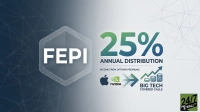
The REX FANG and Innovation Equity Premium Income ETF holds a concentrated basket of large-cap technology and innovation names, then sells call options against those positions to generate income. The underlying portfolio reads like a who’s who of mega-cap tech: Micron, Meta, Apple, Nvidia, Intel, Tesla, AMD, Broadcom, Alphabet, Microsoft, Netflix, Amazon, Oracle, Palantir, and AppLovin all appear in the top holdings.
The sector tilt is heavy. Information technology accounts for 66% of the portfolio, with communication services at 20% and consumer discretionary at 13%. That concentration is the engine of the yield. These are among the most actively traded stocks in the market, which means option premiums on them are rich. The fund yields 27.6% and has $582 million in assets.
What separates FEPI from many high-yield covered call funds is its price performance. Shares have gained 22% over the past year and are up 45% since inception in October 2023. Most covered call funds sacrifice price appreciation to fund the yield. FEPI has managed both, at least through this period, because the underlying tech stocks have appreciated enough to offset the drag from selling upside. The risk is that this dynamic reverses if tech sells off hard, and the covered calls limit the fund’s ability to recover quickly.
Monthly distributions have been running between $0.88 and $1.04 per share through early 2026, down modestly from 2024 peaks near $1.19 but still substantial. The fund launched in October 2023, so the track record is relatively short.
KLIP: China Internet Income With Real Currency Risk
KraneShares KWEB Covered Call Strategy ETF applies the covered call income model to Chinese internet stocks. The fund holds the underlying KWEB ETF, which tracks the CSI Overseas China Internet Index, and writes covered calls against that position to generate premium income. The portfolio is essentially 100% KWEB, so investors are getting concentrated exposure to China’s largest internet companies: the communication services and consumer discretionary sectors that dominate Chinese tech.
The income case is real. Monthly distributions in 2025 ran mostly between $0.62 and $0.68 per share, and early 2026 payments came in at $0.58 and $0.64. The prospectus lists an expense ratio of 0.95%, which is on the higher end for a passive-ish strategy but not unreasonable given the options overlay.
The performance picture is more complicated. KLIP is down about 6.7% year-to-date and has dropped nearly 10% over the past month. The one-year price return is only about 1%, meaning most of the total return has come from distributions. Chinese internet stocks carry geopolitical risk, regulatory risk from Beijing, and currency exposure that domestic equity funds do not. The covered call overlay also caps upside, so if Chinese tech stages a sharp rally, KLIP will lag KWEB. The fund launched in January 2023, giving it a three-year track record through multiple cycles in Chinese equities.
USOI: Crude Oil Income With Structural Caveats
The Credit Suisse X-Links Crude Oil Shares Covered Call ETN has several structural characteristics that distinguish it from the other funds in this comparison. The first thing to understand is the structure: USOI is an exchange-traded note, not an ETF. That distinction matters because ETN holders are unsecured creditors of the issuer, Credit Suisse, rather than owners of an underlying basket of assets. Credit Suisse’s acquisition by UBS adds a layer of counterparty complexity that pure ETF investors never face.
The income itself has been volatile. Monthly distributions over the past year have ranged from $0.38 to $2.49 per share, with the July and June 2025 payments particularly elevated. That variability reflects crude oil’s price swings feeding directly into the option premiums the strategy collects. When oil is volatile, premiums are rich. When oil is calm, they compress.
The price performance has been a relative bright spot. USOI shares are up about 19% year-to-date and have gained roughly 15% over the past year. That combination of price appreciation and income distributions has produced a strong total return in the recent energy environment. The risk is the reverse scenario: a sustained crude oil decline would compress both the share price and the option premiums funding the distributions simultaneously.
Choosing Between Them
These four funds differ meaningfully in their underlying exposure and income mechanics. SVOL generates income by selling volatility derivatives, with distributions tied to the fear premium in options markets and NAV sensitivity to volatility spikes. FEPI pairs mega-cap tech holdings with a covered call overlay, producing both price appreciation and income during the recent tech bull run. KLIP applies the covered call model to Chinese internet stocks, introducing geopolitical and regulatory risk alongside the income stream. USOI is an ETN (not an ETF) that writes covered calls on crude oil exposure, with distributions that vary significantly with oil price volatility and counterparty risk tied to the issuer.
Contact [email protected] for any questions or corrections.
Austin Smith is a financial publisher with over two decades of experience as an investor, analyst, and advisor. He covers stocks, ETFs, Artificial intelligence and personal finance for 24/7 Wall St. Previously, he spent over a decade at The Motley Fool as a senior editor for Fool.com, portfolio advisor for Millionacres, and launched The Ascent to help reader take control of their personal finances.
His work has been featured on Fool.com, NPR, CNBC, USA Today, Yahoo Finance, MSN, AOL, Marketwatch, and many other publications. He is as an advisor to private companies, and co-hosts The AI Investor Podcast with Eric Bleeker.
When not looking for investment opportunities, he can be found skiing, running, or playing soccer with his children. Learn more about Austin's investment approach here.