Rivian’s Future Rides on April’s R2 Launch
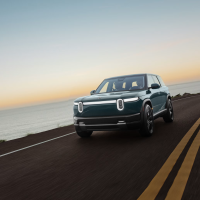
Rivian Automotive (NASDAQ:RIVN | RIVN Price Prediction) is set to begin customer deliveries of its new R2 electric vehicle in April, according to showroom reps, marking a pivotal moment for the EV maker. The compact SUV represents Rivian’s push into…


Rivian Automotive (NASDAQ:RIVN | RIVN Price Prediction) is set to begin customer deliveries of its new R2 electric vehicle in April, according to showroom reps, marking a pivotal moment for the EV maker. The compact SUV represents Rivian’s push into more affordable territory after years of focusing on premium R1 models. The company’s future hinges on whether the R2 can make rubber meet the pavement — translating hype into real-world sales and production ramp-up. If the R2 fails to connect with mainstream car buyers, Rivian’s stock could quickly run into the ditch amid ongoing losses and cash burn.
Yet one prominent analyst sees the road wide open for Rivian. TD Cowen’s Itay Michaeli believes significant sales uptake for the R2 will far exceed what Wall Street is currently modeling, potentially unlocking profitability and sending shares higher.
Wall Street Eyes a Turnaround
In a fresh research note released this morning, TD Cowen upgraded Rivian from Hold to Buy and lifted its price target to $20 per share. The move, which helped push its shares up as much as 5% in morning trading, reflects Michaeli’s detailed bottom-up analysis of R2 demand.
He forecasts full-scale U.S. demand for the model in the range of 212,000 to 335,000 units annually once production hits stride. That range sits well above consensus estimates and could drive meaningful upside to 2027 revenue and EBITDA forecasts. Michaeli narrowed his projected 2027 EBITDA loss and applied a higher terminal multiple of 17x (versus 14.5x previously), citing improved visibility into Rivian’s volume trajectory.
Central to his bullish thesis is the belief that U.S. EV sentiment has bottomed. Michaeli expects the next meaningful leg of demand growth to arrive in 2027-2028, fueled by two key catalysts: the broad introduction of next-generation EV models and the wide deployment of personal autonomous vehicles within the next 18 months. He argues as pricing continues to decline across the industry, affordability barriers will ease and spur an uptick in adoption.
It’s All Riding on the R2
The R2 is Rivian’s most important weapon in that fight. Positioned as the company’s cheapest model at a starting price around $45,000 (actual pricing will be unveiled on March 12), it undercuts the current average new-car transaction price of $49,191 (according to January data from Kelley Blue Book). That positioning should help Rivian attract a broader audience than its $76,000-plus R1 lineup ever could.
Yet even at that level, the R2 still prices many buyers out of the market. The disappearance of sub-$20,000 new cars has raised the industry floor, and $45,000 remains a stretch for the average household. Used cars continue to offer far more affordable alternatives, while the elimination of federal EV incentives has removed a key purchase carrot for many consumers. Meanwhile, hybrids have emerged as the true sweet spot — delivering better range anxiety relief and lower upfront costs without relying on charging infrastructure that remains patchy outside major metro areas.
Michaeli acknowledges these headwinds but maintains that Rivian’s execution on the R2 launch will be the decisive factor. He highlights the company’s Georgia plant preparations and its aggressive 2026 delivery guidance of 62,000 to 67,000 vehicles overall, with the R2 expected to contribute the bulk of incremental volume. If Rivian can scale production smoothly and hit even the low end of his demand range, the analyst sees a clear path to narrowing losses and eventually reaching positive EBITDA.
The upgrade underscores TD Cowen’s view that the risk/reward skews favorably heading into the April deliveries, especially with shares down roughly 12% year-to-date.
Market Realities Should Temper the Optimism
Despite the upbeat call, broader EV market dynamics remain challenging. Consumer surveys continue to show hesitation around charging times, cold-weather performance, and total cost of ownership. Hybrids outsold pure battery EVs in several recent months, and legacy automakers have dialed back ambitious EV targets in favor of plug-in hybrids.
Rivian must also contend with intensifying competition from Tesla’s (NASDAQ:TSLA) refreshed Model Y, new entrants from China, and legacy brands discounting their own EVs aggressively.
Key Takeaway
TD Cowen’s outlook feels overly enthusiastic at this stage. While a viable market surely exists for the R2, actual uptake may prove meaningfully lower than the analyst’s 212,000 to 335,000-unit projection — and even below the more muted consensus on Wall Street. Production delays, quality issues, or simply softer-than-expected demand could quickly erase the current optimism.
At around $17 per share, Rivian stock trades at a premium to its recent lows but still embeds high expectations for the R2 ramp. Investors would be wise to stay on the sidelines and wait for concrete evidence of traction — steady monthly deliveries, positive customer reviews, and margin improvement — before jumping in. The R2 launch is indeed make-or-break, but proof of success should come before committing capital.
Contact [email protected] for any questions or corrections.
After two decades of patrolling the dark corners of suburbia as a police officer, Rich Duprey hung up his badge and gun to begin writing full time about stocks and investing. For the past 20 years he’s been cruising the markets looking for companies to lock up as long-term holdings in a portfolio while writing extensively on the broad sectors of consumer goods, technology, and industrials. Because his experience isn’t from the typical financial analyst track, Rich is able to break down complex topics into understandable and useful action points for the average investor. His writings have appeared on The Motley Fool, InvestorPlace, Yahoo! Finance, and Money Morning. He has been featured in both U.S. and international publications, including MarketWatch, Financial Times, Forbes, Fast Company, and USA Today.