TeraWulf Price Prediction: 22% Pullback Creates Buying Opportunity
TeraWulf (NASDAQ:WULF) has pulled back sharply from its recent highs, sliding -10% over the past month and currently trading at $14.22. Despite a remarkable 340% one-year run, the stock sits 22% off its 52-week high of $18.51. Most Wall Street…


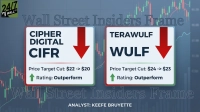
TeraWulf (NASDAQ:WULF) has pulled back sharply from its recent highs, sliding -10% over the past month and currently trading at $14.22. Despite a remarkable 340% one-year run, the stock sits 22% off its 52-week high of $18.51. Most Wall Street analysts carry more measured outlooks, but Keefe Bruyette is holding firm with an Outperform rating and a $23 price target. The broader analyst consensus sits at $25.33, with 13 analysts rated 100% bullish. Keefe Bruyette maintains its Outperform rating with a $23 price target, citing the contracted revenue foundation and HPC build-out schedule as key factors in its outlook.
Keefe Bruyette’s $23 WULF Prediction
Keefe Bruyette trimmed its target modestly from $24 to $23 but maintained its Outperform rating, maintaining its Outperform rating despite the recent pullback. The firm points to TeraWulf’s contracted revenue foundation as the anchor: approximately $12.8 billion in long-term contracted revenue backed by Google credit-enhanced leases provides a level of cash flow visibility rare among bitcoin-adjacent names. With $3.27 billion in cash on the balance sheet following major financing rounds, the company has the capital to execute its build-out through 2026 and beyond.
Key Drivers of WULF Stock Performance
- The pullback itself. A 22% decline from the February 52-week high represents a significant decline from recent highs as contracted HPC capacity comes online through 2026.
- HPC revenue acceleration. HPC lease revenue grew 35% quarter-over-quarter to $9.70 million in Q4 2025, and multiple construction milestones are scheduled for delivery across 2026, including CB-3 in mid-May, CB-4 in Q3, and CB-5 in Q4. Each delivery converts contracted capacity into recurring cash flow.
- Scale of the contracted platform. 522 critical IT MW of contracted HPC capacity and a 2.9 GW gross multi-regional platform underpin an estimated $815 million in average annualized NOI from the contracted platform, reflecting the scale of TeraWulf’s long-term NOI potential.
Keefe Bruyette’s $23 Price Target: Key Factors
Keefe Bruyette’s price target reflects the firm’s Outperform rating, with analysts citing on-time delivery of the 2026 construction milestones, continued growth in HPC lease revenue as a share of total revenue, and stability in bitcoin prices as key factors in its outlook. Bitcoin prices remain a swing factor given BTC’s 20% year-to-date decline to around $70,000.
The primary risk is TeraWulf’s approximately $2.0 billion net debt position, which leaves limited margin for construction delays or tenant setbacks. Even so, with 2026 fixed operating cost guidance of $100 to $125 million and a fully contracted growth pipeline, Keefe Bruyette’s $23 target reflects the firm’s Outperform rating on the stock.
Contact [email protected] for any questions or corrections.
Joel South covers large-cap stocks, dividend investing, and major market trends, with a focus on earnings analysis, valuation, and turning complex data into actionable insights for investors.
He brings more than 15 years of experience as an investor and financial journalist, including 12 years at The Motley Fool, where he served as an investment analyst, Bureau Chief, and later led the Fool.com investing news desk. He has also co-hosted an investing podcast and appeared across TV and radio discussing market trends.