MOS Trades at 14x Earnings While Its Brazil Business Just Grew EBITDA 190% In Q3 2025
Mosaic (NYSE:MOS | MOS Price Prediction) is trading near its 52-week low after shares fell about 14% over the past week and about 13% over the past month. The catalyst was a Q4 2025 net loss of $519.5 million, driven…

This post may contain links from our sponsors and affiliates, and Flywheel Publishing may receive compensation for actions taken through them.
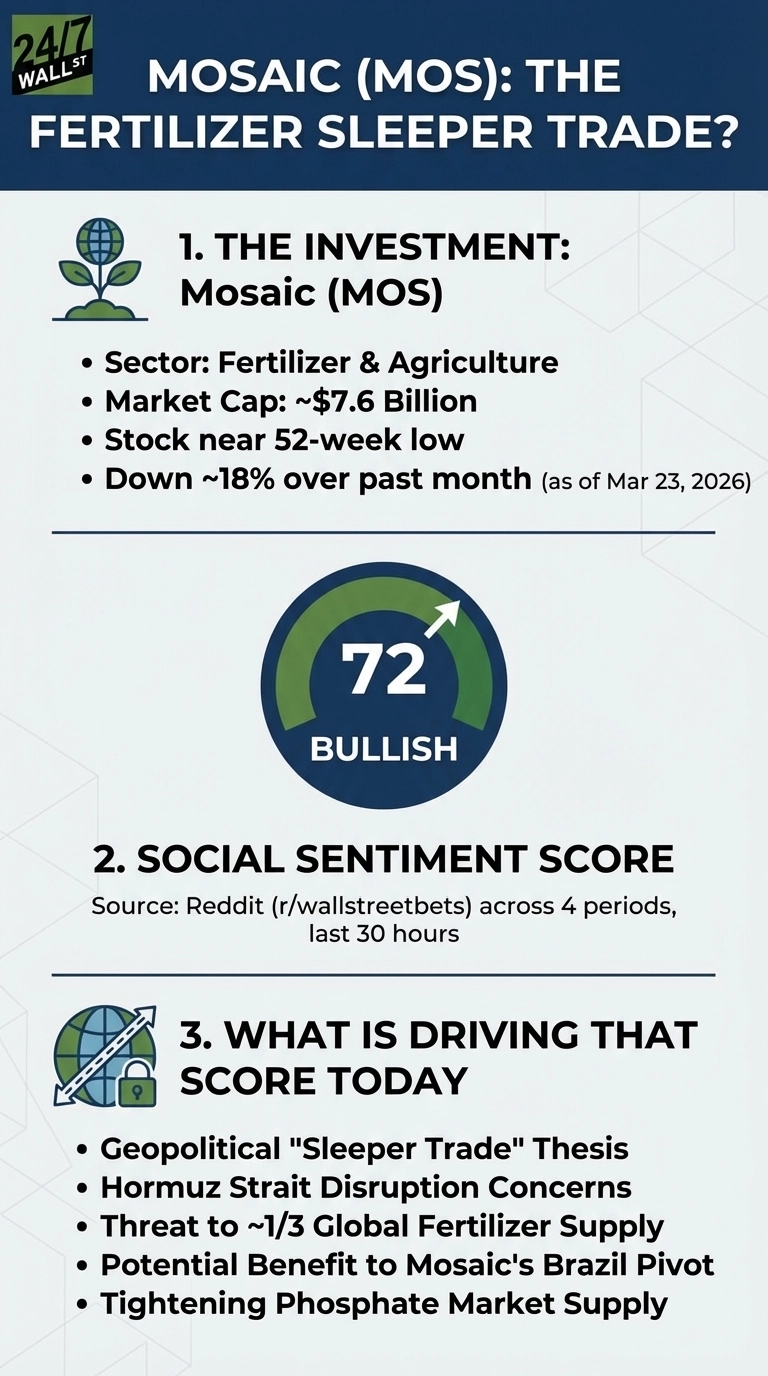
Mosaic (NYSE:MOS | MOS Price Prediction) is trading near its 52-week low after shares fell about 14% over the past week and about 13% over the past month. The catalyst was a Q4 2025 net loss of $519.5 million, driven by surging sulfur costs and a $189 million impairment charge. Yet full-year 2025 net income came in at $540.7 million, a number that tells a very different story than the headline quarter.
It won’t come as much of a surprise to learn that Reddit has taken notice. A single thread on r/wallstreetbets is driving all of Mosaic’s current social sentiment, with a bullish score of 72 out of 100 across four consecutive measurement periods over the past 30 hours.
The Hormuz Fertilizer Thesis
The dominant thread, posted by u/Cueg, frames Mosaic as a geopolitical sleeper trade. The post argues that oil gets the headlines, but fertilizer is the second-order play: “a massive chunk (1/3) of global fertilizer production and logistics runs through that region, directly or indirectly… fertilizer feels like it lags, then moves harder once shortages actually show up.”
If Hormuz stays disrupted, fertilizer might be the sleeper trade
by u/Cueg in wallstreetbets
The post has accumulated 1,198 upvotes and 473 comments as of early Tuesday, up from 728 upvotes and 401 comments at peak engagement Monday evening. Activity scores held steady rather than spiked, suggesting genuine investment discussion. The bullish case rests on three structural arguments:
- Chinese phosphate exports are expected to fall more than 1.5 million tonnes, tightening global supply into 2026 and pushing buyers toward Mosaic’s volumes.
- Mosaic’s Brazil segment delivered 190% EBITDA growth year-over-year in Q3 2025, with gross margins expanding from $44 to $65 per tonne, making it the company’s clearest growth engine.
- Mosaic trades at roughly 14x earnings, well below the chemicals industry average of 26x and the peer group average of 19x.
Sulfur Costs and the Bear Case
Looking at analyst considerations, Bank of America downgraded Mosaic from Buy to Neutral on March 20-21, cutting its price target to $30 from $33 and declaring that “margin expansion is now more likely a 2027 story.” As a result of this analyst shift, the stock fell nearly 10% on that day alone.
CFO Luciano Pires was direct on the Q4 earnings call: “Every $10 increase in sulfur prices adds approximately $10 million of quarterly expense. Compared with the prior year first quarter, we thus expect a roughly $250 million headwind to Q1 ’26 EBITDA.” Sulfur hit approximately $500 per metric ton late in Q4 2025, against a recorded cost of $306 per tonne. Working capital consumed $960 million in cash during 2025.
Peer Nutrien (NYSE:NTR) trades at a trailing P/E of roughly 16x, with a market cap near $35 billion, offering more diversified fertilizer exposure with less Brazil-concentration risk. CF Industries (NYSE:CF) is up 65% year to date, largely because its domestic natural gas advantage insulates it from the sulfur and ammonia inflation squeezing Mosaic.
Management expects a $300 to $500 million working capital release in 2026, and phosphate conversion costs are already on a downward path toward a sub-$100 per tonne target. The underlying supply tightness in phosphate is real. Whether Brazil’s credit constraints and sulfur headwinds clear fast enough to show up in cash flow is the question that matters.
Data Sources:
- Mosaic’s Rare Earths Bet Could Revalue the Stock (247 Wall St, March 18, 2026): background on Brazil strategic initiatives and rare earths optionality.
- Is Mosaic (MOS) Still A Bargain After Its Recent 20% Share Price Jump?: P/E valuation benchmarks, DCF analysis, and peer comparison metrics.
- The Mosaic Company (MOS) Traded Down Due to Softer Fertilizer Demand: Q4 2025 financial results, production guidance, and execution risk context.
- Q4 2025 Earnings Call Transcript (Alpha Vantage): sulfur cost quantification, Brazil production curtailments, working capital dynamics, and management guidance.
Contact [email protected] for any questions or corrections.
David Beren has been a Flywheel Publishing contributor since 2022. Writing for 24/7 Wall St. since 2023, David loves to write about topics of all shapes and sizes. As a technology expert, David focuses heavily on consumer electronics brands, automobiles, and general technology. He has previously written for LifeWire, formerly About.com. As a part-time freelance writer, David’s “day job” has been working on and leading social media for multiple Fortune 100 brands. David loves the flexibility of this field and its ability to reach customers exactly where they like to spend their time. Additionally, David previously published his own blog, TmoNews.com, which reached 3 million readers in its first year. In addition to freelance and social media work, David loves to spend time with his family and children and relive the glory days of video game consoles by playing any retro game console he can get his hands on.