Eli Lilly’s Path to $1 Trillion Runs Directly Through the AI Boom
Eli Lilly (NYSE:LLY | LLY Price Prediction) has built one of the most remarkable growth stories in modern pharmaceutical history through its GLP-1 franchises. Mounjaro and Zepbound conquered the weight-loss market, giving Lilly roughly a 60% share of the weight-loss…


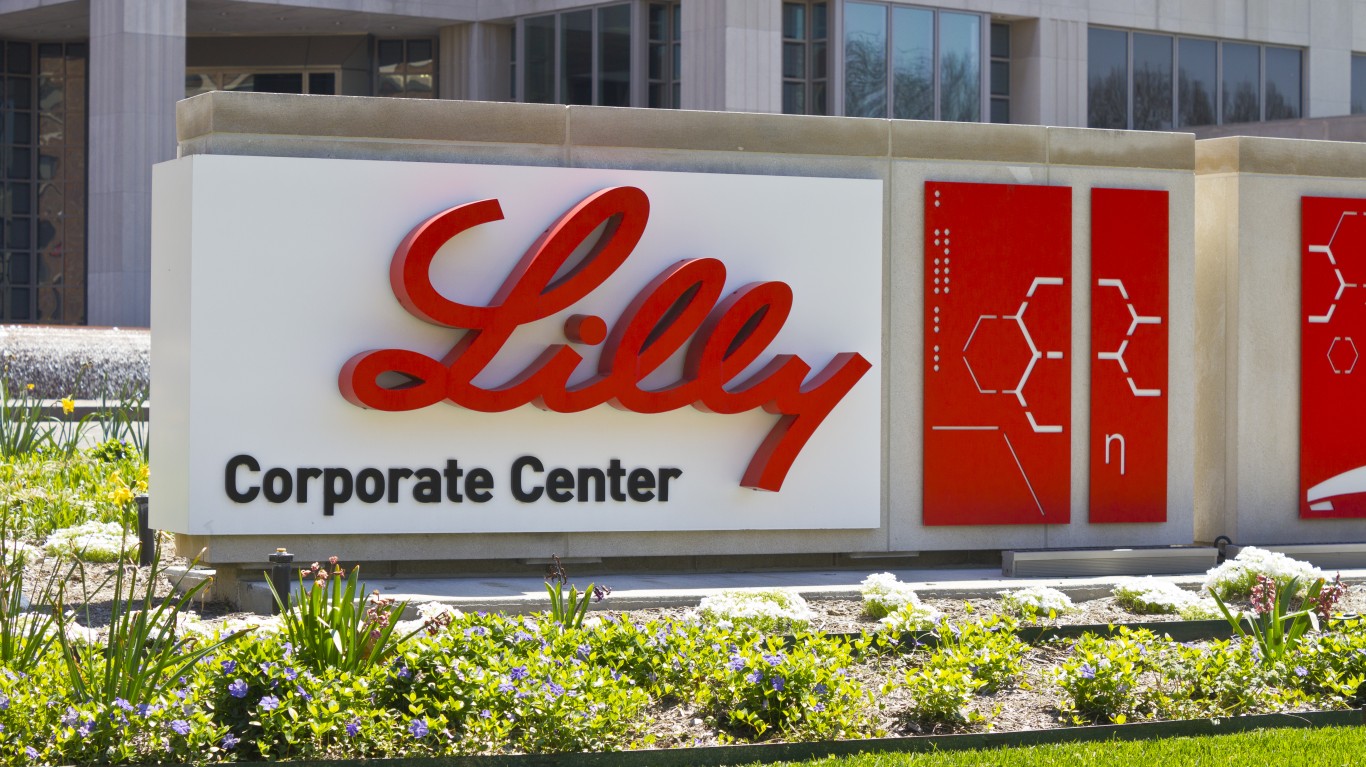
Eli Lilly (NYSE:LLY | LLY Price Prediction) has built one of the most remarkable growth stories in modern pharmaceutical history through its GLP-1 franchises. Mounjaro and Zepbound conquered the weight-loss market, giving Lilly roughly a 60% share of the weight-loss opportunity, a dominance that pushed full-year 2025 revenue to $65.18 billion, up 44.7% year-over-year. Shares have pulled back 12.8% year-to-date from a strong 2025 run. The question: can Lilly reach $1,120, the price that would push its market cap past $1 trillion?
Wall Street Already Sees Substantial Upside
The consensus one-year price target sits at $1,209.21, implying significant upside from the current price of $935.58. The analyst breakdown: 24 Buy ratings, 6 Hold, and just 1 Sell. Lilly’s 2026 revenue guidance of $80 billion to $83 billion and EPS guidance of $33.50 to $35.00 give analysts concrete numbers to build on. The company beat revenue expectations in all four quarters of 2025 and beat EPS estimates in three of four quarters, suggesting guidance is conservative.
The Math Behind $1,120
Lilly currently trades at a forward multiple relative to the midpoint of its 2026 EPS guidance. Hitting $1,120 would imply a meaningfully higher forward multiple on 2026 earnings. For a company guiding to non-GAAP EPS of $33.50 to $35.00 after growing net income 94.9% in 2025, that multiple is reasonable against the S&P 500‘s 21x to 23x forward earnings.
Several catalysts are already in motion:
- Orforglipron FDA approval: FDA approval is expected in Q2 2026, with submissions filed in the U.S., Japan, and 40+ countries. An oral GLP-1 pill removes the injection barrier for millions of patients.
- AI drug discovery: CEO David Ricks confirmed: “We recently announced a new collaboration with NVIDIA (NASDAQ:NVDA) to open a co-innovation AI lab. This project will combine Lilly’s scientific expertise with NVIDIA’s leading technology to accelerate drug discovery.” Lilly also signed a $2.75 billion deal with Insilico Medicine in March 2026, gaining exclusive rights to an AI platform that has already developed 28 AI-generated drugs.
- Medicare expansion: A government agreement caps out-of-pocket costs for Medicare beneficiaries at $50 per month, effective no later than July 1, 2026, opening a senior population that currently uses GLP-1s at below-average rates.
- Retatrutide pipeline: Phase 3 data showed patients lost an average of 71.2 lbs, with six additional Phase 3 readouts expected in 2026.
Lilly’s Track Record Supports the Target
Reaching $1,120 requires meaningful appreciation from current levels. Over the past five years, Lilly shares returned 430.74%, and over ten years, 1,409.7%. Even over the past 12 months, shares gained 15.17% through a volatile stretch. The current pullback from the 52-week high of $1,132.06 puts $1,120 below Lilly’s recent peak, making this a recovery story as much as a growth one.
The Bottom Line
Wall Street’s consensus already points to $1,209.21, meaning analysts effectively expect Lilly to surpass the $1 trillion threshold. The GLP-1 franchise continues generating extraordinary volume growth, the oral GLP-1 catalyst is imminent, and AI drug discovery partnerships represent the next frontier of value creation. Risks include pricing pressure, product concentration, and tariff uncertainty. For a company that grew net income 94.9% in 2025, the path to $1 trillion is well within sight.
Contact [email protected] for any questions or corrections.
After two decades of patrolling the dark corners of suburbia as a police officer, Rich Duprey hung up his badge and gun to begin writing full time about stocks and investing. For the past 20 years he’s been cruising the markets looking for companies to lock up as long-term holdings in a portfolio while writing extensively on the broad sectors of consumer goods, technology, and industrials. Because his experience isn’t from the typical financial analyst track, Rich is able to break down complex topics into understandable and useful action points for the average investor. His writings have appeared on The Motley Fool, InvestorPlace, Yahoo! Finance, and Money Morning. He has been featured in both U.S. and international publications, including MarketWatch, Financial Times, Forbes, Fast Company, and USA Today.