Trump Bombed Iran Back to the ‘Stone Age.’ These Are 2 Stocks That Rewarded the Thesis
What started as a rhetorical threat in April 2026 became active military conflict by late February. With the Strait of Hormuz disrupted, Brent crude near $97 a barrel, and Lockheed Martin's backlog now at a record $230 billion, the defense…

This post may contain links from our sponsors and affiliates, and Flywheel Publishing may receive compensation for actions taken through them.

When President Trump issued his “stone ages” ultimatum in early April 2026, markets treated it as yet another rhetorical warning shot. It was not. Within weeks, U.S. and Israeli forces launched strikes on Iranian nuclear facilities, and the conflict has since escalated into a sustained military campaign that continues today. The Strait of Hormuz remains disrupted, crude oil has surged to around $93 to $97 a barrel as of early September, and the two stocks identified in this article at its original publication have delivered on the thesis: Lockheed Martin (NYSE:LMT | LMT Price Prediction) and Venture Global (NYSE:VG).
Why the Original Thesis Held Up
The original argument was straightforward: any sustained conflict involving Iran would accelerate defense orders and lift U.S. LNG demand as buyers scrambled for non-Persian Gulf supply. Both dynamics materialized. The conflict disrupted shipping through the Strait, which in 2025 carried roughly 25% of the world’s maritime crude trade and about 19% of global LNG, according to a Congressional Research Service update published in August 2026. U.S. LNG exporters stepped into the breach exactly as anticipated.
Lockheed Martin (LMT)
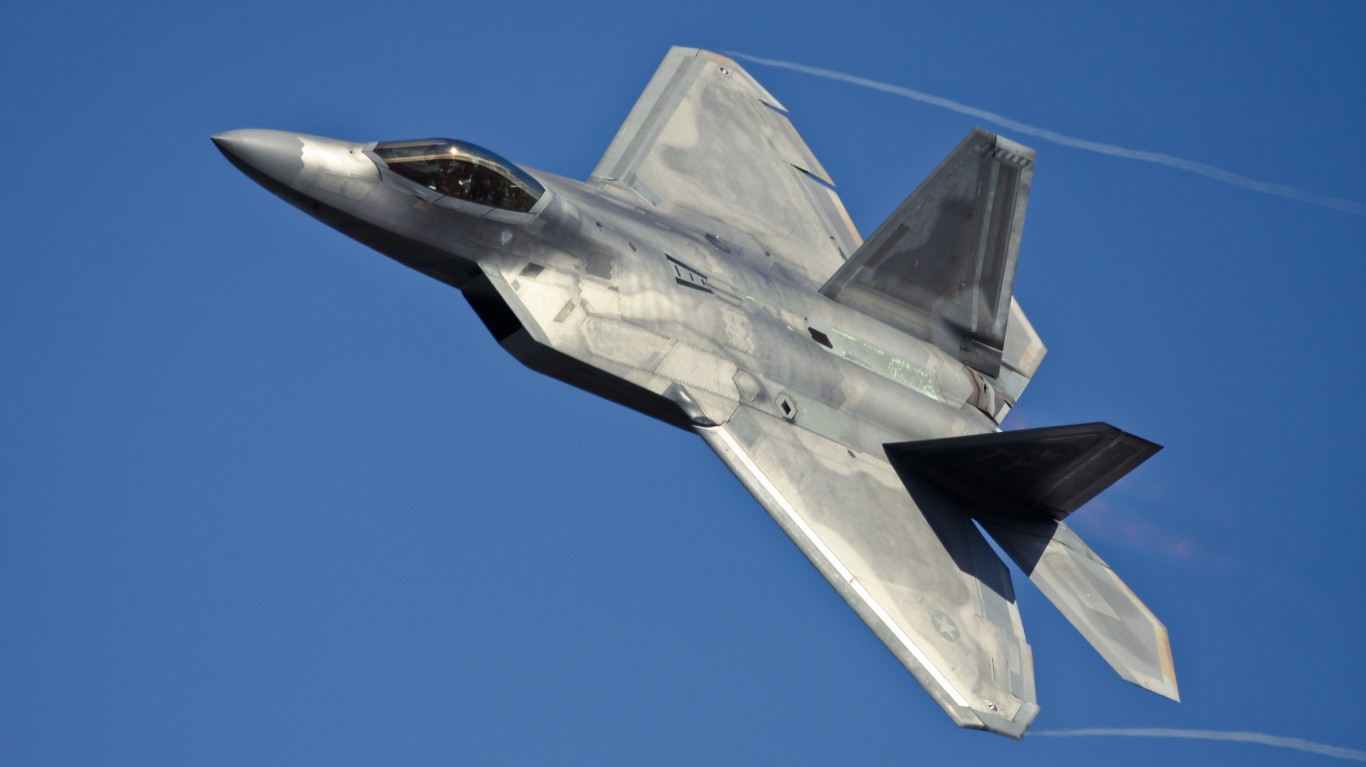
Lockheed Martin builds the hardware of sustained modern conflict: F-35 jets, PAC-3 Patriot interceptors, JASSM cruise missiles, and the radar networks that tie them together. When active combat operations replace diplomatic brinkmanship, the company’s order book fills fast.
The full-year 2025 results, reported in late January 2026, confirmed the foundation: a record $194 billion backlog (up 6% year-over-year), total sales of $75 billion (also up 6%), and free cash flow of $6.9 billion, up roughly 31% from the prior year. Those figures were already strong before the shooting started.
Since then, the numbers have moved sharply higher. By Q2 2026, Lockheed’s backlog had climbed to an all-time record of $230 billion, up about $64 billion year-over-year, on a book-to-bill ratio of 3.2x. Quarterly sales rose 19% year-over-year to $20.1 billion, driven by production ramps on PAC-3 Patriot and THAAD systems and by a $35 billion Missile Defense Agency contract to quadruple THAAD output. Management raised full-year 2026 sales guidance to $79.75 billion to $81.75 billion, representing an 8% midpoint increase above prior guidance, with free cash flow now projected above $7 billion.
The company also received a seven-year, $53.86 billion PAC-3 Missile Segment Enhancement contract from the U.S. government, one of the largest awards in the missile division’s history. Lockheed shares traded around $574 as of late July 2026, up roughly 15% year-to-date at that point. The trailing P/E sits at roughly 29x, and the forward dividend stands at $13.50 per share. The broader context: Lockheed has also agreed to acquire Ultra Maritime for $3.45 billion, expanding its undersea warfare capabilities, though that deal remains subject to regulatory approval and is not in current guidance.
Venture Global (VG)
Venture Global operates U.S. Gulf Coast LNG liquefaction facilities that export American natural gas to Europe and Asia. The investment case rested on a simple premise: any Strait of Hormuz disruption forces buyers to pivot toward U.S. supplies, lifting both volumes and pricing. That is precisely what happened.
Full-year 2025 results, published in early March 2026, showed revenue of $13.8 billion, a 177% jump from 2024. Net income reached $2.3 billion (up 53%) while consolidated adjusted EBITDA climbed 198% to $6.3 billion. The company exported a record 1,409 TBtu of LNG across 380 cargo shipments in 2025, up 181% year-over-year, as the Plaquemines Project ramped toward full capacity.
Q4 2025 alone delivered $4.4 billion in revenue (up 192% year-over-year) and 478 TBtu sold. In the months after the conflict began, Venture Global secured new long-term supply agreements that reinforced its commercial position: a 20-year sales deal with Hanwha Aerospace for 1.5 million tonnes per annum starting in 2030, and a separate binding agreement with trading house Trafigura. Management guides for 486 to 527 total cargo shipments in 2026 and targets full-year 2026 adjusted EBITDA of $5.2 billion to $5.8 billion, a range held firm despite market volatility. Trailing EPS stands at $0.92.
The revenue growth rate of 177% far outpaces the mid-single-digit norm for integrated oil majors, and the company’s low payout ratio leaves room for continued capacity expansion. Its pure-play LNG model has turned geopolitical friction into cash flow in a way that broader energy companies, tied to upstream production schedules, cannot easily replicate.
Risks That Remain
The conflict has already proved that de-escalation moves fast when it does arrive. Earlier this year, oil prices fell sharply on reports of a possible U.S. seizure and reopening of the Strait, unwinding weeks of war premium in a single session. A genuine ceasefire or nuclear agreement could reverse oil gains and trim defense orders quickly, as seen in past de-escalation cycles.
Prolonged conflict keeps inflation elevated, and energy cost pressures ripple through the broader economy. Venture Global carries a substantial debt load relative to its enterprise value, a real concern if rates stay elevated longer than expected. Lockheed faces its own execution risks: cost overruns on classified programs and a $4.6 billion tax dispute are live issues, and the P/E premium of roughly 29x reflects high expectations.
As of early September 2026, the U.S. Energy Information Administration does not expect Middle East oil production to return to near pre-conflict levels until early 2027, and projects Brent to average $87 a barrel for the full year. That forecast may itself prove conservative given that Brent has already touched nearly $98 in recent sessions and analysts warn of potential spikes to $120 if Strait disruptions intensify further.
Key Takeaway
What began as a geopolitical thesis in April 2026 has since been validated by actual conflict, record contract awards, and surging LNG demand. Lockheed’s backlog has grown to $230 billion while its 2026 revenue guidance has moved meaningfully higher. Venture Global’s pure-play LNG model delivered 177% revenue growth in 2025 and locked in decade-long offtake deals just as the Strait of Hormuz came under sustained pressure.
The volatility is real, and a diplomatic breakthrough could shift the calculus rapidly. But the underlying earnings engines for both companies have, through the first half of 2026, done exactly what the original thesis anticipated.
Editor’s note: This article has been updated to reflect developments since original publication in April 2026. Key changes include: Lockheed Martin’s backlog has grown to a record $230 billion by Q2 2026 (from $194 billion at end-2025), with 2026 sales guidance raised to $79.75 to $81.75 billion; Brent crude now trades near $97 a barrel with the U.S. Energy Information Administration projecting a full-year 2026 average of $87; and Venture Global has signed new long-term LNG supply agreements with Hanwha Aerospace and Trafigura following the onset of active U.S.-Iran military operations in late February 2026.
Contact [email protected] for any questions or corrections.
After two decades of patrolling the dark corners of suburbia as a police officer, Rich Duprey hung up his badge and gun to begin writing full time about stocks and investing. For the past 20 years, he’s been cruising the markets looking for companies to lock up as long-term holdings in a portfolio while writing extensively on the broad sectors of consumer goods, technology, and industrials. Because his experience isn’t from the typical financial analyst track, Rich is able to break down complex topics into understandable and useful action points for the average investor. His writings have appeared on The Motley Fool, InvestorPlace, Yahoo! Finance, Money Morning, and, of course, 24/7 Wall St. He has been featured in both U.S. and international publications, including MarketWatch, Financial Times, Forbes, Fast Company, and USA Today.