




The family of companies spun out from General Electric represents one of the most consequential industrial breakups in modern history. What was once a single conglomerate now trades as three distinct public companies, each operating in a sector with very different growth profiles: aerospace, energy transition, and medical technology. The metrics that matter most are revenue growth rate, per-share earnings performance versus estimates, order backlog trajectory, free cash flow generation, and forward guidance credibility.
3. GE HealthCare
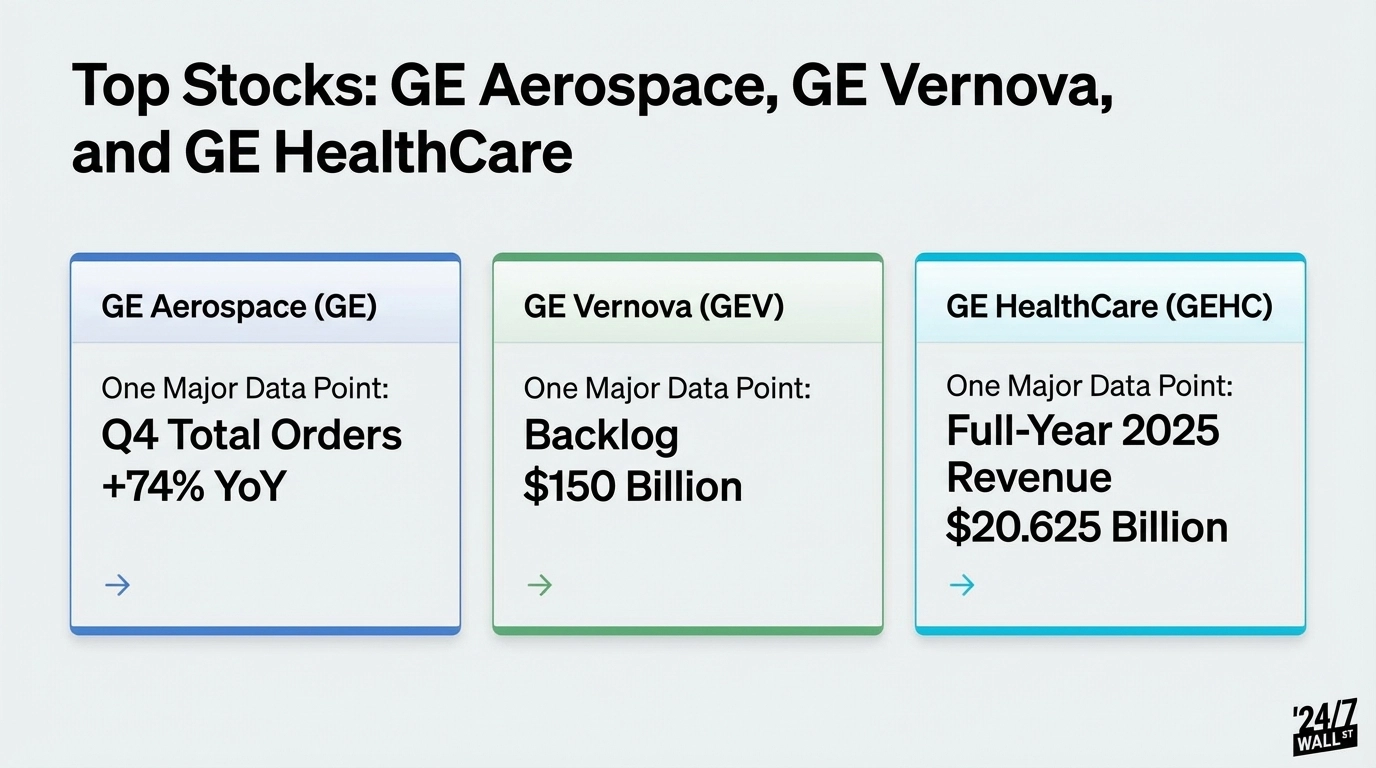
GE HealthCare (NASDAQ: GEHC) is the smallest of the three by a wide margin, with a market cap of approximately $33.3 billion. Full-year 2025 revenue grew 4.84% to $20.625 billion, the slowest growth rate in the group. Adjusted EPS of $4.59 beat the consensus estimate by 0.85%, reflecting steady execution rather than acceleration.
Tariffs were the defining headwind. The company absorbed an estimated $245 million in tariff impacts to adjusted EBIT and approximately $0.43 per share to adjusted EPS for the full year. GAAP net income fell 18.19% year-over-year in Q4 to $589 million, and adjusted EBIT margin compressed 200 basis points to 16.7%. Free cash flow declined 2.9% for the full year to $1.505 billion. Pharmaceutical Diagnostics posted 22.3% revenue growth in Q4, driven by strong Flyrcado demand. The stock is down 11.1% year-to-date. For 2026, management guided organic revenue growth of 3% to 4% and adjusted EPS of $4.95 to $5.15. Analyst consensus sits at 14 Buy ratings, five Holds, and one Sell, with a consensus price target of $91.74.
2. GE Vernova
GE Vernova (NYSE: GEV | GEV Price Prediction) carries a market cap of $262.6 billion and is the energy transition story of the three. Q4 2025 backlog reached $150 billion, a record, representing a sequential gain of $15 billion in a single quarter. Q4 organic order growth reached 65%, with 41 heavy-duty turbine orders in the Power segment and Electrification equipment backlog surging 53% year-over-year to $30.5 billion.
Full-year 2025 revenue grew 9.06% to $38.10 billion, with free cash flow more than doubling to $3.70 billion, up 117.65%. Wind remains a drag, posting a 24% revenue decline in Q4, and management expects Wind organic revenue to fall low-double digits in 2026 with approximately $400 million in EBITDA losses. CEO Scott Strazik noted the company “increased our backlog to $150 billion, with better equipment margins, and are entering 2026 with significant momentum.” The 2026 revenue guidance was raised to $44 to $45 billion, and the 2028 revenue target stands at $56 billion with a 20% adjusted EBITDA margin target. The stock is up 49.11% year-to-date and 198.1% over the past year. Analysts carry 29 Buy ratings against just one Sell.
1. GE Aerospace
GE Aerospace (NYSE: GE) ranks first across every core metric. With a market cap of $330.8 billion, it is the largest of the three. Q4 2025 revenue of $12.72 billion grew 28% year-over-year, beating the consensus estimate of $10.62 billion by 19.69%. Full-year 2025 free cash flow reached $7.69 billion, up 109.19%, with FCF conversion exceeding 100%. Operating income for the full year rose 47.91% to $10 billion. Q4 total orders surged 74% year-over-year, and backlog stands at approximately $190 billion.
CEO H. Lawrence Culp, Jr. stated: “revenue grew 21%, EPS was up 38%, and free cash flow conversion exceeded 100%.” For 2026, the company guided adjusted EPS of $7.10 to $7.40 and free cash flow of $8.0 billion to $8.4 billion. Analysts show 18 Buy ratings versus one Sell, with a consensus price target of $355.65. The stock has gained 67.5% over the past year and trades at a P/E of approximately 39x.
The GE Family: A Clear Pecking Order
Across revenue growth, backlog scale, free cash flow expansion, and guidance credibility, GE Aerospace stands apart. GE Vernova earns second position on record backlog and energy transition positioning, despite the Wind drag. GE HealthCare, while solid with a differentiated diagnostics portfolio, faces the most constrained near-term growth outlook. Each company reflects a different chapter of the same industrial legacy, now competing on its own merits.














 Top Gaining Stocks
 Top Losing Stocks