Forget Exxon. The Smartest Oil Trade in 2026 Is the Company That Owns the Ground Beneath It
Since Iran closed the Strait of Hormuz on February 28, 2026, the global oil market has been volatile. U.S. and Israeli strikes on Iranian energy infrastructure sent crude prices surging through March. A ceasefire briefly knocked Brent below $100, then…

This post may contain links from our sponsors and affiliates, and Flywheel Publishing may receive compensation for actions taken through them.
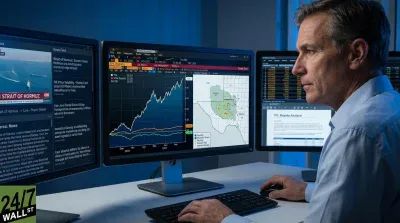
Since Iran closed the Strait of Hormuz on February 28, 2026, the global oil market has been volatile. U.S. and Israeli strikes on Iranian energy infrastructure sent crude prices surging through March. A ceasefire briefly knocked Brent below $100, then Pakistan-brokered talks collapsed after 21 hours of negotiations. President Trump announced a naval blockade of the strait. As of Tuesday, U.S. officials are signaling a second round of talks with Iran could happen before the ceasefire expires on April 21. Oil is pulling back on renewed diplomacy hopes. The ceasefire technically holds, but the strait remains effectively shut, and the structural supply shock that began in late February has not resolved.
For investors positioning around this, the instinct is often to buy Exxon or Chevron. One name that stands out in this environment is Texas Pacific Land (NYSE:TPL | TPL Price Prediction).
What TPL Owns
Texas Pacific Land owns the ground itself, not the oil beneath it. TPL holds ~882,000 acres of land concentrated in the Permian Basin and collects royalties from every barrel, every cubic foot of gas, and every barrel of produced water that passes through its land. Third-party operators do the drilling. TPL collects a check.
In Q4 2025, TPL generated income from four sources:
- Oil and Gas Royalties: $96.72 million in Q4 2025, driven by record quarterly production of 37,500 Boe/d.
- Water Sales: $60.73 million in Q4 2025, with record volumes of 1.0 million barrels per day. The Delaware Basin produces ~4 barrels of water for every barrel of oil.
- Produced Water Royalties: $33.5 million in Q4 2025, growing 25% year over year for full-year 2025.
- Easements and Surface Income: $20.61 million in Q4 2025, covering pipelines, wellbore access, and data center infrastructure.
The business model produces margins most industrial companies cannot approach. Operating margins ran ~71% on a trailing twelve-month basis, and EBIT margins have been reported as high as 83.7%. The asset-light structure eliminates production cost risk entirely.
How Oil Price Spikes Flow to TPL
When WTI climbed from $56.01 in early January 2026 to $114.01 by early April, that surge flowed almost entirely to TPL’s royalty income. There are no hedges to dilute the upside. CEO Tyler Glover has been explicit about this design: “Our business model is designed to succeed throughout the commodity cycle without the need for hedging, thus preserving considerable incremental upside for TPL when the industry macro environment eventually improves.”
Compare that to Exxon. Major integrated producers carry enormous capital expenditure obligations, refining margin compression, and operational exposure that absorb a significant portion of any price rally before reaching shareholders. TPL’s asset-light structure means the royalty check grows almost dollar-for-dollar with commodity prices. When Q4 2025 realized prices slipped from $65.14/bbl in Q3 to $59.48/bbl, TPL still grew full-year revenue 13% to $798.19 million and free cash flow 8% to $498.33 million.
Water Tech, Data Centers, and Active Land Acquisition
What separates TPL from a static royalty trust is active asset expansion. In 2025, the company deployed $450.7 million in cash to acquire 17,306 net royalty acres in the Midland Basin. It also committed $50 million to Bolt Data and Energy for data center campus development on TPL land, positioning itself at the intersection of energy infrastructure and AI-driven power demand in West Texas.
The produced water desalination program deserves attention. TPL has filed a patent for proprietary fractional freeze desalination technology and is constructing a Phase 2B facility targeting ~10,000 bbl/d capacity expected in 1H 2026, with a commercial-scale ~100,000 bbl/d Phase 3 facility targeted for 2027. If that technology scales, it adds a water-treatment revenue stream with no analog in the royalty trust universe.
Valuation, Volatility, and a Governance Shift
Three real constraints limit the upside case here.
- Valuation is demanding. At a current price near $422, TPL trades at a trailing P/E of roughly 60x and a forward multiple of ~38x. Analyst consensus price targets average $445, and GuruFocus has flagged its GF Value estimate at $333.6.
- No hedging cuts both ways. The same structure that amplifies upside in an oil rally leaves TPL fully exposed when prices fall. Q4 2025 natural gas realizations collapsed from $2.01/Mcf to $0.66/Mcf in a single quarter, dragging EPS to $1.79 against a $1.83 estimate. If the Iran situation resolves and WTI retreats sharply, royalty income follows.
- Governance uncertainty. Murray Stahl, CEO of TPL’s largest shareholder Horizon Kinetics and a TPL board member, passed away in early April. TPL shares dropped 15-16% on the news before recovering ~8%. Horizon Kinetics continues buying systematically, holding ~14.5% of outstanding shares, but the loss of Stahl introduces governance uncertainty.
TPL is up ~44% year to date even after recent volatility, and up 150% over five years. The ten-year return of ~2,626% reflects a land position in the most productive oil basin in the United States, managed by a team that has consistently expanded the asset base and grown cash flows through multiple commodity cycles without taking on debt.
TPL functions as a long-duration Permian compounder, offering commodity upside without operational risk. But the same unhedged structure that made 2026’s oil spike rewarding can turn just as quickly if diplomacy in the Strait of Hormuz finds its footing.
Contact [email protected] for any questions or corrections.
Omor Ibne Ehsan is a writer at 24/7 Wall St. He is a self-taught investor with a focus on growth, cyclical, and dividend equities that have strong fundamentals, value, and long-term potential. He also has an interest in high-risk, high-reward investments such as penny stocks.