Jensen Huang Says Nvidia Turns Electrons Into Tokens. That’s the Whole Business.

Photo of Jeremy Phillips
By Jeremy Phillips Published

Quick Read

  • Jensen Huang framed Nvidia (NVDA) as an “AI Factory” that converts electricity into tokens, positioning the company as the essential infrastructure capturing value between input electrons and output intelligence.

  • Data Center revenue surged 75% year-over-year to $62.3B in Q4 FY2026 while free cash flow jumped 124% to $34.9B, validating the factory metaphor with massive scale and efficiency gains.

  • Nvidia’s moat rests on supply chain control rather than fear of commoditization—even as token prices fall, exponentially growing agent usage and reasoning models will drive total token volume acceleration, with Microsoft processing over 100 trillion tokens in Q1 FY2026, a 5x year-over-year increase.

  • It sounds nuts, but SoFi is giving new active invest users up to $1,000 in stock for a limited time, and all it takes is a $50 deposit to get started. See for yourself (Sponsor)
    DISCLOSURE:
    INVESTMENTS ARE NOT FDIC INSURED • ARE NOT BANK GUARANTEED • MAY LOSE VALUE Brokerage and Active investing products offered through SoFi Securities LLC, member FINRA(www.finra.org)/SIPC(www.sipc.org). Advisory services are offered by SoFi Wealth LLC, an SEC-registered investment adviser. Information about SoFi Wealth’s advisory operations, services, and fees is set forth in SoFi Wealth’s current Form ADV Part 2 (Brochure), a copy of which is available upon request and at www.adviserinfo.sec.gov. Probability of Member receiving $1,000 is a probability of 0.026%; If you don’t make a selection in 30 days, you’ll no longer qualify for the promo. Customer must fund their account with a minimum of $50.00 to qualify. Other fees, such as exchange fees, may apply. Please view our fee disclosure to view a full listing of fees. Investing in alternative investments and/or strategies may not be suitable for all investors and involves unique risks, including the risk of loss. An investor should consider their individual circumstances and any investment information, such as a prospectus, prior to investing. Interval Funds are illiquid instruments, the ability to trade on your timeline may be restricted. Brokerage and Active investing products offered through SoFi Securities LLC, Member FINRA(www.finra.org) /SIPC(www.sipc.org). There are limitations with fractional shares to consider before investing. During market hours fractional share orders are transmitted immediately in the order received. There may be system delays from receipt of your order until execution and market conditions may adversely impact execution prices. Outside of market hours orders are received on a not held basis and will be aggregated for each security then executed in the morning trade window of the next business day at market open. Share will be delivered at an average price received for executing the securities through a single batched order. Fractional shares may not be transferred to another firm. Fractional shares will be sold when a transfer or closure request is initiated. Please consider that selling securities is a taxable event. Options involve risks, including substantial risk of loss and the possibility an investor may lose the entire investment Before trading options please review the Characteristics and Risks of Standardized Options  Investing in an Initial Public Offering (IPO) involves substantial risk, including the risk of loss. Further, there are a variety of risk factors to consider when investing in an IPO, including but not limited to, unproven management, significant debt, and lack of operating history. For a comprehensive discussion of these risks please refer to SoFi Securities’ IPO Risk Disclosure Statement This should not be considered a recommendation to participate in IPOs and investors should carefully read the offering prospectus to determine whether an offering is consistent with their investment objectives, risk tolerance, and financial situation. New offerings generally have high demand and there are a limited number of shares available for distribution to participants. Many customers may not be allocated shares and share allocations may be significantly smaller than the shares requested in the customer’s initial offer (Indication of Interest). For more information on the allocation process please visit IPO Allocation.
This post may contain links from our sponsors and affiliates, and Flywheel Publishing may receive compensation for actions taken through them.

Jensen Huang Says Nvidia Turns Electrons Into Tokens. That’s the Whole Business.

© Slaven Vlasic / Getty Images Entertainment via Getty Images

I’ve been holding Nvidia’s stock for years now, and even though I’ve watched about major interview CEO Jensen Huang has done, his recent framing of their business was so incredible that I wanted to share it with you as well.

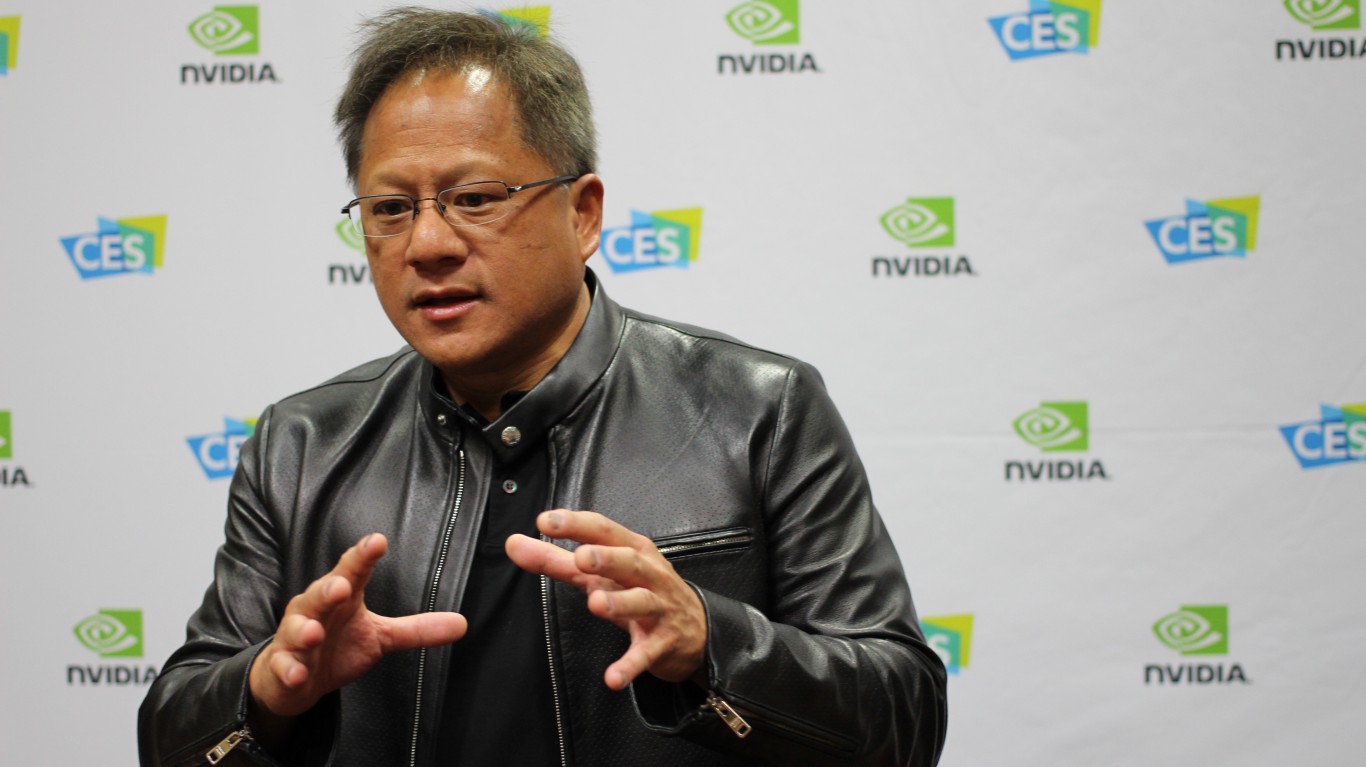
On the Dwarkesh Podcast, he reduced the entire business to one sentence: “The input is electron, the output is tokens. That is in the middle Nvidia.”

That’s the whole thesis: a factory that converts electricity into intelligence.

What an AI Factory Actually Is

Nvidia (NASDAQ:NVDA | NVDA Price Prediction) has spent years building toward this framing. Jensen has called data centers “AI factories” across multiple earnings calls, but the Dwarkesh appearance sharpened the concept. Every kilowatt of power flowing into a Blackwell rack comes out as tokens, the unit of AI output that every model, agent, and application runs on.

The numbers back the metaphor. Data Center revenue hit $62.3 billion in Q4 FY2026, up 75% year over year. Networking, the connective tissue of those factories, grew 263% year over year to roughly $11 billion, driven by the NVLink fabric ramp. Free cash flow for the quarter was $34.9 billion, up 124% year over year.

For full-year context, Nvidia has nearly $100 billion in supply purchase commitments, with Semi Analysis reporting the figure closer to $250 billion when broader supply chain obligations are included.

Why Commoditization Fears Miss the Point

The bear case on Nvidia usually goes: models get cheaper, token prices fall, demand softens. Jensen’s counter is structural. He argues the number of AI agents and tool users will grow exponentially, so even as the cost per token falls, total token volume accelerates. He specifically called out engineering software, predicting demand for tools like Synopsys Design Compiler will “skyrocket” as engineers get backed by fleets of agents exploring design space at unprecedented scale. His caveat: “The reason why it hasn’t happened yet is because the agents aren’t good enough at using their tools yet.”

The earnings calls support this directionally. Microsoft processed over 100 trillion tokens in Q1 FY2026, a fivefold increase year over year. Reasoning models compound that demand further. As Jensen explained: “The token generation amount, the number of tokens reasoning goes through, is a hundred, a thousand times more than a one-shot chatbot.”

The Supply Chain as Competitive Moat

Jensen’s real moat, as he described it on the podcast, is his ability to align the entire supply chain around his vision. Suppliers invest specifically for Nvidia because they trust he can absorb supply and sell it downstream. His annual GTC keynotes function as “education” to help the supply chain reason about AI’s trajectory. He was candid about the limits: “at some level, the instantaneous demand is greater than the supply upstream and downstream.”

That’s a near-term constraint worth watching. But for a company guiding to ~$78 billion in Q1 FY2027 revenue while holding 57 buy ratings and a $268 analyst consensus target, the market is clearly betting the factory model holds. When electrons keep getting cheaper and tokens keep getting more valuable, the machine in the middle tends to win.

Photo of Jeremy Phillips
About the Author Jeremy Phillips →

I've been writing about stocks and personal finance for 20+ years. I believe all great companies are tech companies in the long run, and I invest accordingly.
Continue Reading

Top Gaining Stocks

F Vol: 216,040,772
ENPH Vol: 11,494,602
ON Vol: 21,604,160
AKAM Vol: 10,963,672
HPE Vol: 27,485,105

Top Losing Stocks

CTRA Vol: 73,319,495
FDS Vol: 1,153,275
CEG Vol: 6,643,946
J Vol: 2,646,938
PODD Vol: 1,990,232