AMD Will Be a $1 Trillion Company Faster Than You Think
AMD’s conviction case is strengthening with every data point. Hyperscaler capex, server CPU share gains, and AI accelerator traction all reinforce the bull thesis on AMD (NASDAQ:AMD | AMD Price Prediction) heading into 2026.Here is the simple version. Hyperscalers are…


AMD’s conviction case is strengthening with every data point. Hyperscaler capex, server CPU share gains, and AI accelerator traction all reinforce the bull thesis on AMD (NASDAQ:AMD | AMD Price Prediction) heading into 2026.
Here is the simple version. Hyperscalers are pouring money into data centers fast enough that every component in the rack is straining on the supply side, and AMD sits inside two of the most strained corners. Server CPUs, where it has been quietly eating Intel’s share for years. And AI accelerators, where it has gone from also-ran to credible second source. NVIDIA (NASDAQ:NVDA) is still the GPU king. The AI buildout no longer needs only one winner, and that is the trade.
Reason One: The Data Center Engine
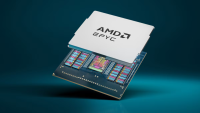
Q4 2025 data center revenue hit a record $5.38 billion, up 39% YoY. The OpenAI 6 gigawatt agreement, the Oracle public AI supercluster putting 50,000 GPUs into production in Q3 2026, the HPE Helios platform, AWS instances on 5th Gen EPYC, and the multi-year Microsoft Xbox custom silicon deal are real revenue with multi-year visibility. Lisa Su called “2025 was a defining year for AMD” on the Q4 call and said the company is entering 2026 “with strong momentum across our business, led by accelerating adoption of our high-performance EPYC and Ryzen CPUs and the rapid scaling of our data center AI franchise.” When the CEO talks like that and the segment numbers back her up, investors should pay attention.

Reason Two: The Earnings Inflection
FY 2025 revenue grew 34.34% to $34.639 billion. Net income grew 164.17% to $4.335 billion. Free cash flow grew 129.48% to $5.519 billion. Operating income grew 94.42% on roughly 34% revenue growth, which is what operating leverage looks like in the wild. Q4 free cash flow of $2.08 billion was a record on a record revenue quarter. This is the inflection the bull case has been waiting on for years.
Reason Three: The Balance Sheet
AMD ended 2025 with $10.55 billion in cash and $3.85 billion of debt. The company also ramped up buybacks aggressively. Companies in the middle of an AI infrastructure war rarely carry low leverage and active buybacks at the same time. AMD does.
The Honest Risk
NVIDIA is enormous, with a $5.07 trillion market cap and Q4 FY 2026 revenue of $68.127 billion against AMD’s $10.27 billion. CUDA is sticky. And U.S. export controls on the MI308 GPU to China cost AMD roughly $440 million in net inventory and related charges in FY 2025. What changes the calculus is that AI workloads are shifting from training toward inference as model gains plateau, and AMD’s accelerators are more competitive on inference than on training. Pair that with EPYC’s strength in CPUs, which every GPU rack still needs, and AMD wins as long as the rack gets built.

Why The Thesis Still Holds
The stock is up 50.92% YTD and 235.31% over the past year, sitting at a market cap of $549.8 billion. The path to $1 trillion looks like roughly two more years of the math AMD already printed in 2025. The thesis holds as long as the math keeps working.
Contact [email protected] for any questions or corrections.
Omor Ibne Ehsan is a writer at 24/7 Wall St. He is a self-taught investor with a focus on growth and cyclical stocks that have strong fundamentals, value, and long-term potential. He also has an interest in high-risk, high-reward investments such as cryptocurrencies and penny stocks.