Dow 50,000
The first 1,000 points took 76 years. The last 10,000 took 21 months. The Dow Jones Industrial Average needed 76 years to climb its first 1,000 points. It needed 21 months to climb its last 10,000. That contrast, more than…


The first 1,000 points took 76 years. The last 10,000 took 21 months.
The Dow Jones Industrial Average needed 76 years to climb its first 1,000 points. It needed 21 months to climb its last 10,000.
That contrast, more than anything else, is the story of Dow 50,000. The index closed at 50,115.67 on Friday, Feb. 6, 2026, jumping 1,206.95 points in a single session, or 2.47%. It was the first time the most-watched gauge in American finance had ever crossed five digits and a comma.
The number itself is round and shiny and a little arbitrary. The pace getting there is not.
From watching paint dry to a speedrun
The Dow was created on Oct. 7, 1896 with 12 industrial stocks. It would not finish a session above 1,000 until Nov. 14, 1972, when it closed at 1,003.16. Goldman Sachs, then a 45-partner firm with 1,500 employees, later called it “a milestone 76 years in the making.”
After that, the gaps started shrinking. The Dow took roughly 26 years to add the next 9,000 points and hit 10,000 in March 1999. It took about 18 years to reach 20,000. The jump from 20,000 to 30,000 happened in just under four years. Forty thousand showed up in May 2024.
Then came the speedrun. From 40,000 to 50,000 took 21 months, an annualized pace of roughly 14%. According to Edward Jones research, that is the strongest run between any two 10,000-point milestones in the Dow’s history.
What compounding looks like at five digits
Part of the answer is just math. A 10% gain on a Dow of 5,000 adds 500 points. The same 10% gain on a Dow of 45,000 adds 4,500. The bigger the base, the smaller the percentage move needed to clear the next big round number. The Dow does not have to run faster in percentage terms to hit milestones in months instead of years. It only has to keep doing what it has been doing.
The other part of the answer is what got it there. The 21-month sprint was not a straight line. The Dow briefly tumbled below 37,000 in April 2025 during the early tariff scare, then reclaimed 45,000 by August and ran through 46,000, 47,000, and 48,000 in quick succession. It crossed 49,000 for the first time on Jan. 6, 2026, and 50,000 exactly one month later.
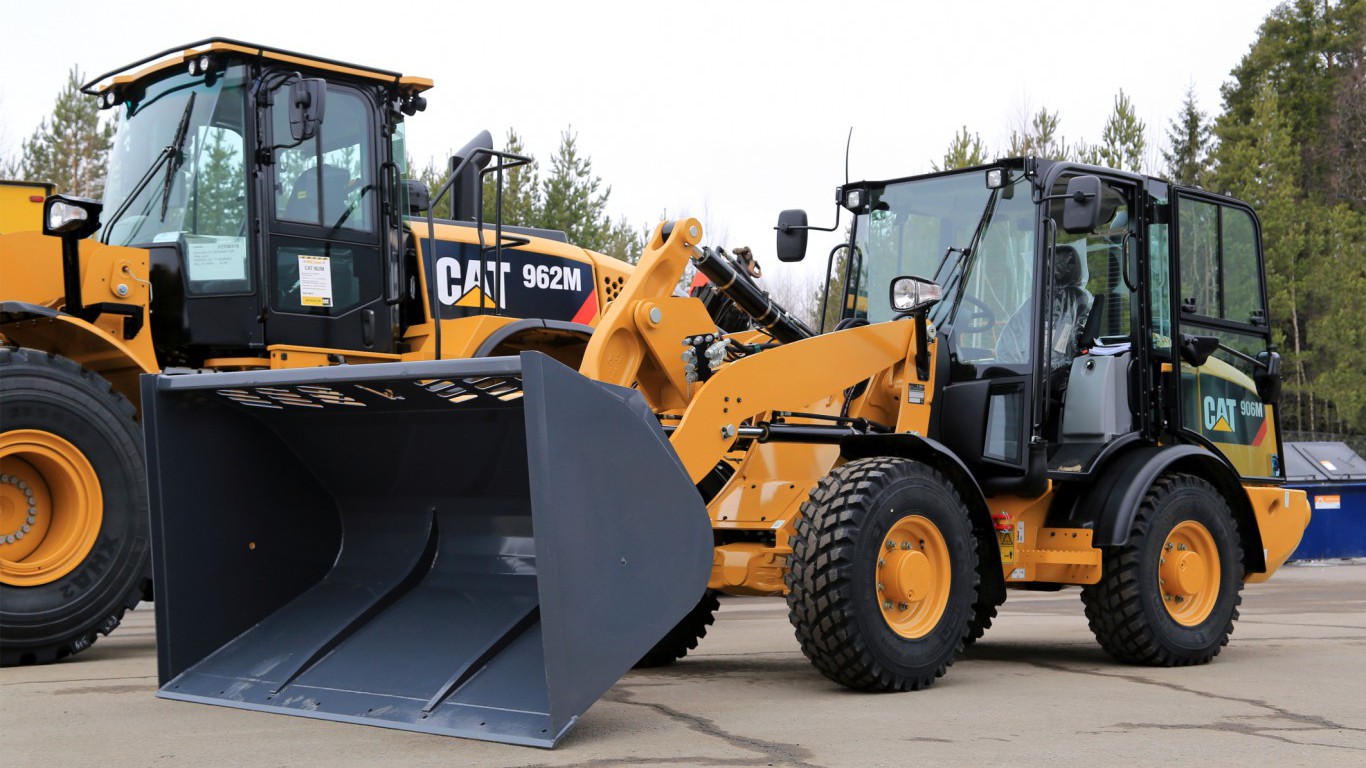
The biggest contributors during that stretch, excluding the late-2024 additions of NVIDIA and Sherwin-Williams, were Goldman Sachs, Caterpillar, IBM, JPMorgan, and American Express. The biggest detractors were UnitedHealth and Salesforce.
What history says comes next
Round numbers tend not to be tops. Edward Jones research shows the Dow has gained an average of about 17% in the twelve months after past 10,000-point thresholds. The 10,000 mark in March 1999 is the obvious exception. The dot-com peak came less than a year later.
The current run looks different in one important way. The Dow’s heaviest hitters are not in the sector at the center of today’s artificial intelligence fever. Goldman Sachs and Caterpillar sit at the top of the index. Microsoft is the only mega-cap AI name in the top ten. The next leg, whatever it looks like, will be written from a starting line that took the Dow 130 years to reach and 21 months to clear last.
Contact [email protected] for any questions or corrections.
Don Lair writes about options income, dividend strategy, and the kind of boring-but-durable investing that actually funds retirement. He's the founder of FITools.com, an independent contributor to 24/7 Wall St., and a former writer for The Motley Fool.