Realty Income Has Raised Its Dividend 113 Consecutive Times. Here Is Why That Is Not Enough to Own It Right Now
Realty Income (NYSE:O) is dominating dividend feeds on Reddit and X again, with monthly-payer loyalists pointing to its 113th consecutive quarterly dividend increase as proof you can collect a check and tune out the rest of the market. The underlying…


Realty Income (NYSE:O) is dominating dividend feeds on Reddit and X again, with monthly-payer loyalists pointing to its 113th consecutive quarterly dividend increase as proof you can collect a check and tune out the rest of the market.
The underlying numbers tell a different story.
The Math On O Has Quietly Broken
O trades at a trailing P/E of 55 and a forward P/E of 40, valuations that belong to a growth name, not a net lease REIT carrying 7.91x net debt to EBITDA and only 1.47x interest coverage. The numbers underneath that multiple are deteriorating. EPS missed consensus by 16.05% in Q4 2025, 12.67% in Q3, 44.50% in Q2, and 14.82% in Q1. Interest expense climbed to $1.13 billion in 2025 from $1.02 billion in 2024, and impairment provisions hit $471.3 million for the year. ROIC is negative.
Management’s own guidance underscores the issue. The 2026 AFFO guide of $4.38 to $4.42 implies 2.8% growth at the midpoint despite a $8.0 billion investment volume guide for the year, a 27% step-up over 2025 deployment. CEO Sumit Roy has conceded that “meaningful upside may take years to materialize.” Same-store rent growth is guided at 1.0% to 1.3%, occupancy is set to drift from 98.9% to 98.5%, and the top 20 clients account for 35.8% of base rent. Paying 40 times forward earnings for sub-3% per-share growth, rising leverage, and concentrated tenant risk is the trade-off retirement income buyers are increasingly questioning in exchange for a monthly payment cadence.
The Better Dividend Vehicle: ABBV
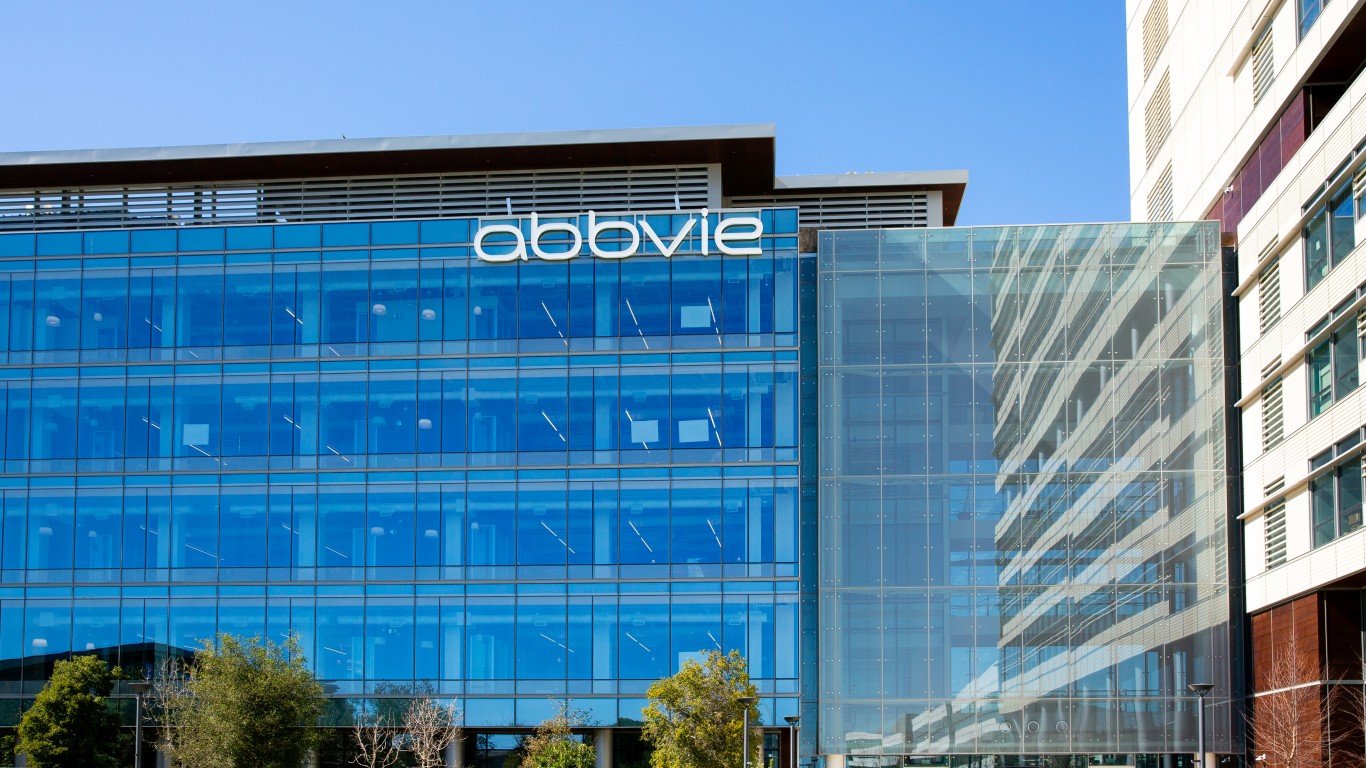
AbbVie (NYSE:ABBV | ABBV Price Prediction) is the redirect, and the case rests on three points.
1. The dividend is actually growing. AbbVie raised its quarterly payout 5.5% to $1.73, lifting the annual run rate to $6.92. The quarterly dividend has compounded every year from $0.40 in 2013 to $1.73 in 2026. Starting yield is 3.19%, lower than O’s 5.01%, and that is the point. A growing stream funded by expanding earnings outpaces a stretched yield funded by debt issuance.
2. The growth engine is delivering. Q1 2026 revenue came in at $15.00 billion, up 12.4% year over year and beating consensus. Skyrizi posted $4.48 billion at +30.9%, Rinvoq $2.12 billion at +23.3%, and neuroscience $2.88 billion at +26.0%. Management raised full-year 2026 adjusted EPS guidance to $14.08 to $14.28. CEO Robert Michael described AbbVie as “off to an excellent start in 2026, with first-quarter results exceeding our expectations.” The Humira erosion that anchored the bear case has already been absorbed, with Skyrizi and Rinvoq more than replacing the lost revenue.
3. The financial quality is in a different league. Gross margin sits at 70.2%, operating margin at 32.8%, interest coverage at 6.94x, and free cash flow yield at 4.88%. Against the midpoint of 2026 EPS guidance, the $6.92 dividend implies a payout ratio near 48.8%, leaving real cushion for further hikes and pipeline reinvestment. The forward P/E of 14 is meaningfully cheaper than O’s forward 40, with 24 Buy or Strong Buy ratings on the Street and a consensus target of $250.33 against a current price of $206.60.
What To Watch
For income-focused investors weighing the two names, the case rests on AbbVie’s growing payout, expanding earnings base, and lower forward multiple versus O’s stretched valuation, sub-3% AFFO growth, and rising leverage.
Contact [email protected] for any questions or corrections.
Alex Sirois is a financial writer with experience spanning both retail and institutional investing. He has written for InvestorPlace and held roles at BNY Mellon and Bernstein, giving him a perspective that bridges Main Street portfolios and Wall Street analysis.
Alex holds an MBA from George Washington University and has built his career across multiple industries, including e-commerce, education, and translation — a breadth of experience that informs how he breaks down complex financial topics for everyday investors. His writing is conversational, actionable, and grounded in long-term, buy-and-hold investing principles.
At 247 Wall St., Alex focuses on delivering analysis that is both accessible and useful, with a clear emphasis on helping readers make more informed decisions with their money.