


Live: Nvidia’s Q1 Earnings Tonight Could Send Shockwaves Across the Market

Quick Read
-
Nvidia (NVDA) reports Q1 FY2027 earnings today with guidance of $78.0B revenue (up 77% YoY) and 75.0% non-GAAP gross margin; Data Center revenue is expected to exceed $70B, with networking revenue having exploded 263% YoY last quarter driven by NVLink demand for Blackwell and GB300 systems.
-
This live blog is being updated by Thomas Richmond, a 24/7 Wall St. contributor. You’ll get expert analysis of Nvidia’s earnings. Simply stay on this page, and new updates will appear below automatically. We expect Nvidia’s earnings to be released shortly after 4:20 p.m. ET.
The analyst who called NVIDIA in 2010 just named his top 10 AI stocks. Get them here FREE.
Live Updates
Live Blog Winding Down
This concludes our live blog of NVIDIA’s Q1 earnings.
We hope you’ve enjoyed. At 24/7 Wall St., we host a weekly podcast on the biggest developments in AI. It’s named The AI Investor Podcast.
We’ll be releasing a new podcast tomorrow, breaking down NVIDIA’s earnings, so we hope you subscribe (it’s free!)
Here’s the best part, the Podcast recommends a full portfolio of AI stocks, and the average recommendation since we started in late 2024 is up nearly 150%. (See for yourself, we’ve attached the full spreadsheet of returns below!)
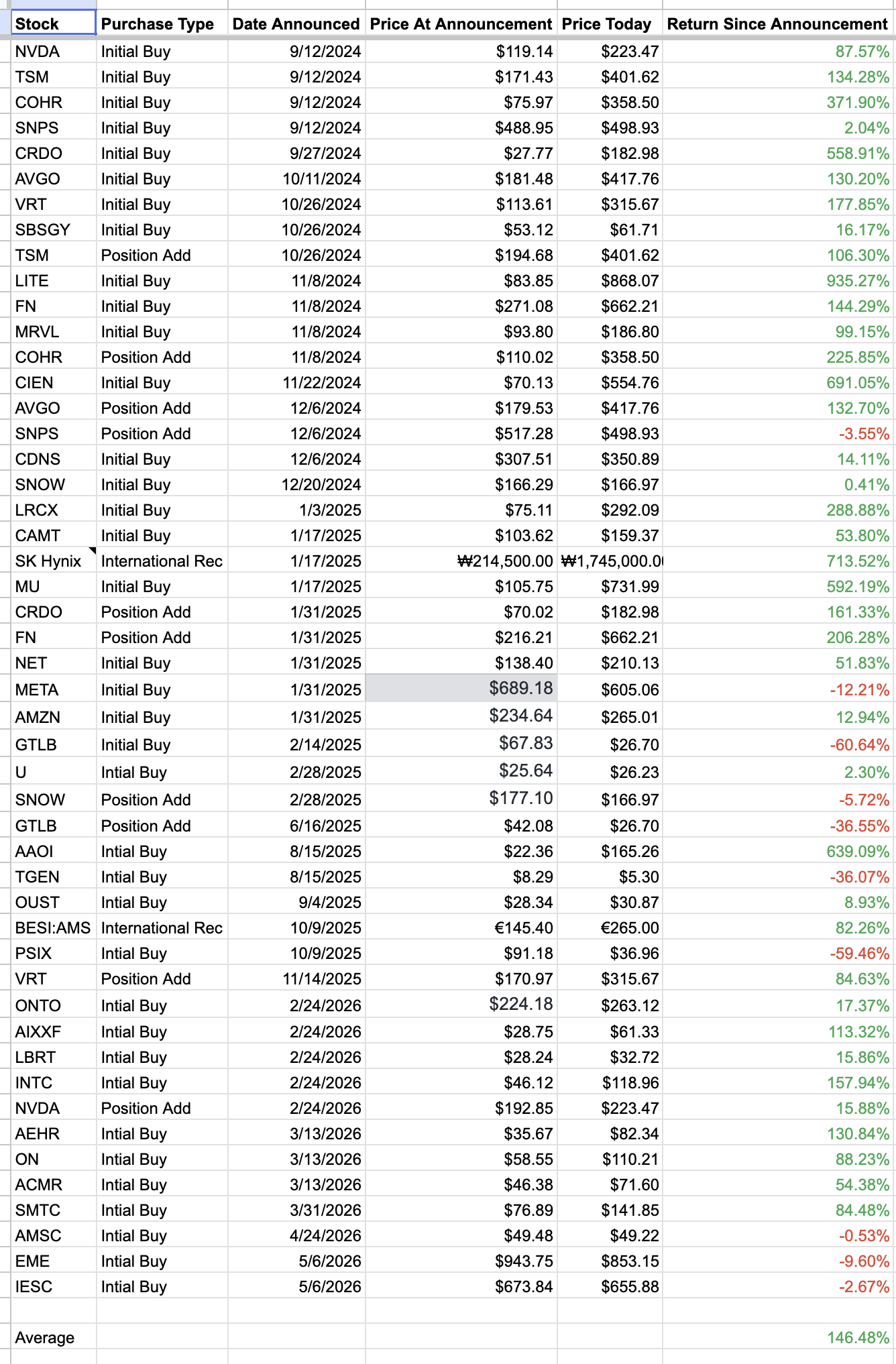
Once again, you can subscribe in your favorite Podcast player here.
Or you can listen to our latest episode in Apple Podcasts or Spotify below.
NVIDIA CEO Jensen Huang Ends Conference Call Saying "Demand Has Gone Parabolic"
NVIDIA’s conference call is now winding down, and CEO Jensen Huang ended the call with some fireworks. He said, “demand has gone parabolic.”
The bottom line: agentic AI is here and its driving the next wave of demand.
As we noted tonight, NVIDIA is now forecasting $20 billion in CPU sales this year (keep in mind, the company is famous for GPUs… So saying they could become the world’s largest CPU company is quite the development!)
And that number likely undersells the opportunity, as that’s a figure for standalone CPUs, while NVIDIA packages its CPUs across a number of systems. Huang also highlighted his “top 5 things.” I’ve included the full quote below, but here’s a summary.
- NVIDIA is the only platform that runs every frontier AI model and has added Anthropic to its partners.
- NVIDIA is in every hyperscale cloud.
- NVIDIA offers a full stack AI factory solution that powers everything from AI native clouds, to sovereign AI clouds, to on-premise enterprises and industrial infrastructure
- NVIDIA CUDA extends to the edge of robotics and enables physical AI (we mentioned earlier in this live blog that NVIDIA just announced its ‘physical AI’ revenue is now $9 billion).
- NVIDIA’s Vera CPU is the world’s first CPU purpose-built for agentic AI and opens up a new $200 billion TAM.
There you have it, the complete list of opportunities NVIDIA is most excited about. Huang’s closing comments are below:
Jen-Hsun Huang Chief Executive Officer
This was an extraordinary quarter, demand has gone parabolic. The reason is simple. Agenttic AI has arrived. AI can now do productive and valuable work. Tokens are now profitable, so model makers are in a race to produce more.
In the AI era, compute capacity is revenue and profits. NVIDIA is the platform of this era. Of all the platforms in the world NVIDIA compute supports the richest diversity of demand. Let me highlight my top 5 things. First, NVIDIA is the only platform that runs every Frontier AI model. With the addition of Anthropic to our existing partners, OpenAI, [ X-AI ], [ Meta MSL ], Gemini and many others, our share of Frontier AI is growing.
Second, we are in every hyperscale cloud, supporting their core data processing and machine learning workloads, internal services as well as supporting their demand for NVIDIA users in their public cloud services. Third, our full stack complete AI factory solution and vast global ecosystem let us uniquely address new AI data center segments. New AI cloud new AI native clouds and sovereign AI clouds and on-premises enterprise and industrial infrastructure. This is the second category I was talking about earlier.
Fourth, NVIDIA CUDA extends all the way to the edge, robotics, autonomous vehicles, embedded medical instruments, AI ran telco base stations. The next wave is physical AI with billions of autonomous and robotic systems operating in the physical world. This is the third segment we were talking about earlier.
And rounding out the top 5 things, we have a major new growth driver, Vera, the world’s first CPU purpose-built for Agentic-AI. Vera opens a brand-new $200 billion TAM for NVIDIA, a market we have never addressed before. And every major hyperscaler and system maker is partnering with us to deploy it. The world is rebuilding computing for agentic AI and robotic physical AI. NVIDIA sits at the center of these transitions. We built NVIDIA compute platform over 3 decades, one architecture, vast ecosystem, extreme co-design across chips, systems, networking and software.
We built it ahead at this moment so that when agentic AI arrived NVIDIA would be ready. It has arrived. Look forward to catching up next time.
NVIDIA CEO Jensen Huang Reveals 3 Growth Markets to Exceed the Company's $1 Trillion Demand Forecast
Earlier, we detailed how NVIDIA had previously issued a forecast that Blackwell and Vera Rubin demand would reach $1 trillion. Investors had hoped the company would update that target tonight, but the company’s CFO Colette Kress maintained it.
That took one catalyst for shares tonight away.
And yet, a very astute qustions from Goldman Sachs on tonight’s conference call highlighted that $1 trillion figure was only for Rubin and Blackwell. Other opportunities like LPX (the company’s acquisition of Groq), Rubin CPX, and CPUs could drive upside.
NVIDIA CEO Jensen Huang was quick to note three ways the company could add incremental revenue above $1 trillion. First, he said the company could take more share on frontier AI models (we’ve noted tonight that Huang has talked about increasing share with Anthropic). Second, Huang said CPUs could drive the company above the $1 trillion forecast. Third, Huang highlighted LPX (Groq), but noted it remains quite limited.
Here’s the full exchange below.
James Schneider Goldman Sachs Group, Inc., Research Division
Back at GTC, I believe you discussed $1 trillion visibility into both your Rubin and Blackwell platform revenue. But I believe that excluded things like LPX, Rubin CPX and the Vera CPU [ Rex ], can you maybe give us a sense about whether the Vera CPUs are going to be the biggest source of upside above and beyond that $1 trillion? Are you contemplating other sort of combinations of products, including CPUs that would allow you to gain an even greater share of that total TAM?
Jen-Hsun Huang Chief Executive Officer
In terms of — in terms of incremental above the $1 trillion, I would say, one, the continued growing of share of the Frontier AI models. I’m expecting to grow more share. And so I’m expecting that to grow. Number two, we didn’t include any Vera CPU, stand-alone CPU in that number. And so I expect that to be the second largest. The TAM is, of course, quite large in agentic systems, and all of our customers are quite excited about Vera and we’re going to sell a whole bunch of Vera’s. And then third would be LPX. because as I explained earlier, LPX is designed as a — because of its SRAM architecture has the benefit of very low latency and very very high interactivity, but it’s also its throughput, its context processing ability is also quite limited.
And that’s just kind of the nature of SRAM type base systems. And — but the combination, we’ll be able to address address the entire spectrum of AI from pretraining to post-training to inference agentic systems through the combination of Vera Rubin and LPX.
NVIDIA Announced $20 Billion in CPU Sales Tonight: But That Number Undersells the Opportunity
The biggest news on NVIDIA’s conference call tonight is the company revealed they expect to record $20 billion in CPU sales this year. That would set the company up to be the world’s leading CPU supplier.
Yet, that number may actually undersell the opportunity. NVIDIA’s CEO Jensen Huang clarifed later on the call that the $20 billion figure is just for standalone CPU sales. That’s an important distinction because the company sells standalone CPUs in addition to larger systems that include CPUs.
Put succinctly, NVIDIA’s actual CPU revenue will likely be much higher than $20 billion. Here’s the full exchange:
Vivek Arya BofA Securities, Research Division
Jensen, there’s a lot of excitement around CPU for Agentic applications and just a lot of noise around the number of CPUs actually exceeding the number of GPUs. And I was just hoping that you could kind of give your perspective that, first of all, is this an incremental workload? Is this kind of cannibalizing what the GPU would have done otherwise?
And then secondly, the $20 billion number that you gave, is that for stand-alone Vera CPUs? Or is that kind of already included in that Vera as part of Vera Rubin? So just if you could educate us on the role of CPU versus GPU is it cannibalistic? Is it incremental? And then the $20 billion number, how to kind of put that in context with what you sell, right, which is usually the CPU as part of the GPU.
Jen-Hsun Huang Chief Executive Officer
The $20 billion is for stand-alone CPU. And remember, we have Vera is used in 3 ways. As a stand-alone — 4 ways — let me just start with the one that you already know. The first way is Vera Rubin. And we’ll sell millions of Rubins, and every 2 of them is connected to a Vera. And of course, we price those 2 and they’re properly priced. And so that’s #1 use case.
The second use case is Vera standalone CPU. The third is Vera with [ CX-9 ] and the software stack for storage. And then Vera in a [ CX-9 ] — with a software stack for security and compute isolation and confidential computing. Okay, so each one of those use cases is built on Vera. And my sense is that we’ll be supply constrained throughout the entire life of Vera Rubin. There are 4 different use cases of it. And — but anyhow, the answer to your question is of the $20 billion is a stand-alone. With respect to CPUs, an agent is essentially what people call a harness. The agent has a harness that does the — and the harness could be open cloud, it could be Hermes, code — Cloud Code is essentially a harness around Cloud around the OPUS model. OpenAIs Codex is a harness around the GPT 5.5 model.
And so these are harnesses. And these harnesses provide for things like IO, orchestration, memory management tool use connected to tools, for example, browsers and things like that, see compilers, python compilers. And so the harness runs on CPU. And the tool use runs on CPUs. So for example, if the AI were to do a search or do a browser, use a browser that would run on the CPU. The world has 1 billion users, human users. My sense is that the world is going to have billions of agents. Not today, I mean, we’re going to grow into it but we’ll have billions of agents. And those billions of agents will all use tools. And those tools that can be like PCs, just like us humans using PCs today. In the future, you’ll have an agent using PC and so if you kind of think along the lines of in the future, you pick your favorite number of agents at the moment at the moment, call it, a few hundred thousand, but in the future, call it, eventually a few billion.
I could imagine them all using the effectively having PCs that they can all use. And so — but the large length, every one of those agents are going to spin off subagents. And every time they spin these off, you’re going to need to do inference. That’s where the thinking happens. All of the thinking happens on GPUs, all of the orchestration essentially runs on CPUs. And the subagents when they’re spun off, they — when they’re thinking they use GPUs. Whenever the agents use simulators, those can run on CPUs or GPUs, which is the reason why we’re working so closely with Cadence and Synopsys and to accelerate all of the world’s tool we’re accelerating all of the world’s tools and data processing engines and database engines because agents use these tools and have — they have lower patients tolerance humans, and they want things to happen quickly. And so we’re accelerating all the world’s tools so that it runs on CUDA. And you could see us doing that when I work with Cadence and Synopsys, and Siemens and companies in Adobe. And that’s because we’re trying to get all of the world’s tools to run on GPUs because they already have GPUs, and it’s a lot faster. So we’re going to need a lot more CPUs, and Vera was designed to be an agenetic CPU. The CPUs of the past were designed to have many cores so that it could be easily rentable. People rent at course. Well, agents don’t rent cores.
They just want the work to be done fast. The economics of the past was dollars per core. That’s the economics of cloud computing of the past. The economics of the AI of the future is tokens per dollar or dollars per token. And so what we need to do in the future is to generate tokens, process tokens as fast as possible, and that’s what Vera does incredibly well. So we’re expecting to be very successful with Vera. But ultimately, ultimately, what we’re doing is we’re building infrastructure for AI and it needs incredibly great storage.
That’s the reason why we built STX. It needs incredibly good networking. That’s why we have Spectrum-X. It needs incredibly great GPUs, of course, and inferencing ability. That’s the reason why NVLink 72. It needs incredibly great security and confidential computing, which is the reason why Vera Rubin is the world’s first platform with end-to-end confidential computing and it needs great CPUs. We’ve got it all covered.
Inference Is Driving AI Growth in 2026 - Here's What NVIDIA CEO Jensen Huang Had to Say About the Market
On tonight’s NVIDIA conference call, Christopher Muse of Cantor Fitzgerald asked about how the company’s inference market share looked in 2026 and 2027.
Jensen Huang was quick to note the company is growing its market share. One area worth noting is Huang highlighted the company’s growth with Anthropic, which is quickly becoming one of the most important companies in AI. Here is the full exchange below:
Christopher Muse Cantor Fitzgerald & Co., Research Division
You have Vera Rubin coming soon, and you obviously have great insight into coming updates to frontier models, new techniques to optimize around diverse AI workloads with interest keenly focused on your market share and inference. How do you see Vera Rubin in your [ Extreme co-engineering ] impacting your share of the inference market as we look into late ’26, ’27?
Jen-Hsun Huang Chief Executive Officer
Well, we are growing share in inference, and we’re growing share in inference very, very quickly. And the reason for that is this year, the number of frontier model companies grew. And so there’s Cursor and [ Complexity ] and there’s some new model companies, TML and Reflection and the list goes on. And so the number of frontier model companies has grown, and we added Anthropic to our partnership this year. They’re expanding incredibly fast. We’ve partnered with them to secure computing capacity across Azure, AWS, [ Core weave ], I forget who else we’ve already announced, but there’s a whole list of others that we are bringing online for them.
And so the amount of capacity that we’re going to bring online for Anthropic this year and next year is going to be quite significant, very significant. And so we’re growing — and our coverage of anthropic has been largely 0 until just recently. And so we’re gaining share tremendously in inference.
Vera Rubin’s is going to be even more successful than Grace Blackwell at this point. every single, I can’t think of one. Every single frontier model company will jump on Vera Rubin from the get-go, and that wasn’t true before on Blackwell. And so Vera Rubin is off to a tremendous start and will surely be more successful than even Grace Blackwell. So I think the end of your answer, C.J., is that we’re gaining share in inference. Let me go back again to the question that Ben was asking.
Remember, so far, everything that I’ve just explained in the inference question is really focused on hyperscale Remember, there’s a whole second category of AI data centers that we serve almost uniquely. Now this segment is very fragmented. It requires a fairly — really well-integrated platform solution and a very large go-to-market. And that segment, all of the inference, 100% of that — the vast majority of that is NVIDIA. And then, of course, physical AI. NVIDIA is practically the only company serving physical AI today. And we’ve been working on physical AI for a long time. And so that is also growing. So our share of inference is growing very quickly.
Investors Were Watching If NVIDIA Would Update Their $1 Trillion Demand Forecast Tonight - Here's What They Had to Say
NVIDIA (NVDA) has previously forecast $1 trillion in demand for Blackwell and Rubin through the end of 2027. One area investors were watching tonight was whether the company would update that forecast given many of the tailwinds across the AI space.
CFO Colette Kress just finished her statements, and she re-emphasized the trillion-dollar figure:
“Let me turn to the outlook for the second quarter. Total revenue is expected to be $91 billion, plus or minus 2%. We expect sequential growth to be driven primarily by data center. We are continuing to work vigorously on our supply chain ecosystem to address the incredible demand we see ahead of us, giving us full confidence in the $1 trillion in Blackwell and Rubin revenue we foresee from 2025 through calendar 2027.”
Updating their trillion-dollar demand figure was seen as a potential catalyst this quarter, but it doesn’t appear NVIDIA is willing to increase its forecast at this time.
NVIDIA's Robotics Unit is Now a $9 Billion Business and Growing Fast
NVIDIA has described ‘physical AI’ as a $50 trillion opportunity. Embedded in that number is the idea that robotics will become the next massive opportunity beyond data centers.
On tonight’s earnings call, NVIDIA’s CFO announced that their sales of ‘Physical AI’ exceeded $9 billion in the past 12 months. NVIDIA changed how they report tonight, so this new disclosure on physical AI revenue could be related to that new reporting.
It’s likely this number includes both robotics products like Jetson as well as the company’s self-driving revenues.
NVIDIA Reveals CPU Revenue for the First Time: Says They're 'The World's Leading CPU Supplier'
Investors are rabidly buying Intel (INTC) on the incredible surge in CPU demand this year, but NVIDIA just revealed how much revenue they’re getting from CPUs. On the company’s call, NVIDIA reported having visibility to $20 billion in CPU revenue.
NVIDIA says this would make the company the world’s leading CPU supplier. Here’s the exact quote:
“Agentic-AI and reinforcement learning represents new growth opportunities for CPUs. Building on the success of our [ Brace ] CPU, Vera is arriving just in time to meet this inflection. Built on custom arm [indiscernible] and codesigned end-to-end with Rubin GPUs and NVLink, Vera will deliver up to 1.5x faster performance per core, 2x performance per watt and 4x density per rack compared to x86-based alternatives.
Vera CPU opens a brand-new 200 billion [ down ] for NVIDIA a market we have never addressed before. And every major hyperscale and system maker is partnering with us to get it deployed. We have visibility to nearly $20 billion in total CPU revenue this year, setting us up to become the world’s leading CPU supplier.”
NVIDIA Reports Its Hyperscaler Revenue For the First Time Ever - 46% of Revenue Comes from Hyperscalers
We noted in our last update that NVIDIA (NVDA) is changing how it reports its revenue. It will now directly report revenue coming from hyperscalers versus other companies (AI clouds, industrial, and enterprise customers).
Here’s what NVIDIA had to say:
“Moving back to our data center results. Hyperscale revenue of $38 billion was approximately 50% of data center revenue and increased 12% quarter-over-quarter. ACIE revenue was $37 billion and grew 31% quarter-over-quarter, including AI cloud revenue that more than tripled year-over-year. Our customers have enabled rapid stand-up of AI compute capacity.
The number of partner [indiscernible] exceeding 10 megawatts has nearly doubled in just 1 year, now surpassing 80 sites. Sovereign revenue increased more than 80% year-over-year. NVIDIA AI infrastructure is now deployed across nearly 40 countries, representing $50 trillion in GDP. As evident to our Q1 results, our customer base is diverse and growing, supported by our best ecosystem and installed base, breadth of CUDA accelerated application and the lowest token cost provider. We are well-positioned to address a market opportunity that far exceeds that of any other AI computing platform.”
The bottom line: hyperscale revenue of $38 billion is about 46% of NVIDIA’s total. The company reported
NVIDIA Announces Important New Disclosures On Tonight's Q1 Conference Call
NVIDIA’s CFO Colette Kress is speaking on the company’s conference call and has announced a major shift in how the company reports revenue.
Here’s what she had to say:
“For your models, data center computing revenue of $60 billion was up 77% year-over-year while data center networking revenue of $15 billion, nearly tripled year-over-year.
Before we dive into data center, we’d like to brief you on our transition to a new reporting framework that better reflects our current and future growth drivers. We have 2 market platforms, data center and edge computing. Within data center, we will report 2 submarkets hyperscale and ACIE, which incorporates AI clouds, industrial and enterprise. Hyperscale will include revenue from the public cloud and the world’s largest consumer Internet companies, while ACIE addresses our growth opportunities in diverse AI purpose-built data centers and AI factories across industries and countries. Edge computing highlights devices for agent and physical AI, including PCs, gaming consoles, workstations, AI RAN base stations, robotics, and automotive. For your reference, we have posted on our website a revenue breakdown based on our new platforms for the past 9 quarters. ”
The bottom line here is that investors will now see exactly how much revenue is coming from hyperscalers. Concentration in this group has long been one of the biggest factors weighing on NVIDIA’s share price.
NVIDIA's Conference Call Is Starting - We'll Keep Updating This Blog
The next big event NVIDIA shareholders need to watch is the company’s conference call. Its starting now.
We will continue issuing updates during the call, so if you’ve been following this live blog, don’t leave now. New updates will post automatically.
We’ll likely post 5 to 6 updates across the earnings call with the most important quotes and statements from NVIDIA’s management team.
Nvidia Is Building a Second AI Business Beyond Hyperscalers
Nvidia’s earnings presentation showed something interesting. The company broke Data Center revenue into two categories for the first time: traditional hyperscalers and a separate group called AI Clouds, Industrial, and Enterprise (ACIE).
Hyperscalers generated roughly $37.4 billion in quarterly revenue, while the ACIE segment actually came in slightly higher at $37.9 billion. That suggests AI demand is spreading far beyond just Microsoft, Amazon, Meta, and Alphabet into enterprise AI deployments, sovereign AI projects, and specialized AI cloud providers.
That’s important because one of the biggest concerns around Nvidia has been whether the business depends too heavily on a small number of hyperscalers. This new breakdown suggests the company’s AI customer base may already be broader than many investors assumed.
Nvidia’s AI Economics Narrative Is Becoming a Bigger Competitive Weapon
Nvidia repeatedly emphasized that its AI infrastructure delivers the lowest token cost and highest token throughput based on recent MLPerf and InferenceX benchmarks.
The AI market is increasingly shifting from simply building larger models toward generating AI output efficiently and profitably at scale. As inference workloads grow, cost per token and throughput become increasingly important competitive metrics.
Nvidia appears to be positioning itself as the maker of the world’s fastest chips as well as the company delivering the best overall economics for operating large AI systems. That could become increasingly important as hyperscalers and enterprises focus more heavily on AI monetization and return on investment.
Nvidia Says Agentic AI Could Create a Major CPU Opportunity
Nvidia spent part of its earnings presentation highlighting CPU growth opportunities, which is something investors rarely associate with the company.
Management specifically pointed to agentic AI and reinforcement learning as emerging workloads that could increase demand for CPUs alongside GPUs. That’s notable because Nvidia has historically been viewed primarily as a GPU company.
The shift suggests Nvidia increasingly wants to own more of the full AI compute stack rather than just accelerators. If successful, that could significantly expand Nvidia’s total addressable market over the next several years as AI infrastructure becomes more complex and compute-intensive.
Top Questions Ahead of Nvidia's Q1 Earnings Call Tonight at 5 PM
Nvidia’s Q1 earnings call begins at 5:00 PM ET via webcast at investor.nvidia.com. Shares are flat after the earnings release, but any insights gleaned from tonight’s call could send the stock in a totally different direction tomorrow.
Top 5 Questions for Management
- Path forward on China licenses after zero H20 shipments in Q1.
- Why Data Center Compute landed at $60.4B versus the $61B bar.
- Vera Rubin and Blackwell 300 ramp timing.
- Durability of 75.0% gross margin after lapping the H20 charge.
- How much of supply commitments at $119.0B is firm versus optional.
Clarify From the Release
- Q2 guide of $91.0B excludes China
- The dividend jumped from $0.01 to $0.25 alongside an $80.0B buyback, signaling a shift in capital allocation.
Red Flags
- Softer hyperscaler tone
- Networking deceleration after +199% YoY
- Weaker Gaming guidance on elevated memory prices
Nvidia's Q2 Guidance Blew Past Wall Street's Estimates
Guidance Bombshell: $91 Billion Blows Past the Street
The headline surprise in Nvidia’s Q1 earnings tonight is the Q2 FY2027 revenue guide of $91.0 billion, plus or minus 2%, well above the $87.36 billion consensus and a clean step-up from $81.61 billion reported for the first quarter. Management raised the bar materially after already crushing its own ~$78.0B Q1 guide.
The Hidden Surprise
Critically, the figure excludes any Data Center compute revenue from China, leaving optionality untouched. Non-GAAP gross margin is held at 75.0% (±50 bps), defying compression fears as Blackwell 300 ramps.
Key Assumptions
Total supply commitments swelled to $119.0 billion from $95.2B, underwriting visibility. Some things to watch out for are a substantial Q2 cash tax jump and an FY2027 tax rate of 16.0%-18.0%. Guidance was unambiguously raised, signaling continued acceleration rather than the normalization bears feared.
Nvidia's Capital Return for 2026 Just Got Supercharged
Beyond the headline beat, NVIDIA’s board authorized one of the largest shareholder return packages in its history, a story buried under the Data Center compute miss driving shares down 1% after-hours.
Dividend Hike
The quarterly dividend jumps from $0.01 to $0.25 per share, payable June 26, 2026, to holders of record on June 4.
Buyback Authorization
The board added $80 billion in fresh repurchase capacity on top of $38.5 billion remaining. Q1 alone returned roughly $20 billion via buybacks and dividends.
Why It Matters
Free cash flow hit $48.55 billion, up 85.41% YoY. With insider activity flagged as net buying, the capital return signal counterweights tonight’s compute concerns. Keep an eye on the stock as Jensen Huang opens the call at 5:00 PM ET.
Nvidia’s Monster Q1 Results Just Raised the Stakes for the Entire AI Trade
Nvidia delivered another massive quarter, but the report also reinforced how dependent the company has become on AI infrastructure spending staying red-hot.
Bull Case
- Data Center revenue jumped to $75.2 billion, now representing more than 92% of total revenue
- Q2 guidance of $91.0 billion implies another strong quarter as Vera Rubin rollout begins
- Net income nearly tripled to $58.3 billion, showing profitability is scaling even faster than revenue
- Nvidia returned roughly $20 billion to shareholders and approved another $80 billion buyback authorization
- Gross margins held near 75%, reinforcing Nvidia’s pricing power in AI infrastructure
Bear Case
- Operating expenses jumped 51.5% year over year as Nvidia aggressively ramps its hardware roadmap
- The business is becoming increasingly concentrated around hyperscaler AI spending and data centers
- Nvidia’s dividend increase looks less meaningful beside the $19.3 billion spent on buybacks this quarter
- Inventory and supply chain execution become more important during the Vera Rubin transition
- Expectations remain extremely high after another major earnings beat and raised guidance
Nvidia Stock Flat Despite Delivering "A Grade" Q1 Results
Overall Grade: A. NVIDIA (NASDAQ:NVDA | NVDA Price Prediction) delivered a clean beat-and-raise with $81.61B revenue, $1.87 EPS, and a Q2 guide of $91.0B that exceeded the $87.36B consensus.
| Category | Grade | Notes |
|---|---|---|
| Revenue | A | +85.2% YoY, Data Center +92%. |
| EPS | A | Beat by 5.42%, 4th straight beat. |
| Guidance | A+ | Q2 $91B, excludes China. |
| Margins | A | Non-GAAP GM 75.0% held. |
| Cash Flow | A | FCF $48.55B, +85.4%. |
| Mgmt Confidence | A+ | $80B buyback, dividend 25x hike. |
Supply commitments at $119B signal visibility well beyond next quarter. Watch Jensen Huang’s 5:00 PM ET call for China and Rubin commentary.
Nvidia Highlights Rubin Launch, CPU Expansion, and China Optionality
Nvidia’s earnings presentation included several important forward-looking updates that investors will likely focus on during tonight’s conference call:
- Vera Rubin remains on track for launch in the second half of the year, with rollout beginning in Q3
- Nvidia is increasingly emphasizing its CPU opportunity alongside GPUs, signaling the company sees a much larger long-term AI infrastructure market beyond accelerators alone
- Investors will likely watch closely for commentary around CPU growth and how Nvidia plans to compete more aggressively in full-stack compute systems
- As expected, Nvidia reported zero China shipments during the quarter due to ongoing export restrictions
- Importantly, Nvidia’s Q2 guidance also assumes zero China Data Center revenue, meaning any positive commentary around China demand or export approvals in tonight’s earnings call could create upside for future estimates
The China setup may become especially important because Nvidia already delivered stronger-than-expected guidance without contributions from one of the world’s largest AI markets.
Nvidia CEO Says the AI Infrastructure Boom Is Accelerating
CEO Jensen Huang used Nvidia’s earnings release to reinforce the company’s long-term AI narrative, calling the AI factory buildout “the largest infrastructure expansion in human history.”
Management also emphasized that “agentic AI has arrived,” with AI systems increasingly performing productive work and scaling across industries. The commentary suggests Nvidia believes enterprise AI adoption is still early rather than peaking.
Nvidia also positioned itself as the core infrastructure layer powering the AI ecosystem across hyperscalers, cloud providers, frontier AI labs, and edge deployments. That messaging matters as investors continue to debate whether current AI spending levels are sustainable long-term.
Nvidia Just Authorized Another $80 Billion Buyback
Nvidia announced roughly $20 billion in shareholder returns during Q1 through dividends and share repurchases while also approving an additional $80 billion buyback authorization with no expiration date.
The company ended the quarter with roughly $38.5 billion remaining under its prior authorization, meaning Nvidia now has well over $100 billion available for future repurchases. Nvidia also raised its quarterly dividend from $0.01 per share to $0.25 per share.
The move signals continued confidence from management despite Nvidia already becoming one of the world’s most valuable companies. Strong free cash flow generation of roughly $48.6 billion during the quarter continues to give Nvidia enormous flexibility to invest aggressively while still returning capital to shareholders.
Nvidia Stock's Down 3% Post-Earnings on Data Center Revenue Miss
Despite beating on revenue, EPS, gross margins, and Q2 guidance, Nvidia shares are down because some of the company’s most closely watched AI metrics came in mixed.
The biggest issue may be Data Center Compute revenue, which came in at $60.4 billion versus expectations closer to $61 billion. That miss matters because compute remains the core engine of Nvidia’s AI story and carries some of the company’s highest investor expectations.
Investors may also be reacting to signs that Nvidia’s growth mix is shifting. While Networking revenue climbed to $14.8 billion, exceeding expectations of $12.8 billion, some investors likely wanted to see even stronger acceleration in the core GPU compute business.
The setup heading into earnings was also extremely aggressive, with Nvidia shares already rallying sharply into the report and Wall Street broadly expecting another major beat. In that environment, even strong results can trigger a sell-the-news reaction if expectations were simply too high.
Nvidia Q1 Earnings Are Out - Stock Falls 3%
Nvidia just reported Q1 earnings with shares initially down 3% following the report. Here are the key numbers:
- Revenue: $81.62 billion vs. $79.19 billion expected
- Adjusted EPS: $1.87 vs. expectations near $1.77-$1.78
- Adjusted Gross Margin: 75.0%
- Data Center Revenue: $75.2 billion vs. $73.48 billion expected
Guidance:
- Q2 Revenue: $91.0 billion ±2% vs. $87.36 billion expected
- Q2 Adjusted Gross Margin: 74.5%-75.5%
Quick read:
Nvidia delivered another major beat driven by continued AI infrastructure demand, with Data Center revenue once again coming in ahead of expectations.
The biggest bullish surprise may be Q2 guidance, which came in well above Wall Street estimates and suggests hyperscaler AI spending remains extremely strong despite concerns around slowing demand.
Nvidia’s Networking Business Is An Underappreciated AI Growth Driver
Nvidia’s networking business is becoming one of the company’s fastest-growing AI segments. The division generated roughly $11 billion in Q4 revenue, up about 3.5x year over year, driven by soaring demand for NVLink, Spectrum-X Ethernet, and InfiniBand connectivity products.
The bigger story is that Nvidia’s networking stack is increasingly tied to the growth of massive AI clusters. As hyperscalers build larger GPU systems, demand for high-speed interconnects is rising alongside compute demand because AI workloads become bottlenecked by data movement and latency.
Investors are also watching Nvidia expand beyond its own GPU ecosystem. Amazon Web Services is expected to adopt Nvidia NVLink networking technology for future Trainium AI chips, potentially opening a new revenue stream tied to third-party AI hardware platforms.
Longer term, Nvidia’s Rubin and Kyber rack-scale roadmaps could further increase networking revenue per deployment as AI systems scale from hundreds to potentially more than 1,000 GPUs connected within a single domain.
Nvidia Earnings Expected Around 4:20 PM ET, But Don’t Panic if They’re Late
Nvidia is expected to release earnings around 4:20 PM ET, though the company reported closer to 4:30 PM ET last quarter despite the scheduled release window.
We’ll post Nvidia’s results, guidance, and key takeaways immediately after the company reports. Thanks for reading our updates, and feel free to stay on this page for live updates as the numbers come in.
Political Backlash Against Data Centers Is Emerging as a New Nvidia Risk
One of the more unconventional risks surrounding Nvidia heading into earnings is growing political resistance to data center expansion across the U.S. Local opposition around energy usage, land development, taxes, and environmental impact has started intensifying across both political parties.
Nvidia sits at the center of the AI data center buildout, supplying the GPUs powering many of the industry’s largest projects. Some analysts now argue that slowing approvals, local pushback, and potential moratoriums on future data center construction could eventually pressure long-term AI infrastructure growth assumptions.
At the same time, the AI workload mix may also be evolving. As companies shift more toward inference and agentic AI systems, some investors believe future data centers could rely on relatively more CPUs and fewer GPUs per deployment than earlier large language model training clusters.
For now, hyperscaler spending remains extremely strong, but investors may listen closely for any commentary around changing AI infrastructure demand patterns, deployment timelines, or customer buildout pacing.
3 Key Factors Will Decide if NVIDIA Rises or Falls After Q1 Earnings
One thing is nearly certain. NVIDIA will beat expectations. Prediction markets currently place a 96% probability on the company beating non-GAAP EPS of $1.77.
Instead, watch what’s said about these key areas as they’ll likely drive most of the after-hours movement in NVIDIA’s stock.
- Guidance: NVIDIA is expected to guide to Q2 revenue of $86.95 billion with adjusted EPS of $1.96. Wall Street expects gross margins to stay just under 75% next quarter. Simply meeting these numbers won’t be ‘good enough’ as Wall Street generally expects a beat. Beyond the headline guidance NVIDIA issues, watch for color whether sales to China are included. We assume they won’t be included in guidance. That could create a situation where guidance excludes China revenue, but on the company’s conference call, the company could speak more positively about future sales to the country. In that case, you could see investors become even more enthusiastic about NVIDIA’s prospects as their call proceeds.
- Rubin: NVIDIA is gearing up for Rubin to be their next major architecture beyond Blackwell. Any commentary from NVIDIA on Rubin’s ramp will be closely studied. NVIDIA may also share more details on Groq. Rival Cerebras IPO’d last week to rabid demand, and it’s expected that NVIDIA’s Groq solution will have significant demand. What will Jensen Huang say about Groq’s ramp?
- The Trillion Dollar Question: NVIDIA has outlined $1 trillion in demand for Blackwell and Vera Rubin through 2027. Will the company update any long-term demand numbers? If NVIDIA says demand has meaningfully risen, that could lead to even further revisions in the company’s upcoming growth. Wall Street expects $500 billion in sales next fiscal year. Bullish quotes on tonight’s call could push that number even higher.
Hyperscaler Spending May Finally Be Slowing Ahead of Nvidia's Q1 Earnings
One of the biggest signals for Nvidia’s earnings has historically been hyperscaler capex spending. Over the past several years, spending from Microsoft, Amazon, Meta, and Alphabet has shown an extremely tight correlation with Nvidia’s revenue growth.
This quarter, however, the setup looks more mixed. Alphabet’s capex climbed to $36 billion, up more than 100% year over year, but Microsoft’s spending stayed roughly flat sequentially, near $31 billion, while Meta’s capex actually declined from $21 billion to $19 billion quarter over quarter.
Nvidia’s massive earnings beats have become increasingly difficult to sustain as Wall Street expectations continue climbing. Based on current hyperscaler spending trends, some analysts believe Nvidia’s likely revenue range now sits closer to the existing $78-80 billion consensus range rather than dramatically above it.
Investors will also watch whether Nvidia can maintain its exceptionally strong cash flow profile. Free cash flow margins have remained between roughly 40% and 50%, helping counter concerns that AI demand quality or customer receivables were deteriorating.
Nvidia Now Controls Nearly 9% of the S&P 500 Ahead of Tonight’s Earnings
Nvidia now sits at the center of the AI trade and carries enormous weight across major indexes due to its $5.3 trillion market cap, meaning tonight’s results could influence everything from passive ETFs to broader market sentiment.
Today, Nvidia represents roughly 8-9% of the S&P 500, around 6% of MSCI World indexes, and nearly 5% of some global equity benchmarks. That level of concentration means millions of passive investors are heavily exposed to the stock, whether they realize it or not.
Investors are increasingly relying on mega-cap AI names to sustain index performance, making Nvidia’s guidance and commentary especially important for sentiment across semiconductors, hyperscalers, and the wider AI infrastructure trade.
China Still Wants Nvidia Chips Despite Huawei’s Push
One of the more important dynamics heading into Nvidia’s earnings is that China’s AI demand still appears heavily tilted toward Nvidia hardware despite government pressure to support domestic players like Huawei.
As soon as restrictions loosened around Nvidia H200 exports, Chinese firms reportedly rushed to secure supply. That aligns with broader signs that Nvidia GPUs remain extremely difficult to obtain globally, with Blackwell availability effectively sold out across many cloud providers.
The longer-term risk is that China is rapidly scaling up power generation and AI infrastructure, potentially giving domestic firms like Huawei an advantage in deploying larger clusters of less-efficient chips. But for now, demand still appears centered on Nvidia’s ecosystem, software stack, and performance leadership.
Investors will also watch CEO Jensen Huang closely for any commentary around China following his recent trade-related visit. Any signs that Nvidia could regain a larger foothold in China’s AI market would likely be viewed as bullish for long-term revenue expectations.
Here’s What Could Make Nvidia Stock Pop Tonight After 4 Straight Post-Earnings Drops
Why Q2 Guidance Will Outweigh A Double-Beat Tonight
NVIDIA‘s (NASDAQ:NVDA) pattern is to guide conservatively and then exceed the bar. Each of the last four quarters cleared the prior guide, with Q4 FY26 revenue landing at $68.13B versus a $65.0B guide. Tonight, Wall Street wants a Q2 FY27 revenue outlook in the $82-85B consensus zone.
Bullish Setup
Q2 guidance meaningfully above $85B, non-GAAP gross margin held at 75-76%, networking sustaining triple-digit growth off 263% YoY, and any China Data Center re-inclusion would justify analysts’ consensus price target of $272.94.
Bearish Setup
In-line guidance, margins drifting below 74%, widening supply constraints, or cautious hyperscaler CapEx commentary against the $700 billion 2026 backdrop would likely trigger a sell-off. Across the last 4 earnings beats, NVIDIA has seen an average day-of reaction of –1.54%, highlighting just how important excellent guidance will be for the stock to move higher tonight post-earnings.
Nvidia's Q4 Recap Before Q1 Results Tonight
Last Quarter Recap: Q4 FY2026
NVIDIA (NASDAQ:NVDA) closed fiscal 2026 with non-GAAP EPS of $1.62, beating the $1.52 consensus by 6.58%. Revenue reached $68.13 billion, up 73.2% YoY. Data Center delivered $62.31B, with Networking surging 263% YoY to $10.98B on NVLink ramp.
Guidance Set the Bar
Management guided Q1 FY2027 revenue to ~$78.0B ±2% at a 75.0% non-GAAP gross margin, explicitly excluding China Data Center compute.
Stock Reaction
Shares closed at $195.95 on report day, then slid to $177.19 the next session, a -4.16% drop that deepened into a -10.67% 30-day drawdown.
Call Takeaways
Jensen Huang declared, “The agentic AI inflection point has arrived.” The Rubin platform debuted with up to a 10x reduction in inference token cost, Meta committed to millions of Blackwell and Rubin GPUs, and supply commitments swelled to $95.2B, setting the bar for tonight.
Nvidia’s Q1 Earnings Tonight Could Decide Whether the AI Boom Still Has Fuel
Why Bulls Stay Aggressive
- Ecosystem lock-in: Lambda just signed 1,000+ Blackwell systems for Hudson River Trading, and CoreWeave reports customer demand remains “overwhelmingly centered on Nvidia GPUs.”
- Analyst conviction: 58 Buy, 2 Hold, 1 Sell ratings with a $272.94 average target.
- Demand visibility: Anthropic on Azure (1 GW initial), plus 10+ gigawatts committed to OpenAI to underwrite multi-year Rubin demand.
Risks Bulls Can’t Ignore
- Beat fatigue: The last three earnings beats produced day-of declines averaging -1.54%, with Q4 sliding -5.46%.
- Optical headwind: Folding stock-based comp into non-GAAP starting Q1 FY27 muddies YoY comparability.
- Fixed obligations: $95.2 billion of supply commitments leave little room for a demand air pocket.
- Reddit risk: Retail sentiment slid to 25 (Bearish) amid rate fears on May 19.
Nvidia’s Bull vs Bear Case Ahead of Q1 Earnings That Could Decide the Fate of the Market
Nvidia’s earnings report tonight may become the market’s biggest AI stress test yet. Bulls see another massive leg higher driven by accelerating AI demand, while bears think expectations and valuation leave little room for error.
Bull Case
- AI infrastructure spending still looks explosive globally
- Nvidia remains the dominant AI hardware and software platform
- Blackwell demand could keep revenue and margins elevated into 2027
- China demand may quietly return and boost future sales
- Valuation still looks reasonable at 26.4x forward earnings relative to growth rates
Bear Case
- Expectations are so high that a beat may not move the stock higher
- Amazon, Google, and others are building competing AI chips
- Gross margins near 75% may eventually compress
- AI spending could slow if ROI fails to materialize
- Rising rates could pressure Nvidia’s premium valuation multiple
Famed AI Investor Gavin Baker Says One Bottleneck Holds NVIDIA Back from ‘Trillions’ in Sales
Atreides Management CIO Gavin Baker appeared on the popular investing podcast ‘Invest Like the Best’ and had some interesting quotes about demand for NVIDIA’s products.
Baker said, “If Taiwan Semi did what Jensen wanted, NVIDIA could sell $2 trillion of GPUs in 2026 or 2027.”
Baker went on to say that the number could even be as high as $3 trillion. His point here was that demand continues to dramatically exceed the supply of how many chips Taiwan Semiconductor can produce. However, he says this may ultimately be a good thing, as this situation would lead to AI becoming a bubble.
While Baker’s claim of demand in the trillions is eye-popping (NVIDIA is expected to see sales of about $373 billion this fiscal year), there is little question that in the near-term, demand for NVIDIA’s GPUs continues to exceed supply.
If NVIDIA delivers $373 billion in sales this year (history says they’ll top this figure), that will represent about 73% sales growth. That’s an incredible number for a company that’s NVIDIA’s size.
4 Swing Factors That Could Decide Nvidia’s Post-Earnings Move
Fresh Wildcards Beyond Tonight’s Consensus
Here are four under-discussed catalysts that could swing Nvidia stock’s reaction post-earnings.
Hyperscaler Competition
Amazon’s Trainium is now positioned as a multibillion-dollar competing chip, and large CSPs already represent ~50% of Data Center revenue. Any softening in custom-silicon commentary matters.
CoWoS & Taiwan Risk
NVIDIA carries $27.0 billion in multi-year cloud R&D agreements tied to TSMC packaging. The first Blackwell wafer produced on U.S. soil in Arizona is a meaningful geopolitical hedge worth quantifying tonight.
Macro Rate Shock
Rate hike odds reportedly jumped from 1% to 45% in a month, pressuring the stock’s 26.4x forward P/E.
Insider Selling
March saw coordinated selling among insiders, including 121,682 shares from Director Stevens at $174.5685, with no open-market buying since.
Nvidia Heads Into Q1 Earnings With Sky-High Expectations
With Nvidia’s earnings report due tonight at 4:20 PM ET, here’s what Wall Street expects the business to report:
The Consensus Bar
- EPS: $1.77 non-GAAP
- Revenue: $78-79 billion, versus the company guide of $78.0 billion ± 2%
- Data Center: 96.7% odds of clearing $70B, just 8.5% for $80B+
- Gross margin: 74.5% odds the 75-76% band holds
Setup Into the Bell
NVIDIA (NASDAQ:NVDA) is up 9.39% over the past month and 18.3% YTD. Polymarket pegs the probability of a beat at 97.2%, but that might not be enough to send the stock higher as NVIDIA’s last four beats produced an average day-of move of -1.54%.
What Could Trigger a Move Higher
An upside break likely requires Data Center revenue above $70B, gross margins holding 75%, and Q2 revenue guidance near $80B. Anything softer risks another sell-the-news decline.
Nvidia’s AI Growth Is Exploding Even Without China
Even though investors tonight are focused on how growth in China will add to Nvidia’s business, the bigger story may be how strong the business already looks without it.
When adjusting for last year’s China sales, Nvidia’s ex-China business is effectively growing more than 100% year over year. That points to continued aggressive spending from hyperscalers, sovereign AI projects, and enterprise customers building AI infrastructure globally.
Wall Street still expects roughly 80% revenue growth this quarter from Nvidia, even with management’s previous guidance assuming zero China data center compute revenue.
Nvidia trades near 27x forward earnings while analysts expect EPS growth of roughly 120% this quarter. The company trades at a staggering $5.3 trillion market cap, but the stock could still be undervalued relative to the scale of the AI boom.
NVIDIA Has Added The Value of Costco and Netflix Combined So Far in 2026
It certainly ‘feels’ like NVIDIA (NVDA) has been underperforming this year. After all, shares are up about 18% while the broader iShares Semiconductor ETF has grown 65% year-to-date.
Yet, it’s worth noting a couple of facts. First, NVIDIA shares are outperforming major indexes like the Nasdaq (up 13% year-to-date) and the S&P 500 (up 8% year-to-date).
Also, at NVIDIA’s size, an 18% gain adds incredible absolute wealth values. With about 24 billion shares outstanding, NVIDIA adding about $34 to its share price this year pencils out to its market value increasing nearly $820 billion.
That’s roughly the same amount as Costco and Netflix combined.
Options markets currently imply a 6.1% move for NVIDIA’s shares tomorrow. Our guess is the actual move will be less than that. Just remember that at NVIDIA’s size today, a 2% move means its value is swinging by more or less than $100 billion.
Top 5 Analyst Questions Ahead of Nvidia's Q1 Earnings
With NVIDIA (NASDAQ:NVDA) up 62.77% over the past year, here are some key questions analysts are going to want to see answered in tonight’s quarterly results at 4:20 PM ET and on the company’s earnings call at 5:00 PM ET.
Top 5 Analyst Questions
- Will Q2 guidance re-include any China Data Center compute revenue?
- Vera Rubin production timing into H2 2026 and customer commitments?
- Sustainability of 75.0% non-GAAP gross margin as Blackwell Ultra ramps?
- Hyperscaler concentration versus sovereign and enterprise diversification?
- Networking trajectory after 263% YoY growth?
Red Flags
- Margins slipping below 74%
- Data Center under $70B
- Deeper China cuts
- Any softening in hyperscaler capex commentary against the $700 billion 2026 CapEx backdrop.
4 Wildcards That Could Impact Nvidia Stock Tonight After Q1 Earnings
Four Wildcards Not Priced Into Consensus
Tonight’s 94.5% beat probability masks four surprises lurking beneath the headline.
China Exclusion
Management’s ~$78.0 billion guide explicitly excludes Data Center compute revenue from China. Any license thaw could unlock material upside; further tightening deepens the hole left after ~$8.0B of lost H20 revenue in Q2 FY26.
Accounting Shift
NVIDIA (NASDAQ:NVDA) is folding $1.9B of stock-based comp into non-GAAP starting this quarter, which could create an optical miss against legacy models.
Supply Commitments
Purchase obligations jumped to $95.2 billion from $50.3B in the last quarter, with Gaming flagged as supply-constrained.
Rubin Ramp
Any yield or timing slip on the Vera Rubin handoff would jolt a stock priced for flawless execution at $222.39.
Nvidia’s Guidance Tonight Will Matter More Than Quarterly Results
Investors already expect Nvidia to report strong Q1 numbers, with Polymarket traders pricing a 94.3% probability of an earnings beat and 96.7% odds that Data Center revenue tops $70B.
The bigger focus in tonight’s results will likely be management’s guidance and commentary around Blackwell production ramps, hyperscaler demand, and AI infrastructure spending trends.
The market is looking for signs that AI demand is still accelerating rather than normalizing. Commentary on gross margins will also matter, especially as Nvidia shifts further toward selling full AI systems instead of standalone chips, which could support profitability even as competition increases.
China Could Become Nvidia’s Biggest Q1 Earnings Surprise Tonight
One of the biggest storylines heading into Nvidia’s earnings may be the potential return of China demand.
Reuters recently reported that Chinese firms, including ByteDance, Alibaba, and Tencent, received approval to purchase more than 400,000 H200 chips, potentially representing roughly $10 billion to $16 billion in future sales, assuming an H200 price of $25,000 to $40,000.
NVIDIA’s previous guidance from Q4 assumed no China data center compute revenue contribution. If restrictions continue to ease, investors may start modeling meaningful upside to revenue estimates just as global AI infrastructure spending accelerates again.
Nvidia Q1 Earnings Tonight Will Decide the Next Phase of the AI Trade
Nvidia’s earnings report tonight will likely set the tone for the entire AI infrastructure market. With the stock trading at 26x forward earnings and the broader market still relying heavily on the Magnificent 7, investors need to see both a strong beat and higher guidance to keep the AI momentum intact.
The biggest focus areas will be on data center growth, networking demand, and the company’s gross margins. Any signs of slowing hyperscaler spending or weaker profitability could quickly fuel concerns that AI spending is running ahead of actual returns.
Investors will also closely watch CEO Jensen Huang for commentary on Rubin’s production ramp and long-term AI demand trends. His tone may shape expectations about whether AI infrastructure spending will continue to compound into 2027.
Investors are watching NVIDIA (NASDAQ: NVDA) ahead of its Q1 FY2027 results, which are expected at 4:20 PM ET today, May 20. Expectations are high heading into earnings, with shares currently around $224.09 and the company trading at a $5.38 trillion market cap.
Riding the Agentic AI Inflection
Last quarter set a high bar. Q4 FY2026 revenue hit $68.13 billion, up 73.2% YoY, with non-GAAP EPS of $1.62 versus $1.52 consensus. Data Center revenue reached $62.31 billion (+75% YoY), with networking exploding 263% YoY to $10.98 billion on NVLink demand for GB200 and GB300 systems.
Since then, NVIDIA has stacked up commitments: a multiyear Meta partnership covering millions of Blackwell and Rubin GPUs, an Anthropic deal scaling Claude on Azure, OpenAI’s 10 GW deployment, and CoreWeave’s 5+ gigawatts of AI factories by 2030. Shares are up 18.3% year-to-date and 62.77% over the past year.
Consensus and Guidance
| Metric | Q1 FY2027 Guide | Q1 FY2026 Actual | Implied YoY |
|---|---|---|---|
| Revenue | $78.0B ±2% | $44.06B | ~77% |
| Non-GAAP Gross Margin | 75.0% ±50bps | 60.5% GAAP (H20 charge) | +1,450 bps |
| Non-GAAP Opex | ~$7.5B | n/a | n/a |
| FY2026 Revenue (full year) | $215.94B (+65.5% YoY) | FY2026 EPS: $4.77 | |
Polymarket traders price the probability of an earnings beat at 94.3%, with 96.7% odds that Data Center revenue tops $70B.
All Eyes on Networking, Margins, and China
I’ll be watching three things with Nvidia’s Q1 earnings tonight. First, the Data Center results. NVIDIA has topped its own revenue guidance in every quarter of FY2026, with last quarter’s actual 4.8% above the $65B guide. A clean report above $78B would validate the Blackwell Ultra and incoming Vera Rubin ramp.
Second, networking. The 263% YoY explosion in Q4 networking revenue was a real surprise last quarter and shows that NVLink is becoming the moat.
Third, margins and China. Management guided to a non-GAAP gross margin of 75.0%, but starting this quarter, stock-based compensation is included in non-GAAP measures, breaking YoY comparability. Polymarket pegs the 75%-76% band at a 74.5% probability. The guide also excludes any China Data Center compute revenue, leaving optionality if export rules ease.
Investors will also listen for commentary on supply. Total supply commitments now sit at $95.2 billion. Gaming supply constraints are an acknowledged headwind, and the question is whether Jensen Huang still frames inference demand as uncapped.



Thomas Richmond is a financial writer and content strategist with 5+ years of experience covering stocks and financial markets. He has published over 250 articles focused on individual stock analysis, helping investors better understand business fundamentals, stock valuations, and long-term opportunities.
Thomas previously served as a Content Lead at TIKR, a stock research platform, where he helped scale the company’s blog to hundreds of articles per month and contributed to a weekly newsletter reaching more than 100,000 investors.
He specializes in breaking down complex companies into clear, actionable insights for everyday investors, with a focus on fundamentals-driven research.
His work has also been featured on platforms including Seeking Alpha and Sure Dividend.
Outside of work, Thomas enjoys weight lifting and soccer.
© Shutterstock / Below the Sky








 Top Gaining Stocks
 Top Losing Stocks