Robinhood is Cracking: 1 Historically Cheap Financial Pillar to Buy Right Now Instead
Robinhood Markets (NASDAQ:HOOD | HOOD Price Prediction) is back in every feed because retail traders cannot stop debating event contracts, crypto, and the Trump Accounts mandate. But here is what you should actually be watching. The Robinhood story has cracked…


Robinhood Markets (NASDAQ:HOOD | HOOD Price Prediction) is back in every feed because retail traders cannot stop debating event contracts, crypto, and the Trump Accounts mandate. But here is what you should actually be watching.
The Robinhood story has cracked beneath the noise. Q1 2026 was a revenue miss at $1.07 billion versus $1.14 billion expected, and reported EPS of $0.38 against a $0.39 estimate, snapping a four-quarter beat streak. Cryptocurrency revenue, the engine of the prior boom, collapsed 47% year over year to $134 million. Management then raised 2026 adjusted operating expense guidance by $100 million to a range of $2.70 billion to $2.825 billion to fund Trump Accounts infrastructure, with operating expenses growing 18% YoY against revenue growth of just 15%. The stock is down 33.02% year to date and still trades at a trailing P/E of 36 and forward P/E of 38. That is a premium multiple on cooling earnings power, with a beta of 2.294 attached. High-beta retail brokerages have a long history of watching their margins evaporate the moment option-trading enthusiasm cools.
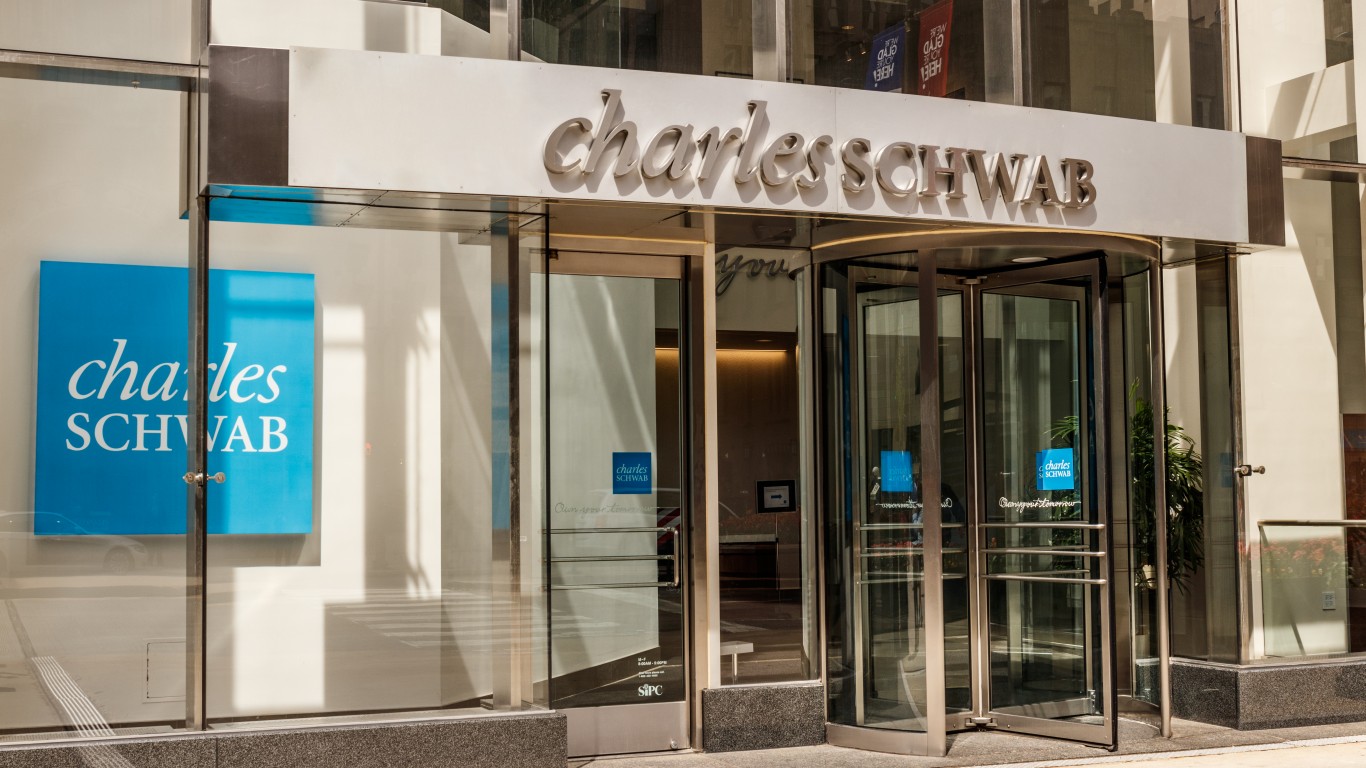
The redirect is Charles Schwab (NYSE:SCHW), trading at a trailing P/E of 18, forward P/E of 15, and price-to-book of 4, with a beta of 0.797. This is a financial pillar priced like a bargain while it compounds quietly.
1. Operating Leverage Is Already Showing Up
Q1 2026 was the proof. EPS of $1.43 beat the $1.3883 consensus, and GAAP net income jumped 29.86% YoY to $2.479 billion. Net interest revenue rose 16% to $3.144 billion as the average deposit rate fell from 0.72% to 0.20% and net interest margin expanded to 2.88%. Pre-tax profit margin moved to 49.2% from 43.8%. That is what real operating leverage looks like.
2. Asset Gathering at a Scale HOOD Cannot Touch
Schwab ended the quarter with $11.77 trillion in total client assets, up 19% YoY, across 39.1 million active brokerage accounts. Q1 brought $140 billion in core net new assets, 1.3 million new brokerage accounts, Managed Investing net flow growth of 46% YoY, and bank loan expansion of 29% to $60.9 billion. CEO Rick Wurster said “Schwab’s strong business momentum continued into 2026 as investors opened 1.3 million new brokerage accounts and brought $140 billion of core net new assets to the firm during the first quarter.” Schwab’s multi-trillion-dollar core client base guarantees recurring net interest income and fee revenue that speculative platforms cannot replicate.
3. Capital Returns Versus Hype
Schwab raised the quarterly dividend from $0.27 to $0.32 per share, the first $0.32 payment hitting February 13, 2026, after eight years of steady increases. Q1 added $2.4 billion in buybacks, repurchasing 24.3 million shares. Robinhood pays no dividend.
Insiders are aligned. On March 1, 2026, Co-Chairman Walter Bettinger acquired 141,757 shares, CEO Rick Wurster acquired 62,140 shares, and Co-Chairman Charles Schwab acquired 38,838 shares. The sell-side consensus is an analyst target price of $116.25, with 8 Strong Buy and 11 Buy ratings against 2 Holds.
For a retirement-focused investor, the choice is straightforward. Robinhood is a high-beta lottery ticket tied to crypto volume, prediction market flows, and payment-for-order-flow with regulatory change risk. Schwab is the fortress: $493.3 billion in total assets, $11.77 trillion in client assets, 49.2% pre-tax margins, expanding NIM, and a growing payout, all available at 15 times forward earnings.
The setup favors SCHW on valuation, capital returns, and operating leverage.
Contact [email protected] for any questions or corrections.
Alex Sirois is a financial writer with experience spanning both retail and institutional investing. He has written for InvestorPlace and held roles at BNY Mellon and Bernstein, giving him a perspective that bridges Main Street portfolios and Wall Street analysis.
Alex holds an MBA from George Washington University and has built his career across multiple industries, including e-commerce, education, and translation — a breadth of experience that informs how he breaks down complex financial topics for everyday investors. His writing is conversational, actionable, and grounded in long-term, buy-and-hold investing principles.
At 247 Wall St., Alex focuses on delivering analysis that is both accessible and useful, with a clear emphasis on helping readers make more informed decisions with their money.