Worried About a Recession? Here’s Why Selling When Economists Call It is Already Too Late
Andrew Sather of The Investing for Beginners Podcast recently made a point that should reshape how investors think about recession headlines. “When people say there’s a recession, they’re saying it 6 months after it happens. Like, that’s the literal definition…

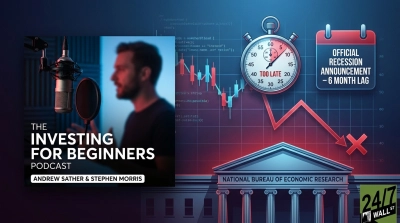
Andrew Sather of The Investing for Beginners Podcast recently made a point that should reshape how investors think about recession headlines. “When people say there’s a recession, they’re saying it 6 months after it happens. Like, that’s the literal definition of it. You have to wait 6 months,” he said on the episode Back to the Basics: How to Manage Your Portfolio Without Overthinking It. That single observation undermines the entire premise of selling on recession news.
Co-host Stephen Morris added the mechanical reason this is true: “you got to have the data to actually back it up. And to your point, it takes a significant amount of time to get that data. And by the time we have that data, we’ve already been suffering through the recession as it is.” The National Bureau of Economic Research, the official arbiter of U.S. recessions, dates downturns retrospectively. Investors waiting for the all-clear or the official call are reacting to information that is already stale.
Why The Real-Time Indicators Already Tell The Story
Look at how the past 12 months actually unfolded. Real GDP growth ran at 4.4% in the third quarter of 2025, then collapsed to 0.5% in the fourth quarter, before recovering to 2.0% in the first quarter of 2026. That kind of deceleration is exactly the pattern that fuels recession chatter, yet the headlines lag the data and the data lags the actual experience.
The labor market told a similar story. Unemployment drifted from 4.1% in June 2025 to a 12-month peak of 4.5% in November 2025, then settled back to 4.3% by April 2026. Initial jobless claims spiked to 259K on September 6, 2025 and have since cooled to 211K as of May 9, 2026. Consumer sentiment slumped to a recessionary 53.3 in March 2026.
Meanwhile, the most-watched recession signal stayed quiet. The 10-year minus 2-year Treasury spread never inverted in the past 12 months, sitting at 0.54% on May 19, 2026. Investors waiting for that one signal would have missed every other warning the economy was flashing.
The Marathon Argument Against Reactive Selling
Morris uses a sharp analogy for what happens when investors finally get the recession headline they have been bracing for. “You’ve already ran half the marathon. You might as well finish,” he said. Sather drove the same point home: “it’s always too late to act on anyway where we know.”
The price action backs the argument. The VIX spiked to 31.05 on March 27, 2026, then snapped back to 17.82 by May 18, 2026. Sellers who bailed at the peak of fear locked in losses just before volatility normalized. Over the very stretch when GDP growth collapsed (July 1 to December 31, 2025), the SPDR S&P 500 ETF (NYSEARCA:SPY) actually rose 10.41%. Looking further back, from December 2, 2019 through June 30, 2020, a window that captured the entire COVID crash and the formal NBER recession declaration, SPY finished down only 1.05%. Investors who held through the headlines were effectively flat.
What To Watch Instead
Sather’s framework rewards patience over prediction. The S&P 500 is up 23.35% over the past year and 257.06% over the past decade, a return earned by sitting through multiple growth scares, an inversion cycle, and a pandemic. For a deeper look at the official measurement window the NBER and BEA actually use, the FRED real GDP growth series shows the lag in plain numbers.
Recession declarations are an artifact of how data gets compiled, not a tradeable event. The investor who finishes the marathon, to borrow Morris’s image, captures the recovery that almost always begins before the headline writers catch up.
Contact [email protected] for any questions or corrections.
Don Lair writes about options income, dividend strategy, and the kind of boring-but-durable investing that actually funds retirement. He's the founder of FITools.com, an independent contributor to 24/7 Wall St., and a former writer for The Motley Fool.