VYM Climbs 26% In a Year While Its Core Dividend Payers Extend Their Streaks
The Vanguard High Dividend Yield Index Fund ETF Shares (NYSEARCA:VYM) is one of the simplest income vehicles in the market: it owns roughly 500 U.S. stocks that pay above-average dividends, weights them by market cap, and passes the cash through…


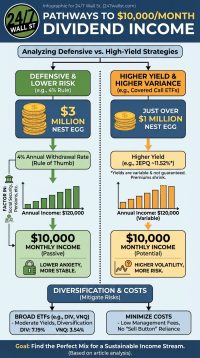
The Vanguard High Dividend Yield Index Fund ETF Shares (NYSEARCA:VYM) is one of the simplest income vehicles in the market: it owns roughly 500 U.S. stocks that pay above-average dividends, weights them by market cap, and passes the cash through to shareholders. VYM tracks the FTSE High Dividend Yield Index, which excludes REITs and screens companies by forecast dividend yield. With an ultra-low expense ratio and a portfolio dominated by mature cash generators, VYM has become a default holding for retirees relying on the distribution to fund living expenses. The question here is whether that income is durable.
How the distribution is actually generated
Every dollar VYM pays out comes from dividends collected on the underlying stocks; the fund uses no options income or leverage. That means the safety of VYM’s distribution is the weighted-average safety of its holdings, with extra emphasis on the names at the top. Five companies in particular do most of the heavy lifting: Johnson & Johnson, Procter & Gamble, Coca-Cola, Exxon Mobil, and AbbVie. If those payouts hold, VYM’s distribution holds.
The Dividend Kings doing the heavy lifting
Johnson & Johnson (NYSE:JNJ | JNJ Price Prediction) just raised its quarterly payout to $1.34, its 64th consecutive annual increase. Q1 revenue grew nearly 10% and management raised full-year adjusted EPS guidance to $11.45 to $11.65. Reported net income fell sharply on litigation charges, but the underlying business is funding the dividend comfortably with EPS of $8.63 against roughly $5.20 in annual dividends, a payout ratio in the low 60s that leaves real cushion.
Procter & Gamble (NYSE:PG) extended its streak to 70 consecutive years of dividend increases, lifting the quarterly to $1.09. Cash flow does the reassuring here: free cash flow ran $3.03 billion in the most recent quarter, and P&G plans to return roughly $10 billion in dividends this fiscal year against a tariff and commodity headwind it has already absorbed into guidance.
Coca-Cola (NYSE:KO) bumped its quarterly to $0.53 for 2026. Q1 free cash flow more than doubled to $1.76 billion, operating margin expanded to 35%, and full-year FCF is guided to roughly $12.2 billion. The $2.06 annual dividend against $3.18 in TTM EPS gives Coca-Cola one of the safer payout ratios in the group.
Exxon Mobil (NYSE:XOM) yields about 2.6% on a $4.04 annual payout, with 40-plus years of increases. Q1 free cash flow took a hit from derivative timing, but underlying earnings rose and the balance sheet is unusually clean: debt/equity sits at 0.17 with interest coverage above 50. Exxon is also executing a $20 billion buyback this year, which signals confidence the dividend has ample cushion.
AbbVie is the one holding that warrants caution. The dividend was raised to $1.73 quarterly, and Skyrizi and Rinvoq are growing fast enough to offset Humira’s decline. But book value is negative, and trailing EPS of $2.05 does not cover the $6.74 annual payout on a GAAP basis. Cash flow does, for now. This is the weakest link in VYM’s top-tier income stream.
Total return and rate context
VYM is up 11% year to date and about 26% over the past year, so the distribution is coming on top of capital appreciation, not at its expense. The 10-year Treasury at 4.5% is the real competition, but with the Fed funds rate cut to 3.75% and inflation near 2.1%, VYM’s growing payout still wins on long-term purchasing power.
The verdict
VYM’s distribution is safe. Four of the five anchor holdings are Dividend Kings or Aristocrats with payout ratios that leave room for both increases and a recession. AbbVie is the soft spot, but its weight is not large enough to threaten the fund-level payout. For retirees who want a paycheck that has grown faster than inflation, this is exactly the kind of boring, diversified income engine that does the job.
Contact [email protected] for any questions or corrections.
After 15 years on Wall Street with 7 of them as Director of Corporate and Municipal Bond Trading for a NYSE member firm, I started my own project and corporate finance consultancy. Much of the work involves writing business plans, presentations, white papers and marketing materials for companies seeking budgetary allocations for spinoffs and new initiatives or for raising capital for expansion or startup companies and entrepreneurs. On financial topics, I have been published under my own byline at The Motley Fool, 247wallst.com, DealFlow Events’ Healthcare Services Investment Newsletter and The Microcap Newsletter, among others. Additionally, I have done freelance ghostwriting writing and editing for several financial websites, such as Seeking Alpha and Shmoop Financial. I have also written and been published on a variety of other topics from music, audiophile sound and film to musical instrument history, martial arts, and current events. Publications include Copper Magazine, Fidelity (Germany), Blasting News, Inside Kung-Fu, and other periodicals.