BOIL Promises 2x Natural Gas, But Contango Has Eaten 99 Percent of Its Value Over the Past Decade
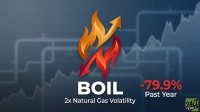
The promise on the ProShares Ultra Bloomberg Natural Gas (NYSEARCA:BOIL) tin is straightforward. You get 2x the daily move in natural gas futures. The reality is that BOIL has boiled 99.98% of its value over the past ten years, and…


The promise on the ProShares Ultra Bloomberg Natural Gas (NYSEARCA:BOIL) tin is straightforward. You get 2x the daily move in natural gas futures. The reality is that BOIL has boiled 99.98% of its value over the past ten years, and anyone holding it longer than a few days has watched capital get ground down by the futures market itself.
What you are actually buying
BOIL holds front-month natural gas futures and swaps tied to the Bloomberg Natural Gas Subindex, levered 2x and reset daily. Every month, expiring contracts roll into the next month’s contracts. When the next month trades higher than the front month, which is the normal state of the natural gas curve called contango, the fund sells low and buys high. That is the return engine, and it runs in reverse.
The expense ratio is 0.95% on $470 million in assets, steep for an ETF and rounding error compared to the structural drag.
The math of decay
Henry Hub sits at $2.87 today. A year earlier it was around $3.34. United States Natural Gas Fund (NYSEARCA:UNG), the unlevered 1x sibling, fell 36% over that year. BOIL fell 78%. Two-times daily exposure delivered well over two times the annual loss on a roughly flat commodity.
Over five years UNG dropped 74% and BOIL dropped 99%. There have been repeated reverse splits, which reset the share price while doing nothing to repair NAV destruction.
But again, no one should be (and hopefully isn’t) investing in BOIL or UNG long-term. There are significant natural gas reserves in the U.S. and abroad, so you will never see a true long-term shortage. You can use these instruments for very short-term event-based trades or even seasonal trades once winter kicks in, but that’s where the use cases mostly end.
When you are right and still lose
January 2026 gave traders the trade they had been waiting for. Henry Hub spot ripped from around $4.00 at year-end to $30.72 on January 23. Then it collapsed below $3 by mid-May, a 90% round trip in four months. This surge was caused by a winter storm that caused soaring demand and surprised suppliers.
During that spike, BOIL kept rolling expensive front-month contracts into the next month while the curve screamed contango. Traders who nailed the directional call still paid the tollbooth on every roll. Spot gas spiked sevenfold in January and BOIL is still down 41% year-to-date through May.
Thus, even your “short-term” trades are probably not going to pay off with this ETF if you don’t understand how this works.
The honest tradeoffs
- Volatility decay from the daily reset. When the underlying chops sideways, 2x daily compounding mechanically erodes NAV regardless of direction. The 2026 round trip from $4 to $30 back to $3 punishes leveraged products hardest.
- Contango on the roll. Natural gas futures usually slope upward, so each monthly roll sells the cheap front month and buys the more expensive next month. This is the dominant return killer over multi-month windows.
- Zero income and high carry cost. Equity ETFs pay dividends while you wait. BOIL pays nothing while bleeding to the futures curve and a 0.95% expense ratio.
Who BOIL actually fits
BOIL works as a stopwatch trade. If you have a specific catalyst and a holding period measured in hours or days, the 2x daily exposure does what the label claims. Hold it longer than a week and you are paying rent to the futures curve.
For longer-dated natural gas conviction, UNG is the lower-decay 1x option, though it lost 90%-plus over the decade. Natural gas equity ETFs give operational exposure without the roll problem. Retirees, income investors, and anyone with a multi-month thesis should treat BOIL the way they treat fireworks. Useful for a moment, dangerous to hold.
Contact [email protected] for any questions or corrections.
Omor Ibne Ehsan is a writer at 24/7 Wall St. He is a self-taught investor with a focus on growth, cyclical, and dividend equities that have strong fundamentals, value, and long-term potential. He also has an interest in high-risk, high-reward investments such as penny stocks.