3 Beaten-Down Healthcare Stocks to Buy in August
Healthcare just posted the best three-month run of any S&P 500 sector, yet two of the three biggest pharma names by market cap are still trailing the broader market. That gap between performance and fundamentals is creating a window that…

This post may contain links from our sponsors and affiliates, and Flywheel Publishing may receive compensation for actions taken through them.

Year to date, the healthcare sector finds itself in the middle of the S&P 500’s pack. But over the past three months, that corner of the market has led all 11 sectors with a 13.10% gain. It’s still lagging YTD, but that lag is exactly what makes the group interesting right now.
The SPDR S&P 500 ETF Trust (NYSEARCA:SPY) is up 13.02% year to date, while two of the three largest pharmaceutical names by market cap are trailing it. With healthcare flagged by analysts as an undervalued entry point heading into the second half, here are three mega-cap drug makers offering a rare mix of innovation exposure and income. Note that all three have rallied off spring lows, so the “beaten-down” label applies more to relative-to-market performance and prior 52-week highs than to outright drawdowns.
Eli Lilly (LLY)
Eli Lilly (NYSE:LLY | LLY Price Prediction) is the cleanest example of a relative laggard. Shares trade at $1,189.34, up just around 10% year to date, below the SPY’s gain and notably off about 4% from the 52-week high of $1,182.73.
The fundamentals are accelerating. Q2 2026 revenue hit $22.97 billion, up 47.7% YoY, after reaching $19.80 billion in Q1. EPS of $8.38 beating the $6.40 estimate. Eli Lilly raised its full-year 2026 revenue outlook to between $85 billion and $87 billion, after raising it in the wake of Q1 earnings to a range of $82 billion to $85 billion.
Risk: Realized prices fell 13% due to rebates and NRDL inclusion in China, and the franchise still leans heavily on a small group of products vulnerable to future biosimilar competition.
Johnson & Johnson (JNJ)
Johnson & Johnson (NYSE:JNJ) is the exception to the beaten-down framing: The stock is up 24.11% year to date around $257.34 and approaching its 52-week high of $274.90. The reason it still belongs on a value list is the forward valuation, which sits at 20x earnings.
Q1 2026 revenue was $24.06 billion, up 10% year over year, with adjusted EPS of $2.70 versus the $2.68 estimate. The oncology engine is doing the heavy lifting: DARZALEX grew 23% to $3.96 billion, TREMFYA jumped 68%, and CARVYKTI climbed 62%. CEO Joaquin Duato called it “a strong start to 2026” with the company “delivering on its promise for a year of accelerated growth and impact.”
Income investors get the headline draw. JNJ pays $1.34 per share quarterly, a 3% raise that marks 64 consecutive years of dividend increases. The current yield sits at roughly 2%, and management raised full-year revenue guidance to $100.3 billion to $101.3 billion.
Risk: STELARA revenue collapsed 60% to $656 million on biosimilar competition, creating roughly a 920 basis point drag on Innovative Medicine. Ongoing litigation charges ($330 million in Q1) remain an overhang.
AbbVie (ABBV)
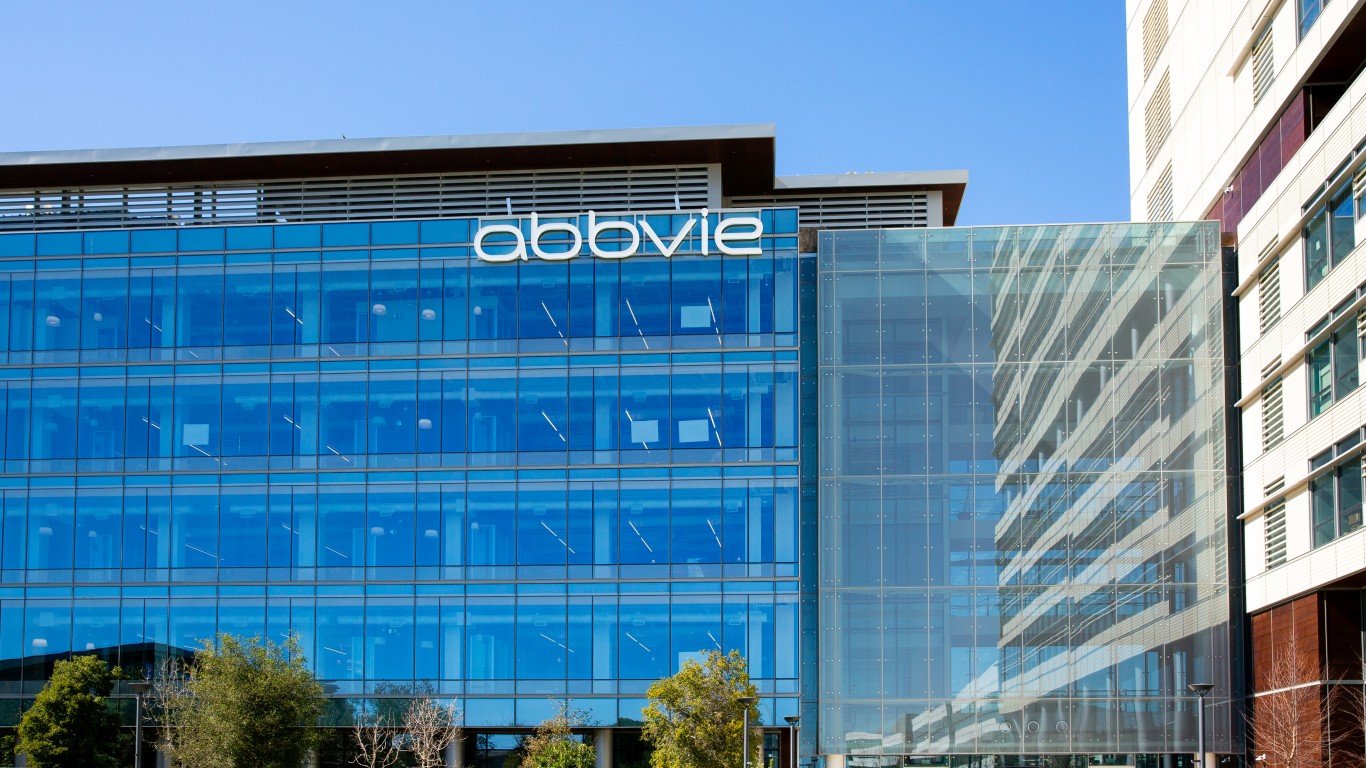
AbbVie (NYSE:ABBV) traded around $244.86 on Friday, Aug. 7, up just 6.78% year to date, lagging the SPY despite a strong recent bounce. Shares have slid 3.84% in the past month, and the YTD shortfall is what keeps the valuation reasonable at 16x forward earnings.
Q1 2026 revenue grew 12% to $15 billion. Skyrizi posted $4.48 billion (up 31%) and Rinvoq added $2.12 billion (up 23%), more than absorbing the Humira decline of 39%. Neuroscience grew 26%. CEO Robert Michael said “AbbVie’s key growth drivers continue to deliver strong performance and support our enhanced full-year outlook.” Management raised 2026 adjusted EPS guidance to $14.08 to $14.28.
The income story is comparable to JNJ’s. AbbVie pays $1.73 per quarter, a step up from $1.64 in 2025, with a yield near 3% and a 53-year consecutive increase streak.
Risk: Humira biosimilar erosion is still accelerating, Imbruvica fell 25%, and acquired IPR&D charges of $744 million created a 41-cent per share drag in Q1. The CRL on trenibotulinumtoxinE pushes one near-term aesthetics catalyst out further.
What to Watch
The second-half setup hinges on H2 earnings momentum, FDA progress on key pipeline programs (Foundayo uptake for Lilly, Skyrizi label expansions for AbbVie, CARVYKTI scaling for J&J), and whether sector rotation continues to favor defensives. With Lilly and AbbVie still trailing the broader market and J&J adding a 64-year dividend streak to the mix, the group offers a reasonable risk profile for income-and-innovation investors heading into Q3.
Contact [email protected] for any questions or corrections.
Joel South covers large-cap stocks, dividend investing, and major market trends, with a focus on earnings analysis, valuation, and turning complex data into actionable insights for investors.
He brings more than 15 years of experience as an investor and financial journalist, including 12 years at The Motley Fool, where he served as an investment analyst, Bureau Chief, and later led the Fool.com investing news desk. He has also co-hosted an investing podcast and appeared across TV and radio discussing market trends.