Is AMD About to Pop Like Micron? Here’s Why You Shouldn’t Underestimate It
At $521.31, Advanced Micro Devices (NASDAQ:AMD | AMD Price Prediction) looks like a stock where the bullish setup still has room to run. The stock ripped roughly 25% in the week after Q1 earnings. Thus, Wall Street is still catching…


At $521.31, Advanced Micro Devices (NASDAQ:AMD | AMD Price Prediction) looks like a stock where the bullish setup still has room to run. The stock ripped roughly 25% in the week after Q1 earnings. Thus, Wall Street is still catching up to what the inference cycle means for the rare chipmaker selling both the CPU and the GPU at AI scale.
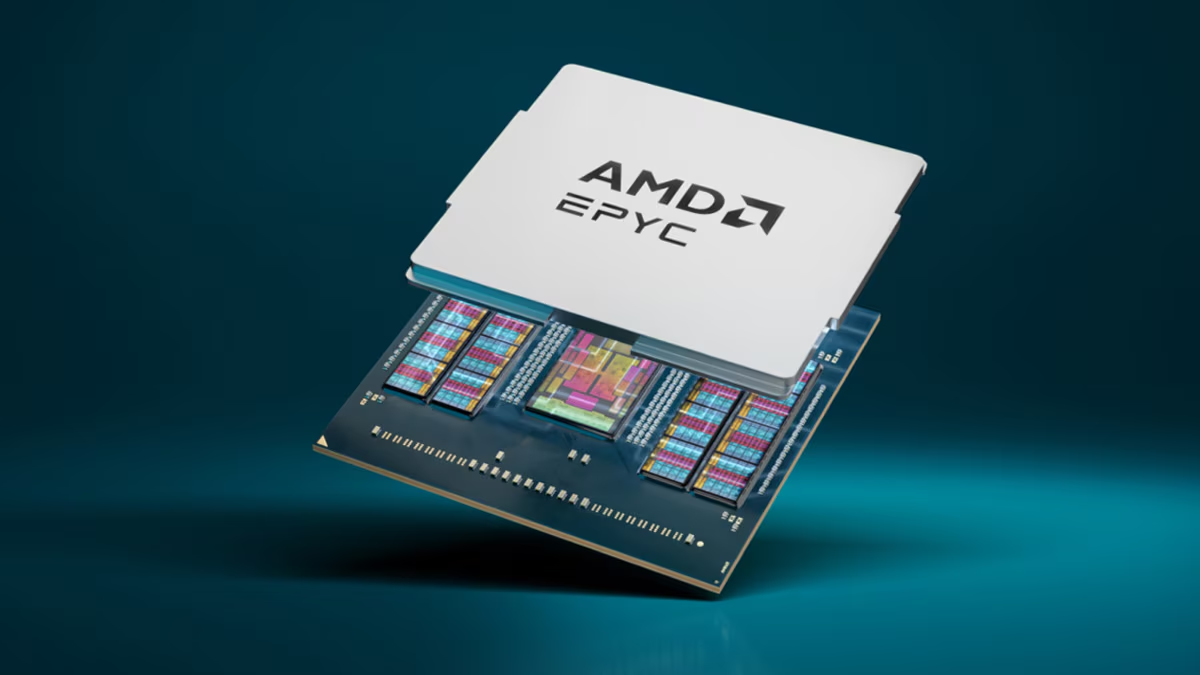
AMD makes the silicon inside modern AI infrastructure. EPYC processors anchor hyperscaler fleets. Meanwhile, Instinct accelerators are shipping into multi-gigawatt deployments at OpenAI, Meta, and Oracle, and the client business is riding an AI PC refresh. The stock has gone from $114 to $521 in twelve months. The question is whether the move is exhausted, or whether this is what an early Micron (NASDAQ:MU)-style repricing looks like.
The quarter that changed the conversation
Q1 revenue hit $10.25 billion, up 37.9% YoY, beating the $9.91 billion estimate. EPS came in at $1.37, beating the $1.29 consensus. Data Center alone delivered $5.78 billion, up 57% YoY, now the dominant earnings engine. CEO Lisa Su said customer engagement around the MI450 Series and Helios is “strengthening, with leading customer forecasts exceeding our initial expectations.”
Moreover, the structural argument got louder when Intel CEO Lip-Bu Tan called the CPU “the indispensable foundation of the AI era.” DA Davidson upgraded AMD to Buy with a $375 price target on the thesis that inference and agentic workloads tilt the mix back toward CPUs, where AMD has been quietly taking share from Intel for years.
Is $521 already be the top?
The valuation is loud. AMD trades at a trailing P/E of 170x and a P/FCF above 99. The average analyst target sits at $472.17, below the current quote, and an AI-model price target prints at $454, implying roughly 12% downside. Consensus already thinks the price has run past the fundamentals.
Plus, China is a wildcard. Q2 2025 absorbed an $800 million charge tied to MI308 export controls, a reminder that one policy memo can dent a quarter. NVIDIA (NASDAQ:NVDA) still dominates AI training.

That said, a similar disconnect between the consensus and the actual price exists elsewhere, too. For example, MU stock is far ahead of price targets due to analysts being left behind by both the fundamentals and the sentiment.
The case for sitting on hands
Momentum buyers have already piled in. AMD is up 53% in a month and 131% YTD. Nvidia is up just 13% YTD over the same window. Reddit sentiment swung from very bullish to bearish and back again inside two weeks, classic crowd behavior. The next honest test is the Q2 earnings report. Management guided $11.2 billion in revenue and a 56% gross margin. Miss either and the multiple compresses fast. Hit both and the bear “already priced in” case starts to look thin.
What the numbers say
AMD trades at $521.31, up 131.39% year to date and 332.56% over twelve months, dramatic outperformance against a much flatter S&P 500. Nvidia is up 14% YTD.
The Wall Street picture covers 50 firms with 4 Strong Buys, 33 Buys, 13 Holds, and zero Sells, and an average target of $472.17 that implies modest downside from spot. Targets are trailing the price and grinding higher. That is how the Micron repricing began too.

AMD’s bullish setup still holds
The thesis is the inference and agentic AI cycle that is only starting, and AMD is the rare company with credible product in both halves of that buildout. Data Center growth went from 14% YoY in Q2 2025 to 22%, then 39%, then 57% in Q1 2026. That trajectory is acceleration.
Furthermore, you should consider the OpenAI 6-gigawatt commitment, the Meta 6-gigawatt deployment, and the Oracle 50,000-GPU Helios supercluster going live in Q3 2026. These are signed contracts, with revenue visibility management said is now exceeding its own internal forecasts.
However, what invalidates the call is a Q2 miss against the $11.2 billion guide. Perhaps caused by a fresh China export shock, or a clear downturn in hyperscaler capex. Until any of those land, analyst targets keep moving up rather than down, and the forward 2027 P/E of 38x starts to look reasonable against a Data Center business compounding above 50%.
If Micron earned a trillion-dollar repricing on memory demand, AMD has a credible case to be repriced on the same inference cycle.
Contact [email protected] for any questions or corrections.
Omor Ibne Ehsan is a writer at 24/7 Wall St. He is a self-taught investor with a focus on growth, cyclical, and dividend equities that have strong fundamentals, value, and long-term potential. He also has an interest in high-risk, high-reward investments such as penny stocks.