18 Words From Fed Chair Kevin Warsh That Could Keep Interest Rates Higher for Years
For much of the past year, investors have been focused on one question: When will the Federal Reserve finally start cutting interest rates? That expectation helped fuel one of the strongest stock market rallies in recent memory. Investors largely assumed…

For much of the past year, investors have been focused on one question: When will the Federal Reserve finally start cutting interest rates?
That expectation helped fuel one of the strongest stock market rallies in recent memory. Investors largely assumed that once inflation cooled, lower rates would follow. But the new Fed chair appears to have a very different idea of what victory over inflation actually looks like.
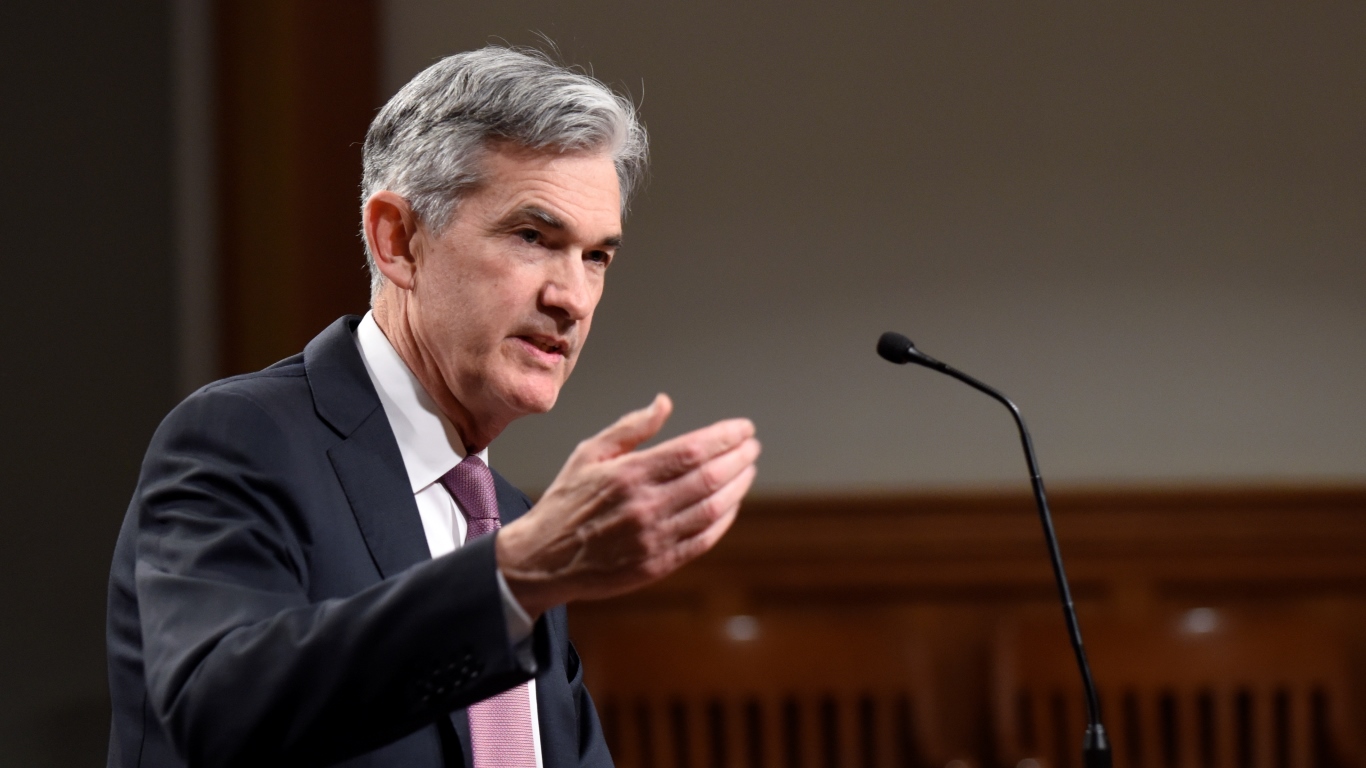
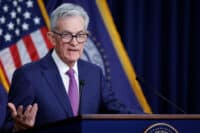
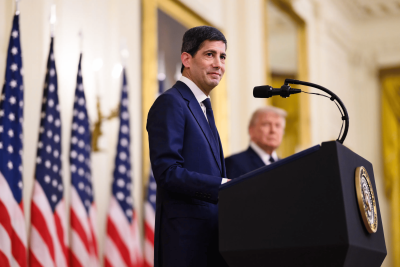
That is the question Wall Street has had to confront since Kevin Warsh succeeded Jerome Powell as Federal Reserve chair after his swearing-in ceremony at the White House on May 22. The Senate confirmed him 54-45, the most divisive vote for a Fed chair in history. President Trump selected Warsh in large part because he believed Powell had been too slow to cut rates and was unnecessarily restraining economic growth.
Yet buried within 2-1/2 hours of testimony before the Senate Banking Committee in April was an 18-word statement that has since forced investors to rethink everything they believed about future Fed policy.
The Quote That Changes Everything
The Federal Reserve has long operated with a clear inflation target: 2%. Whether policymakers are discussing the Personal Consumption Expenditures Price Index, the Consumer Price Index, or inflation expectations, that 2% figure serves as the central guidepost for monetary policy decisions.
Warsh’s comments suggest he views the problem through a different lens. During his Senate testimony, he said:
“I believe that price stability should be a change in prices such that no one’s talking about it.”
At first glance, the comment sounds harmless enough. But investors who dismissed it may now be reconsidering. Inflation spiked to 4.2% in May 2026, the highest reading since 2023, before edging down to 3.5% in June and 3.4% in July. Core inflation, which excludes food and energy, stands at 2.5%. All of those readings remain well above the Fed’s 2% target, and Americans are still very much talking about prices.
Price stability, in Warsh’s view, may not be defined by a specific percentage at all. It appears tied to public perception and confidence. If consumers, businesses, workers, and investors are still talking about inflation, then inflation remains a problem regardless of what the official data says.
Why Wall Street May Be Getting This Wrong
Warsh has long argued that the Federal Reserve became too involved in financial markets. He has repeatedly advocated shrinking the Fed’s balance sheet, which currently stands at $6.7 trillion as of early August 2026, according to Federal Reserve data. That is up more than $108 billion from a year ago, a trend that underscores why Warsh sees further reduction as a priority.
Balance-sheet reduction matters because it represents an alternative form of tightening. Many investors assumed Warsh would simply cut rates faster than Powell would have. His first FOMC meeting as chair, held on June 17, 2026, delivered a stark corrective. He held rates steady at 3.5% to 3.75%, the fourth consecutive hold, and then scrapped forward guidance entirely, announcing that the Fed would no longer signal where rates were heading. That move, a sharp break from the Powell era, rattled markets: the S&P 500 fell 1.2% and the 10-year Treasury yield shot up to nearly 4.5% in the session’s aftermath.
The dot plot released at that same meeting was equally sobering. Nine of the 18 FOMC participants projected at least one rate hike before the end of 2026, with six of those calling for two increases. That is a dramatic reversal from March, when no policymaker had penciled in a hike and the consensus leaned toward a single cut. Bank of America’s economics team subsequently forecast three consecutive 25-basis-point hikes in September, October, and December, a path that would push the federal funds rate to 4.25% to 4.5% by year-end.
If restoring the Fed’s credibility becomes the primary objective, Warsh appears willing to tolerate slower economic growth and softer labor markets in exchange for permanently anchoring inflation expectations. His inflation philosophy, it turns out, could point toward tighter policy for longer, not easier policy sooner. The implications of that stance are significant:
- Interest rates remain elevated longer than markets expect.
- Rate cuts arrive later than investors currently anticipate.
- Quantitative tightening accelerates.
- The Fed prioritizes inflation credibility over supporting asset prices.
In other words, Warsh is working to transform the Fed from a market participant into a neutral guardian of monetary stability. Whether markets are ready for that transition is another question entirely.
A Dangerous Setup for Stocks
The risk for equity investors is straightforward. Today’s stock market is priced around the expectation that borrowing costs will eventually move lower. High-growth technology companies, in particular, derive much of their valuation from future earnings streams that become less valuable as interest rates rise. A prolonged hold, let alone a hike, reshapes that math considerably.
Warsh may ultimately prove less hawkish than his first meeting suggested. But if his definition of inflation extends beyond simply reaching 2%, investors could face a much longer period of monetary restraint than currently expected. The July FOMC meeting, which also held rates steady, saw three dissents from policymakers who favored an immediate increase, a sign that the pressure for tighter policy is building rather than fading.
There is another possibility that could prove even more disruptive. If inflation becomes a more fluid concept under Warsh’s leadership, defined less by a specific numerical target and more by public attitudes toward pricing pressures, the entire framework investors use to predict Fed policy could change. Warsh has already made good on that threat by abandoning forward guidance, introducing the kind of uncertainty that markets historically price as a risk premium.
Markets thrive on certainty. A clearly defined 2% target provides one. A standard rooted in public perception is far harder to model, and far more difficult to trade around.
Key Takeaway
Wall Street may have been focusing on the wrong part of Kevin Warsh’s record. Investors saw a Fed chair appointed by a president who wanted lower interest rates. What the first weeks of his tenure have revealed is a policymaker deeply concerned with restoring the Federal Reserve’s credibility after the inflation surge of recent years, and willing to accept political friction to get there.
Those 18 words suggest that defeating inflation, in Warsh’s view, is about more than reaching a statistical target. It is about eliminating inflation as a topic of conversation altogether. That standard could require rates to stay higher for longer than investors expect. Given the dot-plot signals from his June meeting, it could even justify raising them, a scenario that markets have begun pricing at meaningful odds ahead of the September FOMC decision.
A stock market priced for rate cuts that instead confronts tighter monetary policy faces a reckoning. Today’s record highs may look far less secure by the time Warsh is finished.
Editor’s note: This article has been updated to reflect Warsh’s Senate confirmation by a 54-45 vote, the conduct of his first FOMC meeting on June 17, 2026 (where he held rates at 3.5% to 3.75% and abandoned forward guidance), the shift in the FOMC dot plot to nine members projecting a 2026 rate hike, and the most recent inflation reading of 3.4% in July 2026, down from a May peak of 4.2%. The Fed balance sheet figure has also been refreshed to $6.7 trillion as of early August 2026, up $108 billion from a year ago.
Contact [email protected] for any questions or corrections.
After two decades of patrolling the dark corners of suburbia as a police officer, Rich Duprey hung up his badge and gun to begin writing full time about stocks and investing. For the past 20 years he’s been cruising the markets looking for companies to lock up as long-term holdings in a portfolio while writing extensively on the broad sectors of consumer goods, technology, and industrials. Because his experience isn’t from the typical financial analyst track, Rich is able to break down complex topics into understandable and useful action points for the average investor. His writings have appeared on The Motley Fool, InvestorPlace, Yahoo! Finance, and Money Morning. He has been featured in both U.S. and international publications, including MarketWatch, Financial Times, Forbes, Fast Company, and USA Today.