Acquisition Odds: How These 4 Cult Stocks Stack Up as Buyout Targets
Acquisition speculation is the lifeblood of cult-stock trading. The cleanest takeover targets share three traits: strategic value to a deep-pocketed partner, a cash runway that does not force a fire sale, and proprietary intellectual property that a giant cannot easily…

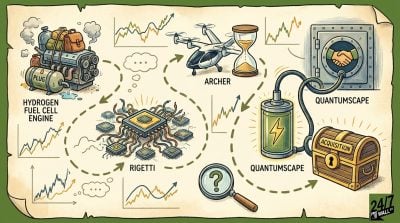
Acquisition speculation is the lifeblood of cult-stock trading. The cleanest takeover targets share three traits: strategic value to a deep-pocketed partner, a cash runway that does not force a fire sale, and proprietary intellectual property that a giant cannot easily replicate. This is a scenario analysis, not a report on any announced or imminent deal. With that in mind, here is how four of the market’s most-debated story stocks stack up.
4. Plug Power: Hydrogen Ambition, Heavy Baggage
Plug Power (NASDAQ: PLUG) is the weakest acquisition candidate of this group. The hydrogen story has merit: Q1 2026 revenue reached $163.51 million, up 22.3% year over year, and CEO Jose Luis Crespo is targeting positive EBITDA in Q4 2026. Gross margin recovered to −13% from −55% a year earlier.

The problem is the balance sheet. Plug carries an $8.2 billion accumulated deficit, burned $150 million in operating cash in Q1 2026, and held just $223.19 million in cash. Shares are down 19.6% over the past month to $2.83. Anchor customers like Amazon and Walmart have historically signed warrants and supply deals rather than buyouts. Hydrogen IP is also commoditizing. The likely path is dilution and asset monetization, including about $275 million in pending hydrogen project sales, rather than a clean takeover.
3. Rigetti Computing: Strong IP, Crowded Field
Rigetti Computing (NASDAQ: RGTI) checks the cash-runway box decisively, with $569 million in cash and investments and zero debt at the end of Q1 2026. Revenue nearly tripled to $4.40 million, and the 108-qubit Cepheus-1-108Q system is now generally available.

The IP, particularly the chiplet architecture and Fab-1 facility, is genuinely strategic. The issue is that superconducting quantum computing is a crowded field with IBM, Google, and IonQ all in play, and no single giant is dependent on Rigetti. The Quanta Computer relationship is meaningful, yet the stock’s run to $20.63, up 64.8% over the past year, makes a takeout pricey. Reddit sentiment whipsawed from very bearish scores of 15–18 in late May to 72–78 by early June—hardly the steady setup an acquirer prefers.
2. Archer Aviation: Burn Rate Cuts Both Ways
Archer Aviation (NYSE: ACHR | ACHR Price Prediction) is where the acquisition logic gets interesting. The Q1 2026 net loss widened to $217.7 million from $93.4 million a year earlier, and cash declined by $188.8 million sequentially to $951.1 million. Shares are off 29.5% year to date to $5.30.
That cash bleed is precisely what shortens Archer’s pre-revenue runway—and shorter runways invite suitors. The strategic partner roster is unusually deep: Stellantis on manufacturing, Anduril on dual-use defense aircraft, plus Korean Air, Japan Airlines, and Saudi PIF. FAA Type Certification is in Phase 4, and the Lilium and Overair patent portfolios meaningfully thicken the IP moat. Analysts carry a $10.61 price target and a consensus Buy recommendation. A move by Boeing, Lockheed, or Anduril would not be surprising.


1. QuantumScape: The Partnership Endgame
QuantumScape (NYSE: QS) is the cleanest scenario. PowerCo, Volkswagen Group’s battery arm, expanded its licensing agreement to a total commitment of up to $261 million, with rights extending beyond the QSE-5 platform. Cobra-based QSE-5 cells are shipping, and the Eagle Line pilot facility was inaugurated on February 4, 2026.
Cash runway is the key differentiator here. Year-end 2025 liquidity was $970.80 million, with management guiding runway through end of the decade. The solid-state separator is a defensive moat that VW cannot quickly replicate elsewhere. Insider activity adds intrigue: seven directors acquired shares simultaneously on June 3, 2026, even as C-suite executives sold shares at around $7.37 in May. Shares trade at $7.23, down 30.6% year to date, making the strategic price tag more accessible.


Why QuantumScape Tops the Scenario List
Measured against the three criteria, QuantumScape clears all of them. Strategic value runs through a single dominant partner already paying for licensing rights. The cash position supports negotiation rather than capitulation. The separator IP is genuinely proprietary. If solid-state cells perform in field testing, the natural endgame for PowerCo is to bring the technology in-house rather than license it in perpetuity. That is what makes QuantumScape the most plausible takeout scenario on this list, while Plug, Rigetti, and Archer each face structural obstacles that might lead suitors to wait.
Contact [email protected] for any questions or corrections.
Trey has been an editor and author at 24/7 Wall St. for more than a decade, where he has published thousands of articles analyzing corporate earnings, dividend stocks, short interest, insider buying, private equity, and market trends. His comprehensive coverage spans the full spectrum of financial markets, from blue-chip stalwarts to emerging growth companies.
Beyond 24/7 Wall St., Trey has created and edited financial content for Benzinga and AOL's BloggingStocks, contributing additional hundreds of articles to the investment community.
Trey's editorial expertise extends across multiple publishing environments. He served as production editor at Dearborn Financial Publishing and development editor at Kaplan, where he helped shape financial education materials. Earlier in his career, he worked as a writer-producer at SVE. His freelance editing portfolio includes work for prestigious clients such as Sage Publications, Rand McNally, the Institute for Supply Management, the American Library Association, Eggplant Literary Productions, and Spiegel.
Outside of financial journalism, Trey writes fiction and has been an active member of the writing community for years, moderating workshop sessions at regional conventions.