Famous Wall Street Tech Analyst Names Meta and Amazon the Best Magnificent 7 Stock Buys Today
Evercore ISI’s head of internet research Mark Mahaney has a contrarian message for investors who’ve watched the Magnificent 7 lag the broader market. On CNBC’s “Closing Bell Overtime” on June 18, 2026, with host Liz Young and co-host Mike Santoli,…

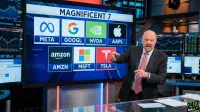
Evercore ISI’s head of internet research Mark Mahaney has a contrarian message for investors who’ve watched the Magnificent 7 lag the broader market. On CNBC’s “Closing Bell Overtime” on June 18, 2026, with host Liz Young and co-host Mike Santoli, Mahaney named Meta Platforms (NASDAQ:META | META Price Prediction) and Amazon (NASDAQ:AMZN) his top buys inside the group, arguing both names are trading at 3-year trough multiples that fit his “dislocated high-quality” (DHQ) framework.
Here’s a shocker: Every Mag 7 name has trailed the S&P 500 over the past month, with SPY up 1.77% over that stretch while META fell 4.13% and AMZN dropped 5.76%. Mahaney attributed the pressure to three forces: investor reluctance to fund the front end of a massive AI investment cycle, the unprecedented scale of capital spending (“Nobody’s talked about spending $200 billion a year on CapEx”), and a “capital suck” from upcoming IPOs pulling dollars from incumbent positions. Santoli added that Goldman Sachs has flagged fresh shorts in the group funding other hedge fund positions.
Meta: A Subscription Story Hiding in an Ad Stock
Meta is the cleanest expression of Mahaney’s thesis. The stock closed at $577.22, well off its 52-week high of $793.65, with a forward P/E of roughly 18x. Our internal model carries a 1-year target near $816, and the sell-side consensus sits at $827.32 with 8 strong buys, 49 buys, 7 holds, and zero sell ratings.
Meta’s fundamentals don’t suggest a broken business. Q1 2026 delivered EPS of $10.44 against a $6.66 consensus, with revenue up 33.08% year over year to $56.31 billion and ad impressions up 19%. You can verify the results directly in the Q1 2026 earnings release filed with the SEC. CEO Mark Zuckerberg framed the quarter around “the release of our first model from Meta Superintelligence Labs”.
Mahaney’s underappreciated catalyst: Meta AI’s persistent client and new subscription products, plus the tens of millions of businesses that depend on the platform. The market still treats Meta as a pure consumer ad name. The signal to watch is whether CapEx intensity peaks; FY26 capex guidance was raised to $125–145 billion, and free-cash-flow revisions turning positive would be the catalyst Mahaney is pointing toward. One interesting note, SpaceX (Nasdaq: SPCX) recently signed deals with both Anthropic and Alphabet for usage of its compute infrastructure. The deal with Anthropic is for $1.25 billion per month, while the Google deal is worth $920 million.
If Meta has excess capacity due to low usage of its models, it could follow the path SpaceX has carved out and rent its infrastructure. That could lead to a sharp re-rating in Meta’s shares as it would lessen the cash burn the company is experiencing betting big on AI infrastructure. That’s a catalyst few investors are watching, but could reverse Meta’s slide
Amazon: AWS Reaccelerating Into the AI Buildout
Amazon trades at $244.39. Our proprietary 24/7 Wall St. price prediction model places a $324 estimate on shares, while Street consensus sits at $312.99 (15 strong buys, 47 buys, 4 holds). The Q1 2026 report removed any doubt about the AI flywheel: AWS grew 28% to $37.59 billion, the fastest pace in 15 quarters, at a 37.7% operating margin. Andy Jassy noted the chips business topped a $20 billion annual run rate growing triple digits year over year, while advertising crossed $70 billion in TTM revenue.
The catch is capital intensity. Jassy guided to roughly $200 billion in 2026 CapEx, which has compressed near-term free cash flow. Prediction markets are pricing this in: Polymarket assigns an 86.5% probability that 2026 CapEx exceeds $200 billion.
Why Google Sits Outside the Trade
Mahaney is relatively less bullish on Alphabet, saying it “hasn’t troughed out”. Alphabet (NASDAQ:GOOGL) trades at $368.03, up 112.95% over the past year, with Google Cloud growing 63% YoY and backlog near $460 billion. It’s still a buy in our model with a target near $450. The point is positioning: Google hasn’t dislocated, so it doesn’t fit the DHQ playbook today.
What to Watch Next
The thesis hinges on one inflection: CapEx intensity peaking and FCF revisions turning. Mahaney argues chips are lasting longer than expected, extending the useful life of existing infrastructure spend. If that holds, Meta and Amazon likely move before the cycle ends. If CapEx keeps grinding higher with no monetization payoff, the trough thesis stretches. Either way, watch Meta’s next capex update closely and watch whether the company copies SpaceX’s playbook in the next twelve months and opens up its compute infrastructure to outside firms.
Contact [email protected] for any questions or corrections.
I've spent more than 15 years inside enterprise software, working alongside the finance, sales operations, and HR leaders who run the revenue engines at some of the largest tech companies in the country.
My day job is helping enterprise executives make smarter decisions about retention, compensation, and growth. These are the same operational levers that show up in every earnings report investors actually read. That perspective shapes my writing for 24/7 Wall St.
The headline numbers are easy. The interesting stuff is underneath: how companies make money, what executives are worried about, and what any of it means for the person checking their 401(k) on a Sunday afternoon. I write about personal finance and business as someone who has spent her career inside the rooms where these decisions get made.